

More news on this day
From predictive pricing engines to AI chatbots that answer routine questions in seconds, hotels are quietly automating swathes of back-office work. As algorithms take over spreadsheets and scheduling, industry observers are asking whether this technological shift could finally free general managers from their computers and bring them back into the lobby, where their presence arguably matters most to guests.
Get the latest news straight to your inbox!
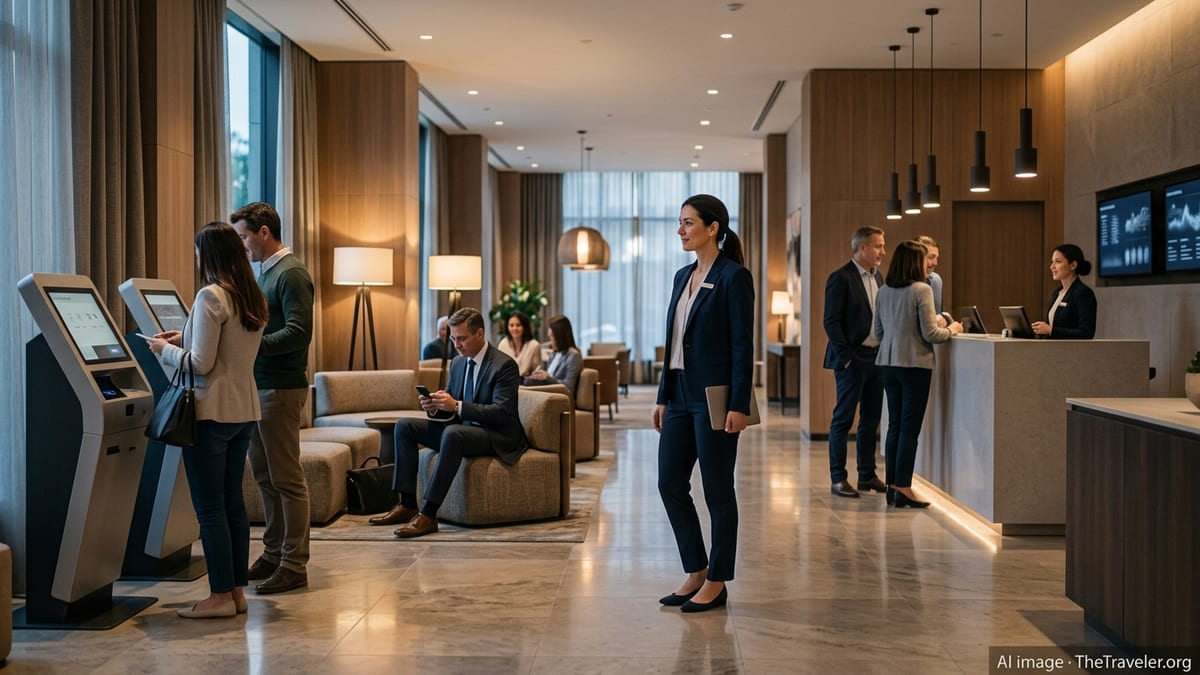
Automation Moves From Pilot Projects to Everyday Operations
Across the hotel sector, AI is moving beyond experiments and into daily workflows, particularly in revenue management and operations. A recent industry survey of owners and developers in North America reported that more than half already use AI tools to optimize revenue, and nearly two thirds apply AI for operational efficiency, including staffing, invoicing and predictive maintenance. These systems monitor booking patterns, competitor rates and demand signals in real time, then recommend or automatically implement pricing and inventory changes.
Consulting and technology reports indicate that hotels are also exploring AI to automate or streamline scheduling, procurement and finance functions. Frameworks for what some analysts call an “AI-first hotel” envision digital twins of properties, continuous energy optimization and centralized reporting that gives leadership real-time visibility across multiple locations. Tasks that once demanded hours of manual data collection and spreadsheet work are increasingly handled by software that surfaces only the exceptions a human needs to review.
The cumulative effect is that routine analytical and administrative work is shifting away from the general manager’s desk. Instead of spending large portions of each day pulling performance reports, reconciling spreadsheets or manually adjusting rate plans, managers at AI-enabled properties receive dashboards and alerts that summarize conditions and flag outliers. This is creating an opportunity, at least in theory, for leadership to redirect time toward coaching staff and engaging with guests on the floor.
Labor Shortages Push Hotels Toward AI and Hybrid Service Models
Persistent labor shortages are accelerating automation in hospitality and reshaping how managers deploy their teams. Industry data show hotel employment in the United States remains below pre-2020 levels, even after hundreds of thousands of jobs have returned. Turnover remains high in front-line roles, with front desk and housekeeping among the hardest positions to keep fully staffed, according to multiple labor market reviews.
To cope, many hotels are adopting AI-powered chatbots, voice assistants and kiosks to cover routine tasks that once demanded staff time. Implementation guides from hospitality technology providers describe properties cutting front desk staffing by up to half during off-peak hours by shifting simple requests to automated systems. AI concierges now handle common questions, late check-out requests and amenity bookings, while mobile apps and kiosks process check-ins and digital key distribution without a traditional counter interaction.
Guest research suggests travelers largely welcome this convenience for simple transactions, but still prefer human interaction for complex or emotional situations. Studies of in-room and mobile AI tools indicate guests appreciate rapid responses and 24-hour availability, yet value face-to-face support when resolving problems or planning special experiences. This hybrid expectation strengthens the argument that general managers and senior staff should be present in public spaces, visible and available to step in when automated systems reach their limits.
From Spreadsheet Custodians to Experience Leaders
As AI expands in the back office, the profile of an effective hotel general manager is changing from data custodian to experience leader. Industry commentary notes that advanced revenue management platforms can already deliver double-digit improvements in average daily rate compared with rules-based systems, while also producing more reliable forecasts. These more accurate forecasts, in turn, support smarter staffing plans and purchasing decisions, reducing the need for managers to micromanage daily numbers.
With analytics handled by specialized systems and corporate teams, brand leaders increasingly describe the on-property general manager as a “chief experience officer” responsible for culture, service quality and local partnerships. Technology vendors marketing AI tools frequently highlight this repositioning as a benefit, suggesting that automation frees managers to focus on mentoring staff, walking the property and personalizing stays for high-value guests.
Analysts caution, however, that this shift is not automatic. In hotels where AI is introduced primarily as a cost-cutting measure, managers can find themselves responsible for more units or more complex reporting requirements, offsetting any time savings. The potential for AI to bring general managers back to the lobby depends on whether owners and brands intentionally redesign roles and performance metrics to reward guest-facing leadership rather than sheer administrative output.
Guest Expectations and the Value of Visible Leadership
Surveys of traveler preferences consistently show that while guests appreciate digital tools, they also associate high service levels with visible, empowered staff. Research into AI voice concierges and messaging platforms finds that guests are comfortable interacting with machines for room controls, simple requests and information, but want quick access to a human being for disputes, special occasions or safety concerns. A general manager who is regularly present in the lobby or public areas can act as a visible escalation point in this hybrid model.
For frequent business travelers and high-spend leisure guests, the presence of senior leadership can be a differentiator, especially in upscale and luxury segments. Industry case studies of AI concierge deployments report higher staff satisfaction when automation handles repetitive administrative work, allowing human concierges and managers to focus on relationship building and complex arrangements. That same logic applies to general managers whose time is freed from dashboards and email in favor of proactive guest engagement.
In practical terms, this could mean managers spending more time greeting arriving groups, checking on event setups, or informally surveying guests about new digital services. When issues arise with automated systems such as mobile keys or kiosks, a manager who is already in the lobby can intervene quickly, preserving trust in both the technology and the brand. The value of this presence may be hardest to measure in spreadsheets, but it remains central to many hotels’ positioning.
Barriers That May Keep Managers in the Back Office
Despite the promise of AI-enabled liberation from the desk, several structural factors could keep general managers tethered to screens. Many hotels continue to roll out new systems with limited integration, leaving managers juggling multiple platforms and logins. In these environments, AI can add complexity rather than remove it, at least in the short term, as staff learn new tools and reconcile data across systems.
Ownership expectations are another constraint. Reports on AI adoption in hospitality show strong optimism about efficiency gains and revenue growth, which can lead to higher performance targets without corresponding increases in support. If AI-generated insights arrive faster and in greater volume, managers may feel pressure to spend more time analyzing them and reporting results, not less, reinforcing a back-office orientation.
There are also concerns among employees about job security and workload distribution as automation advances. Workforce reports highlight both examples of AI reducing burnout by handling routine tasks and cases where automation coincided with job cuts at the front desk. General managers often sit at the center of these workforce transitions, tasked with implementing new technology while maintaining morale and service levels. That responsibility, along with expanding compliance and safety requirements, can still demand significant desk time.
For AI to truly bring hotel general managers back to the lobby, industry commentators suggest that technology strategy, staffing models and leadership expectations must be aligned. Automation can remove much of the manual work that once kept managers in the back office, but only deliberate organizational choices will determine whether that freed time is invested in guest-facing leadership or absorbed by new digital demands.