

More news on this day
As hotels rush to adopt artificial intelligence across everything from pricing to housekeeping, a central question is emerging for the industry: will AI finally free general managers from spreadsheets and back offices and put them back in the lobby with guests, or push them even further behind the scenes?
Get the latest news straight to your inbox!
A New Wave of Automation Behind the Front Desk
Across the hotel sector, AI is rapidly moving into functions that once consumed much of a general manager’s day. Revenue management systems now analyze booking patterns, competitor rates and local events to recommend real-time pricing, shifting detailed forecasting away from individual properties and toward centralized or automated tools, according to recent industry commentary. Instead of manually adjusting rates and room types, managers can increasingly rely on algorithmic recommendations and focus more on strategy and guest-facing priorities.
Back-office automation is expanding in parallel. Hospitality-focused platforms are using AI to reconcile invoices, track payroll, and produce performance dashboards that previously required hours of manual data entry. Coverage in hospitality trade publications indicates that some management companies report measurable time savings at the property level when finance and reporting workflows are automated, reducing the administrative load on general managers.
Customer service is also being reshaped. AI-powered chatbots, messaging platforms and call-routing systems now handle routine questions about check-in times, parking, amenities and local recommendations. Case studies published by hotel technology providers describe reductions in call center volume and average handling time once AI assistants are introduced, suggesting that fewer repetitive inquiries reach the front desk or the general manager’s office.
Together, these tools point toward a future where the operational “noise floor” is lower for property leaders. With fewer spreadsheets to maintain and fewer basic questions to field, the promise is that general managers could redirect their energy toward presence in the lobby, staff coaching and on-the-floor problem solving.
From Control Rooms to Guest-Facing Leadership
Industry analyses increasingly frame AI not as a replacement for hotel staff, but as a way to refocus human roles on higher-value interactions. Reports on AI deployment in hospitality emphasize that when automation takes over predictable tasks such as room assignment optimization, demand forecasting or routine reporting, managers can spend more time circulating through public spaces, observing service in real time and engaging with guests.
In practice, this shift could revive a more traditional image of the hotel general manager. Instead of being anchored to an office monitoring occupancy, pace and labor ratios, data can be surfaced through mobile dashboards and alerts, enabling managers to walk the lobby, restaurants and meeting spaces while still staying informed. Some technology suppliers now market AI-enhanced property-management and operations tools specifically on the basis that they allow leaders to be “on the floor” without losing operational visibility.
There is also a training effect. Analyses of AI chat interactions suggest that front-line teams can learn from how virtual agents respond to common guest issues. When staff can see what information is most often requested and how it is delivered, managers can tailor coaching sessions and service standards accordingly. That can make lobby time more purposeful, with leaders proactively addressing friction points rather than waiting for complaints to escalate.
However, whether general managers actually reappear in visible guest spaces depends less on the technology itself and more on how owners, brands and management companies rewrite job expectations. AI may create the time for lobby leadership, but organizational culture will determine whether that time is truly spent with guests or repurposed into new reporting and corporate initiatives.
Guest Expectations: High Tech and High Touch
Recent surveys of travelers and hotel operators highlight a nuanced picture of guest expectations in the age of AI. Many guests report appreciation for conveniences such as mobile check-in, smart room controls and around-the-clock messaging assistants. At the same time, a notable share of travelers express frustration when technology becomes a barrier to reaching a real person, particularly in moments of stress such as a late-night arrival, a reservation issue or a maintenance problem.
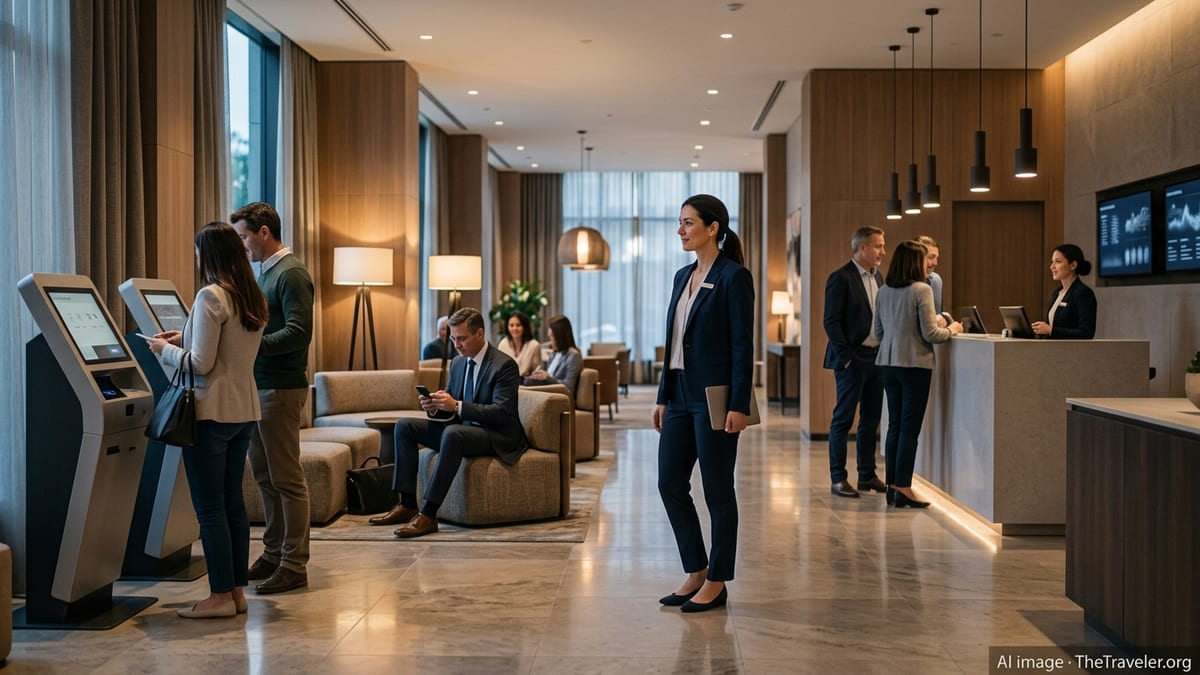
Commentary from hospitality analysts suggests that guests increasingly expect a blend of high tech and high touch. AI is welcomed when it shortens lines, reduces waiting on hold or speeds up requests, but there is resistance when kiosks or bots are perceived as replacing staff in the lobby altogether. In online forums, hotel employees describe mixed responses to automated check-in kiosks, with some properties seeing backlash from guests who still look for a human welcome.
This tension is central to the future role of the general manager. If AI and automation take over much of the paperwork and basic communication, the visible presence of a senior leader in the lobby can become a key differentiator, signaling that technology is used to enhance service rather than shield staff from guests. Conversely, if AI savings are reinvested primarily in cost-cutting, properties risk hollowing out the human presence that many travelers still associate with hospitality.
Analysts note that brands positioned at the upscale and luxury end of the market may feel the strongest pressure to demonstrate human-led service even as they adopt AI behind the scenes. For these hotels, a general manager greeting returning guests by name in the lobby may become an important counterweight to the invisible algorithms handling pricing, personalization and operations.
Operational Risks and New Pressures on Managers
While AI promises to relieve general managers of some tasks, it can introduce new responsibilities and risks. Industry reports on early AI deployments in hospitality highlight concerns around data quality, integration costs, and the potential for algorithmic decisions to conflict with on-the-ground realities. For example, room-assignment or pricing tools may recommend actions that staff consider impractical given maintenance issues, group needs or VIP expectations.
As hotels introduce AI-driven recommendations across revenue, staffing and maintenance, general managers increasingly serve as the final arbiter between system outputs and guest experience. That can shift the role from “doer” to “curator” of technology, requiring a clear understanding of how algorithms work, what data they rely on and where they might fail. Training and change-management programs are beginning to address this, but analysts note that not all properties have the same access to support.
There is also the risk of over-automation. Published commentary from hotel workers describes scenarios where phone trees, kiosks and chatbots make it harder for guests to reach a person, leading to lower satisfaction and staff stress when issues finally escalate to the front desk. If general managers are measured solely on labor savings or technology adoption metrics, they may feel pressure to push automation further even when it undermines the guest experience in the lobby.
Regulatory and ethical questions add another layer. As hotels collect more data to feed AI systems, general managers may find themselves answering guest questions about privacy, data retention and personalization. Clear communication about what AI is used for, and what remains firmly in human hands, could become part of the lobby conversation.
Early Signals From AI-Forward Hotels
Case studies emerging from AI-forward hotels provide early hints about how the general manager’s role may evolve. Properties that pair AI tools with a deliberate focus on visibility of leadership report benefits such as faster issue resolution, more consistent service standards across shifts and improved staff morale. In these examples, automation handles repetitive tasks like logging requests, routing work orders and tracking resolutions, while managers and supervisors spend more time walking the property and speaking directly with guests and employees.
Some global chains are experimenting with AI-powered messaging platforms that consolidate guest communications across channels, from pre-arrival questions to post-stay feedback. Publicly available information indicates that when these platforms are integrated with property-management systems, general managers gain a clearer real-time picture of pain points, allowing them to intervene in person before frustrations become negative reviews.
At the same time, trade press coverage notes that not every AI experiment has led to more human presence. In some pilots, self-service kiosks and voice bots have replaced elements of the traditional front desk without a corresponding increase in senior staff visibility. Where staffing levels are reduced rather than redeployed, lobbies can feel more transactional and less hosted, regardless of how sophisticated the underlying systems are.
For now, AI appears to be giving hotel leaders a choice rather than dictating a single outcome. Technology can clear a path for general managers to spend more time in the lobby, reconnecting with guests and role-modeling service for their teams. Whether that opportunity is seized or sidelined will likely become a defining competitive factor as hotels continue integrating AI into daily operations over the next several years.