

More news on this day
After a gap of more than half a century, new stations at Willenhall and Darlaston are reshaping how residents, commuters and visitors move across the Black Country and into the wider West Midlands rail network.
Get the latest news straight to your inbox!
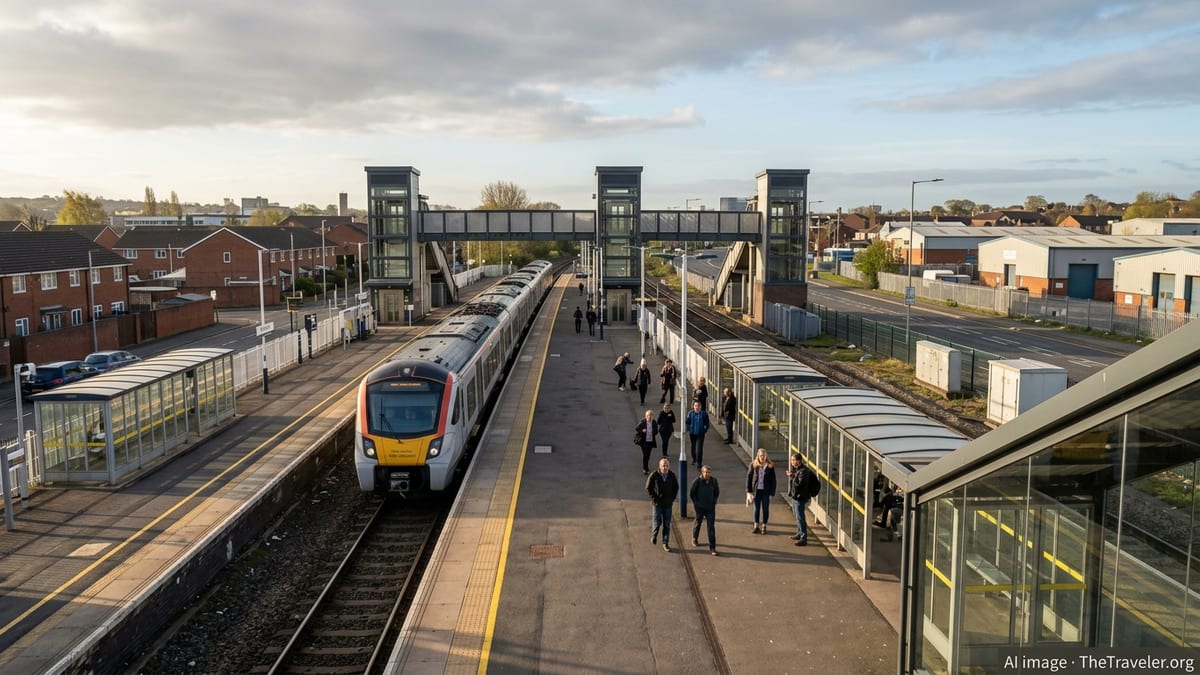
Historic Rail Towns Reconnected After Decades Without Trains
The reopening of rail services at Willenhall and Darlaston marks the end of a long period in which both communities relied solely on roads and buses for regional travel. Passenger services on the Walsall to Wolverhampton line were withdrawn in the mid 1960s, leaving gaps in the rail map that became deeply felt as traffic congestion and journey times increased over subsequent decades.
Publicly available information shows that the new Darlaston station has been developed on and around the historic James Bridge site, which first saw trains in the nineteenth century and closed to passengers in 1965. The project has effectively brought a classic railway alignment back into everyday use, but with modern infrastructure and full accessibility.
Willenhall’s station similarly revives rail access for a town that has roots in the early railway age but has not had regular passenger services for more than 50 years. Earlier stations in the town once linked it directly with Wolverhampton and Birmingham; the new facility restores that role, but within a far more integrated regional transport strategy.
The two stations are part of a wider West Midlands rail investment drive focused on infill stations and reopened corridors. Transport strategy documents indicate that by 2026 the Walsall to Wolverhampton corridor is expected to host new stopping services calling at Willenhall and Darlaston, reinforcing the line’s importance for everyday mobility as well as leisure travel.
Faster Links to Birmingham, Wolverhampton and Walsall
For travellers and tourists, the most immediate change delivered by the new stations is journey time. Journey planners and technical assessments referenced in recent coverage indicate that trips from Darlaston to Birmingham New Street are scheduled at around 22 minutes, with around 11 minutes to Wolverhampton and roughly a quarter of an hour to Walsall. From Willenhall, indicative timings suggest journeys of under 10 minutes to either Wolverhampton or Walsall and around 20 to 25 minutes to Birmingham.
These timings compare with bus and car journeys that can more than double in length during peak periods, particularly on sections of the Black Country Route and surrounding arterial roads. Rail’s relative resilience to congestion is expected to make the new links attractive not only for commuters but also for day trippers heading into Birmingham for culture and retail, or out toward Shrewsbury and the Welsh borders via connections at Wolverhampton.
Service patterns are still evolving, but industry documents and local transport updates point to at least two trains per hour serving the corridor, with aspirations for a dedicated Walsall to Wolverhampton stopping service. A regular interval timetable is seen as essential to building confidence among new users, especially those who have not considered rail a realistic option for local journeys in their lifetimes.
For passengers arriving from further afield, the stations provide new entry points into the heart of the Black Country. Visitors from London, the North West or the South West can change at Birmingham New Street or Wolverhampton for straightforward onward rail hops, placing Willenhall and Darlaston more prominently on the visitor map.
Modern Station Design Focused on Accessibility and Safety
Construction updates from regional transport bodies show that both stations feature paired platforms connected by fully accessible footbridges, supported by lifts and stairs. These elements have been installed using large-scale crane operations, reflecting a move toward standardised, modern station architecture designed around step free access from street to train.
At Willenhall, images and official project descriptions highlight new platforms, a covered footbridge and a compact car park arranged to encourage park and ride without overwhelming nearby streets. Darlaston’s layout sits close to key road junctions and employment sites, positioning the station as a walkable option for residents as well as workers in nearby industrial and logistics hubs.
Both stations are equipped with contemporary lighting, passenger information screens and CCTV. While these elements are now common across the network, their introduction here represents a significant upgrade for areas that previously relied on bus stops and basic shelters. The design approach seeks to balance visibility and safety with a relatively low visual impact on surrounding neighbourhoods.
Cycle parking, drop off facilities and integration with local bus routes are also part of the station specifications. Transport planning material indicates a focus on “multi modal” access, with short walking links and on street improvements intended to make it easier to reach the new rail services without a car.
Economic Ripple Effects for Local High Streets and Housing
Property and regeneration analysts are already drawing connections between the new rail links and investment patterns across the Walsall and Wolverhampton corridor. A recent guide for investors noted that a 60 year wait for new stations in the area is influencing rental yields, with expectations of rising demand for homes within walking distance of Willenhall and Darlaston.
Improved rail access is seen as a catalyst for bringing new businesses into local centres, particularly hospitality, convenience retail and services aimed at commuters. Traders in both towns are expected to benefit from increased passing footfall as more people choose to arrive and depart by train rather than driving directly to larger regional centres.
Consultancy work on accessibility and journey time mapping indicates that the stations could significantly widen the realistic commuting catchment for jobs in central Birmingham, Wolverhampton and beyond. Shorter and more reliable journeys can make it easier for residents to access higher paid employment and education, which in turn supports spending power in local shops and venues.
For tourism, the benefits are subtler but still important. Easier rail access can support visits to nearby heritage attractions, canals and industrial museums across the Black Country, many of which are promoted as day trip destinations from Birmingham and other cities. Tourists staying in the city centre may increasingly consider rail hops out to less familiar towns such as Willenhall and Darlaston as part of a multi day itinerary.
Positioning the Black Country as a Connected Visitor Region
Transport and economic strategy papers increasingly present the Black Country not just as a cluster of post industrial towns, but as a coherent visitor region with its own stories and landscapes. The reopening of Willenhall and Darlaston stations fits within that narrative, providing practical infrastructure to support a more joined up approach to tourism promotion.
With direct services to Birmingham New Street and connections to intercity routes, the new stations make it easier for national and international visitors to explore beyond the best known sights. Combined with other recent rail investments across the West Midlands, they help to rebalance the perception of the region so that smaller towns are not seen as peripheral to the main urban core.
Travel magazines, property blogs and local media have begun to frame the stations as part of a wider “rail revolution” in the West Midlands, in which previously under served communities gain new options that are attractive for both work and leisure. For tour operators and independent travel planners, the presence of reliable rail stops at Willenhall and Darlaston creates opportunities to design new Black Country themed itineraries featuring canal walks, industrial heritage, local food and live events.
As timetables bed in and passenger numbers grow, the two stations are expected to become everyday gateways for residents and practical new entry points for visitors. Their return to the rail map signals a shift in how the West Midlands presents itself to travellers, with the Black Country positioned not at the edge of the network, but firmly on track for renewed attention.