

More news on this day
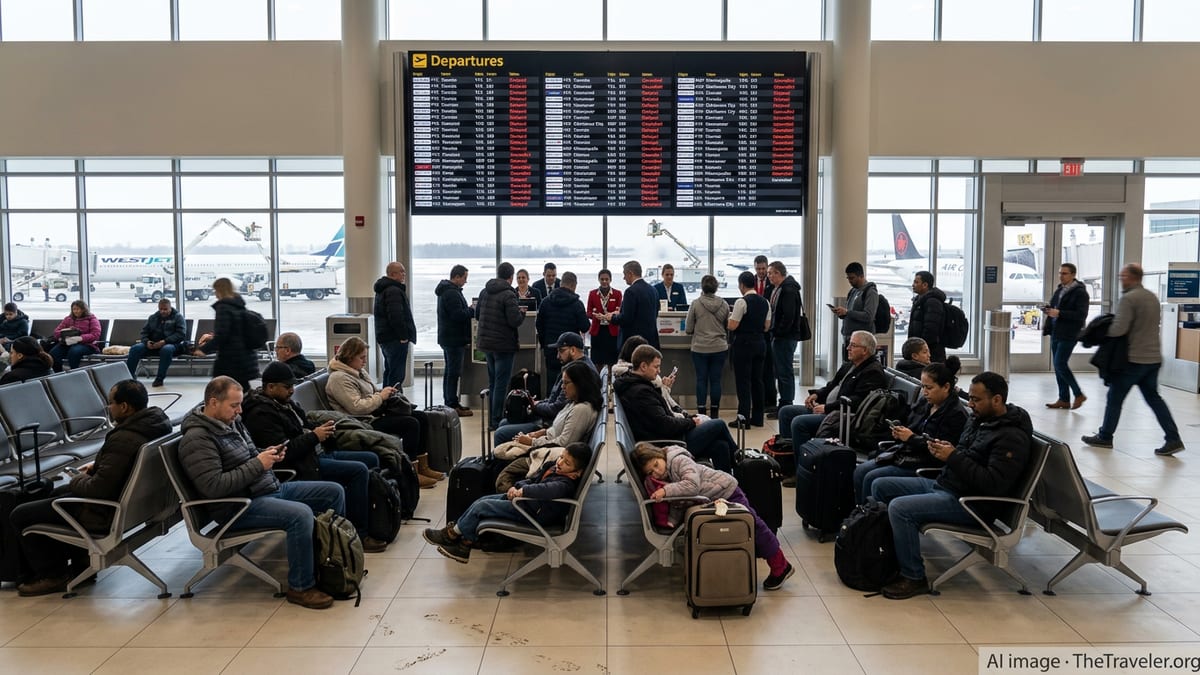
Passengers across Canada and the United States faced unexpected travel turmoil on March 15, 2026, as a wave of delays and cancellations at Winnipeg Richardson International Airport disrupted itineraries stretching from Toronto and Montreal to Vancouver, Minneapolis, Oklahoma City and beyond.
Get the latest news straight to your inbox!
Chain Reaction from a Prairie Hub
Publicly available flight-status information on March 15 indicates that Winnipeg Richardson International Airport recorded at least 12 delayed departures and 12 cancellations over the course of the operating day. The disruption involved a mix of domestic and cross-border services, affecting connections to major Canadian hubs such as Toronto, Montreal and Vancouver, as well as key cities in the United States including Minneapolis and destinations in Oklahoma.
Winnipeg’s role as a connecting node for both east–west and north–south routes meant that localized disruption quickly produced a broader network impact. Travelers using Winnipeg as a transfer point for flights to or from larger hubs found themselves contending with missed connections, extended layovers and last-minute rebookings. Reports from airline operations dashboards suggest that several affected flights were part of multi-leg itineraries, compounding the inconvenience for passengers on longer journeys.
According to real-time tracking platforms, some cancellations occurred in clusters within narrow time windows, a pattern that often points to compatibility issues with aircraft rotations, crew availability or weather-related flow controls along the broader route network. Once an aircraft fails to arrive in Winnipeg on schedule, subsequent services to cities such as Toronto, Vancouver or Minneapolis can be delayed or canceled, with knock-on effects that reach far beyond Manitoba.
By late afternoon, schedule data showed a gradual stabilization of departure and arrival times, but the earlier wave of disruption left many travelers in holding patterns, either waiting at departure gates or seeking alternative routing options through Canada’s major hubs.
Passengers Stranded from Toronto to Oklahoma
The disruption at Winnipeg reverberated most strongly through large Canadian hubs, where many itineraries either originated or were scheduled to terminate. Travelers booked on services between Winnipeg and Toronto Pearson, Montreal–Trudeau and Vancouver were among those most exposed, as canceled or heavily delayed flights broke the continuity of onward connections throughout Canada, the United States, Mexico and sun destinations.
Airline booking engines and airport departure boards showed a patchwork of rebooked routings for affected passengers, with some itineraries shifted through alternate hubs or pushed to next-day departures. For travelers originating in or bound for U.S. cities such as Minneapolis and airports in Oklahoma, the result was an extended journey involving additional stops, long overnight waits or, in some cases, the need to abandon nonessential trips altogether.
Social media posts and traveler forums on March 15 reflected a familiar mix of frustration and adaptation. Some passengers described hours-long waits for updated departure times, while others reported more favorable outcomes after securing earlier connections through alternative cities. Despite the uneven experience, publicly available comments indicated that most travelers were ultimately able to secure new itineraries, albeit at the cost of significant delay.
In several cases, passengers reported that their original Winnipeg connections were critical for time-sensitive commitments such as job interviews, medical appointments or major sporting events in markets like Minneapolis. For these travelers, the combination of cancellations and limited same-day rebooking options turned a routine flight into a stressful logistical challenge.
Weather, Operations and the Complexity of Flight Networks
While a single cause for the March 15 disruptions at Winnipeg had not been clearly identified in available reporting by late evening, broader patterns across Canadian aviation in early March provide context. Recent travel advisories and discussion in passenger communities have highlighted recurring weather systems affecting prairie and central Canadian routes, including snow, freezing rain and low-visibility conditions that can constrain airport capacity and lengthen de-icing procedures.
Industry-focused coverage in recent weeks has also drawn attention to how winter weather in cities such as Toronto, Montreal and Calgary can trigger cascading delays across entire airline networks. When flights into Winnipeg from major hubs arrive late or are canceled entirely due to conditions elsewhere, local schedules are quickly thrown off balance, even if Winnipeg itself is experiencing relatively manageable weather at that moment.
Operational considerations add another layer of complexity. Airline and airport operations data show that tight aircraft rotations, crew duty-time limitations and ground-handling constraints can limit the flexibility to absorb even modest disruptions. Once several flights fall out of sync in a short period, carriers may consolidate services or cancel selected departures to reset their schedules, a strategy that can explain bursts of cancellations such as those recorded at Winnipeg on March 15.
Observers of Canadian aviation note that these patterns are not unique to Winnipeg. Similar ripple effects have been documented in situations where irregular operations at a single hub, whether driven by storms, technical issues or air-traffic control measures, lead to widespread disruption across the continent-spanning networks that link Canadian and U.S. cities.
What Travelers Can Do When Irregular Operations Hit
The events at Winnipeg Richardson International Airport on March 15 serve as a reminder of the vulnerability of tightly timed itineraries, especially during late-winter travel across central and western Canada. Travel experts and consumer advocates consistently recommend that passengers build in additional buffer time for connections during these periods, particularly when itineraries involve smaller hubs like Winnipeg feeding into large intercontinental gateways.
Publicly available guidance from airlines and government agencies emphasizes the importance of monitoring flight status through official airline apps, airport information screens and real-time tracking tools before leaving for the airport. When disruptions occur, passengers who act quickly to request rebooking, explore alternate routings or accept nearby airport options often secure more favorable outcomes than those who wait until flights are formally canceled.
Travel-industry advisories issued in recent seasons also highlight compensation and refund frameworks that vary by jurisdiction and cause of disruption. In Canada and the United States, passengers may have different entitlements depending on whether delays and cancellations stem from weather, safety-related decisions or issues within an airline’s control, such as crew scheduling or maintenance on its own aircraft. Understanding these distinctions in advance can help travelers make informed choices when offered vouchers, alternative flights or refunds during a disruption.
For many passengers affected by the March 15 irregular operations at Winnipeg, the experience will likely result in closer attention to travel insurance options, flexible ticket policies and itinerary planning strategies for future trips. As airlines and airports continue to contend with volatile weather patterns and complex network operations, episodes like this underscore the ongoing need for both robust operational resilience and clear, timely communication with travelers.
Growing Scrutiny of Reliability in Canadian Air Travel
The latest disruptions at Winnipeg Richardson International Airport enter a broader conversation about reliability and resilience in Canadian air travel. Over the past several years, patterns of delays and cancellations at major hubs such as Toronto, Montreal and Vancouver have drawn increased coverage in national media and on consumer platforms, with many travelers voicing concern about the predictability of domestic and transborder journeys.
Analysts following the aviation sector note that Canadian carriers operate in a challenging environment that combines harsh seasonal weather with long domestic stage lengths and concentrated traffic flows through a handful of primary hubs. When irregular operations occur at a smaller but strategically located airport such as Winnipeg, the downstream impact often extends well beyond regional markets, affecting passengers in multiple provinces and several U.S. states.
According to recent industry commentary, sustained episodes of disruption risk eroding passenger confidence and may influence how travelers plan their trips, from choosing early-morning departures less vulnerable to knock-on delays to favoring nonstop routes whenever possible. At the same time, airports and airlines are investing in technology and infrastructure upgrades aimed at improving de-icing capacity, gate management and communication tools that keep passengers better informed during fast-moving operational events.
For now, the March 15 wave of delays and cancellations at Winnipeg stands as the latest example of how a relatively small set of affected flights, in this case 12 delays and 12 cancellations, can trigger disproportionate dismay across a wide swath of North American travelers. As the busy spring and summer travel seasons approach, the experience is likely to inform how both passengers and carriers prepare for the next period of heightened demand.