

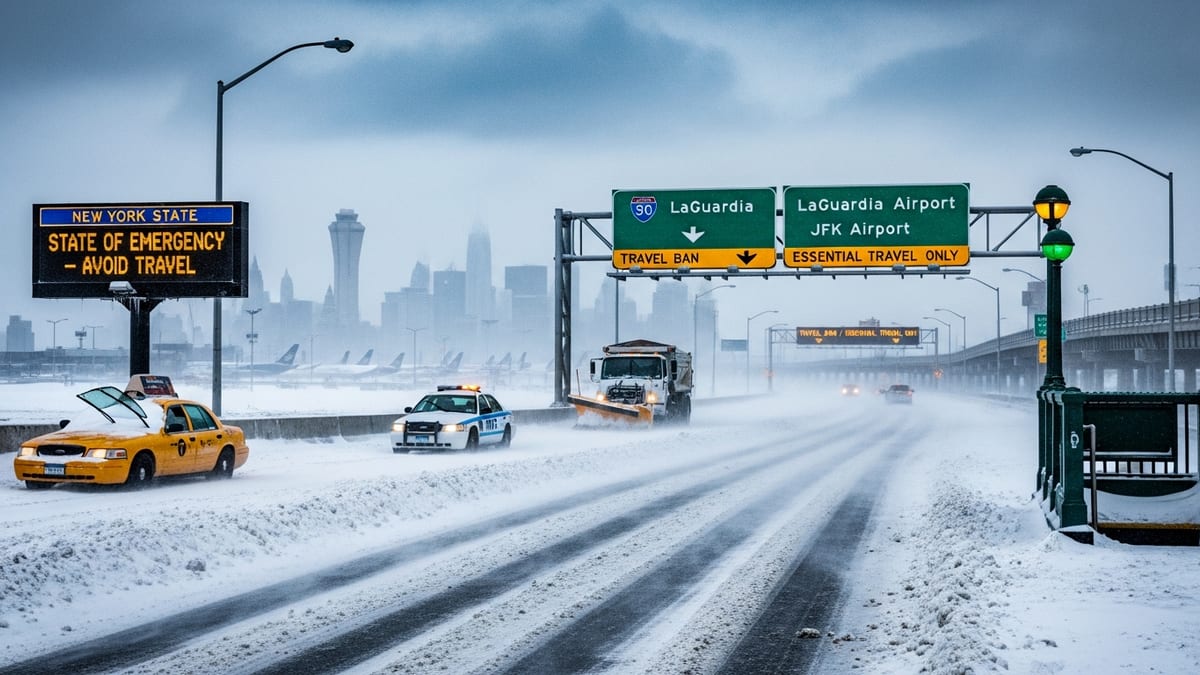
Travelers across New York are facing severe disruption as a powerful winter storm blankets the state with heavy snow, sleet and dangerous winds, forcing mass flight cancellations, snarling highways and prompting officials to warn residents to stay home.
With states of emergency in effect and some of the heaviest snow in years falling on New York City and surrounding regions, transportation networks on Monday, January 26, are struggling to cope with conditions forecasters say could remain hazardous into the start of the workweek.
More News
- Edinburgh and Glasgow Overtake London as UK Nightlife Capitals, Airlines Boost Scottish Routes
- Canada Tightens Travel Warnings as Extreme Weather Claims 83 Lives
- Snowstorm Chaos in Manali: Tourists Stranded as Himachal Issues Urgent Travel Alert
Storm Slams New York With Heaviest Snowfall in Years
The winter storm, part of a wider system battering much of the United States, swept into the New York metropolitan area on Sunday, January 25, quickly transforming streets into snow-packed corridors and sharply reducing visibility. By early evening, Central Park had recorded nearly 9 inches of snow, with similar totals at the city’s airports and higher accumulations reported in parts of Long Island and coastal Connecticut.
Forecasters described the event as New York City’s biggest snowstorm in roughly five years, a shift from several winters of relatively modest snowfall. The National Weather Service has warned that snow bands could continue to pivot across the region, adding a few more inches in spots, while strong winds whip up drifts and blow existing snow back onto already-plowed surfaces.
In upstate New York, the storm’s impact has been just as intense. Regions stretching from the Hudson Valley through the Capital Region and into western and northern New York have reported treacherous road conditions, periods of near-whiteout visibility and rapidly accumulating snow on key interstate routes. Lake-effect enhancement is expected to prolong snowfall in some corridors, compounding cleanup challenges.
Officials say the combination of heavy snow, gusty winds and bitter cold could make Monday morning particularly difficult, with refreezing on untreated roads and sidewalks and lingering snow showers across the state. Travelers are being warned to prepare for an extended disruption rather than a quick return to normal.
States of Emergency and Travel Bans Aim to Keep People Off the Roads
New York Governor Kathy Hochul has kept a statewide state of emergency in place, urging residents to avoid unnecessary travel as plow crews struggle to keep pace with the snowfall. In a briefing late Sunday, the governor said resources from multiple state agencies, including the Department of Transportation and the Thruway Authority, had been deployed to pre-position plows, salt trucks and emergency vehicles in hard-hit regions.
Local leaders across the downstate region echoed that message. New York City officials called for residents to stay off the roads whenever possible, emphasizing that fewer cars on the streets allows sanitation crews to move more quickly and keeps emergency routes open for ambulances, fire services and law enforcement. In some suburban counties, officials have issued advisories strongly discouraging all nonessential driving, while a handful of localities have implemented temporary travel restrictions on smaller roads.
On key arteries such as the New York State Thruway, the Long Island Expressway and the Major Deegan Expressway, traffic on Sunday was markedly lighter than a typical weekend, but those who ventured out encountered long stretches of snow-covered pavement and sporadic spinouts. Tractor-trailers and buses in particular have been singled out for enhanced restrictions in certain corridors as authorities seek to prevent jackknifed trucks from blocking major highways.
Transportation officials have cautioned that even as snowfall rates ease, drifting snow and plummeting temperatures will keep road surfaces dangerous. Black ice and hard-packed snow are likely in shaded areas and on bridges, which freeze more quickly than regular roadways. Motorists who must drive are being urged to reduce speeds significantly, carry emergency supplies and check conditions frequently through local media or state travel alert systems.
Air Travel in Turmoil as New York Airports Become Storm Epicenters
Air travelers have been among the hardest hit by the storm, with New York’s airports standing at the center of a nationwide wave of cancellations. By Sunday afternoon, thousands of flights across the United States had been scrubbed, and aviation tracking services identified LaGuardia Airport and John F. Kennedy International Airport among the most disrupted hubs in the country.
At LaGuardia, roughly nine out of ten scheduled flights on Sunday were canceled as snow intensified and runway conditions deteriorated. JFK also saw hundreds of flights wiped from the board, representing a large majority of its daily operations. Newark Liberty International Airport, just across the Hudson River in New Jersey, reported comparable levels of disruption. Airlines have warned that Monday, January 26, could bring another day of severe constraints as carriers work through a mounting backlog of displaced passengers and aircraft out of position.
Nationally, the storm has triggered more than ten thousand cancellations in a single day, rivaling some of the worst weather-related disruptions since the early pandemic era. Major U.S. carriers including American, Delta, United, Southwest and JetBlue have preemptively cut large slices of their schedules, with some airlines axing close to half or more of their flights on Sunday alone in order to avoid stranding passengers on tarmacs or operating in unsafe conditions.
For travelers in the New York area, the practical effect has been a near-shutdown of normal airport activity. Terminals at LaGuardia and JFK remained open for stranded customers and limited operations, but with so few departures and arrivals, concourses were dominated by lines at airline service desks, families camping near power outlets and travelers refreshing their smartphones for rebooking updates. Airport authorities are advising passengers to check their flight status before leaving home and to expect lengthy waits for rebooking to popular domestic and transatlantic destinations.
Public Transit Under Strain but Still Moving Millions
Even as roads and runways buckle under the storm’s weight, New York’s extensive public transit network has sought to keep people moving on a limited basis. The Metropolitan Transportation Authority reported that subway service was still running late Sunday, though with delays, localized suspensions and slower speeds as crews worked to clear snow from outdoor tracks and protect sensitive signaling equipment.
Bus routes have been particularly vulnerable. Many surface lines across the five boroughs experienced significant delays, detours or full suspensions due to impassable side streets, parked vehicles buried in snowbanks and icy hills. Riders were urged to allow substantial extra travel time and, where possible, to favor subways over buses in order to reduce strain on street-level operations.
On the commuter rail lines that tie New York City to its suburbs, including the Long Island Rail Road and Metro-North Railroad, service adjustments have included reduced schedules, potential branch suspensions and the use of shorter trains to facilitate snow-clearing work in rail yards. Riders heading into Manhattan from Long Island, Westchester and Connecticut have been asked to monitor real-time alerts carefully and to anticipate crowding on the limited trains that do run during the height of the storm.
Beyond the city, regional transit operators around Albany, Buffalo, Rochester and other upstate cities have made similar moves, temporarily curtailing bus and rail service as conditions worsen. Officials emphasize that while transit remains a safer option than driving in many cases, residents should still avoid nonessential trips and use the network primarily for critical work, medical or caregiving travel.
Schools, Deliveries and City Services Adjust to Storm Reality
The storm’s timing at the start of the workweek has prompted a sweeping shift in how New Yorkers will study, work and access everyday services on Monday. New York City public schools announced a move to remote instruction for January 26, giving custodial crews more time to clear entrances, sidewalks and playgrounds while reducing the number of students and staff traveling during the morning rush.
School districts across Long Island, the lower Hudson Valley and northern New Jersey followed a similar path, declaring closures or remote days in anticipation of hazardous roads and limited transportation. For families and educators, the pivot evoked memories of previous winters and of the virtual-learning routines honed during the pandemic, though officials stress they hope the disruption will be short-lived if cleanup proceeds quickly.
Private sector services have also responded. Food delivery platforms and courier services scaled back or temporarily suspended operations in parts of the city on Sunday night as conditions deteriorated, with some companies stating they would reassess on Monday morning once plows had a chance to make headway. That left many New Yorkers rushing to stock up on groceries and essentials ahead of time.
At the same time, city agencies have been working around the clock to keep critical functions going. Sanitation crews have been operating in 12-hour shifts, with plows and salt spreaders deployed on primary routes first, then on residential streets as capacity allows. Emergency management officials are coordinating with utility companies to respond quickly to any power outages, while shelters and warming centers are on alert to assist vulnerable residents exposed to the cold.
Travelers Scramble for Alternatives as Cancellations Mount
For visitors and residents alike, the storm’s rapid escalation has forced difficult decisions about whether to press ahead with trips, reroute or postpone travel altogether. At New York’s airports, many travelers whose flights were canceled on Sunday found themselves rebooked days later, particularly those heading to or from other storm-battered cities in the South, Midwest and Mid-Atlantic that are also grappling with closures.
Airlines have introduced flexible travel policies to manage the disruption. Several major carriers serving New York have issued weather waivers allowing passengers booked over the storm period to change flights without penalty, provided they travel within a specified rebooking window and maintain the same origin and destination. Some are adding extra flights on key routes later in the week to help relieve the backlog, though the availability of seats remains tight during peak times.
With the skies unreliable, many travelers have turned to rail and rental cars as alternatives. Amtrak services in and out of New York are operating but subject to weather-related delays, slower speeds and potential cancellations on corridor routes where snow and ice accumulate on tracks and power lines. Rental car agencies at major airports and city locations have reported a spike in demand, with some categories of vehicles already sold out for early in the week.
Tourism operators say the storm’s timing is particularly challenging for leisure travelers who scheduled long-weekend city breaks or winter getaways to upstate ski areas. Many are trying to salvage their plans by extending stays, shifting to flexible hotel bookings or rebooking later in the season. Travel advisers recommend that tourists heading into the region keep arrangements as flexible as possible and consider refundable rates for both transportation and lodging until the full impact of the storm becomes clear.
Safety First: Officials Urge Caution for Those Still on the Move
Against this backdrop of rolling disruptions, officials at every level are stressing a central message: safety must take precedence over schedules. The combination of heavy snow, strong winds and frigid temperatures presents a serious risk not just on the roads, but also for pedestrians and transit riders navigating slippery platforms, steps and crosswalks.
Emergency responders are particularly concerned about the risk of stranded vehicles on highways, which can hamper plowing operations and divert resources away from more urgent calls. Motorists who become stuck are advised to stay with their vehicle, ensure the exhaust pipe is clear of snow to avoid carbon monoxide buildup and conserve fuel by running the engine intermittently rather than continuously.
Those who rely on public transport are being urged to dress in layers, wear waterproof footwear and build in extra time for potential service changes. Residents are also reminded to clear snow from sidewalks adjacent to their property within the legally required timeframe, while taking care to avoid overexertion and to watch for icy patches concealed beneath fresh powder.
For tourists unfamiliar with winter weather, local authorities recommend following the lead of residents: limit outdoor activity during the heaviest snowfall, avoid driving if possible and heed official alerts. Hotels and short-term rental hosts are being encouraged to share up-to-date information with guests about transit changes, airport disruptions and neighborhood conditions so that visitors can make informed choices about when and how to move around the city and state.
What Travelers Should Expect in the Coming Days
While conditions are expected to gradually improve after the storm’s peak, the ripple effects on travel across New York are likely to persist for several days. Airlines must reposition aircraft and crews, highways require repeated rounds of plowing and salting, and transit agencies will need time to dig out rail yards, bus depots and aboveground infrastructure. Even as the snow stops, cold temperatures will slow the melt and keep surfaces slick.
Travel experts anticipate that air service at LaGuardia, JFK and Newark will resume in earnest once runways and taxiways are fully cleared and visibility improves, but schedules may remain thinned and uneven through midweek. Passengers whose trips are not time-sensitive may find it easier to shift their plans later rather than attempting to fly at the earliest possible opportunity, when competition for limited seats will be fiercest.
On the roads, plow crews will focus first on restoring major highways and emergency routes to normal conditions before tackling narrower residential streets, where parked cars and high snowbanks complicate operations. This staggered approach means that some neighborhoods may see packed snow and rutted surfaces linger even as main arteries appear relatively clear.
For now, officials are urging patience and flexibility. Travelers are advised to monitor airline and transit updates frequently, leave extra time for any essential journeys and, above all, reconsider whether their plans can be postponed until the worst of Winter Storm Fern’s impact on New York’s transportation networks has passed.