

More news on this day
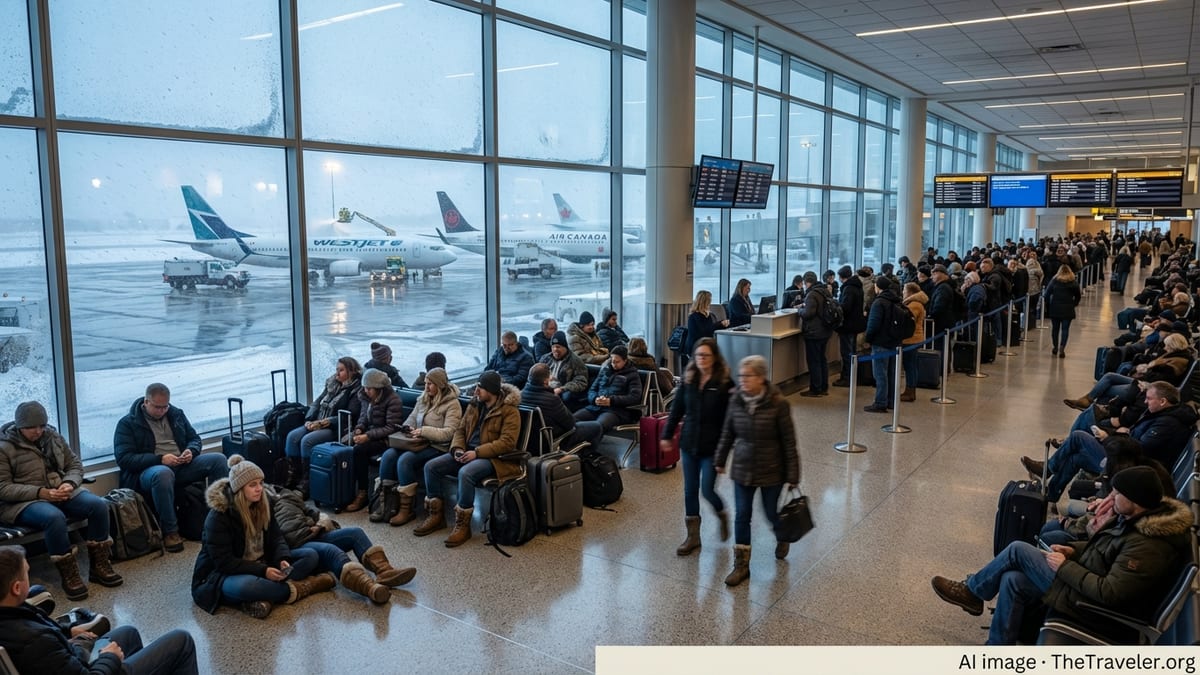
Hundreds of passengers were stranded in Canada on Tuesday and Wednesday as a powerful winter storm battered Calgary, prompting WestJet, Air Canada and several other carriers to suspend or delay at least 22 flights at Calgary International Airport and disrupt air travel across the country.
Calgary Hit Hard as Cancellations Mount
Calgary International Airport found itself at the center of Canada’s latest weather-driven travel chaos as heavy snow and high winds swept across southern Alberta on February 17 and 18. The storm, which brought reduced visibility and hazardous runway conditions, triggered a wave of cancellations and long delays on both domestic and transborder routes.
Operational data compiled from airport boards and tracking services showed at least 22 flights involving Calgary suspended outright across a roughly 24 hour period, with many more operating several hours behind schedule. The disruption affected departures and arrivals to cities including Vancouver, Toronto, Edmonton, Winnipeg and several U.S. hubs, stranding travelers in terminals and at outstations waiting for Calgary-bound aircraft that never left the ground.
The pattern fit into a broader picture of national disruption. Industry tallies indicated that across Canada on February 17 there were well over 200 cancellations and hundreds of delays, with Calgary among the hardest hit western hubs. By Wednesday morning, delayed operations at Calgary were still echoing through the network, as aircraft and crews remained out of position and recovery flights struggled to keep up.
Airport officials emphasized that safety procedures, particularly for de-icing and snow clearance, limited how quickly operations could recover. Even as conditions slowly improved, bottlenecks at de-icing pads and on taxiways meant that flights cleared for departure were sometimes forced to wait on the ground, further compounding schedule disarray.
WestJet and Air Canada Shoulder the Brunt
As Calgary’s dominant carrier, WestJet bore the largest share of the disruption. The airline and its regional affiliate WestJet Encore together accounted for the majority of Calgary cancellations and delays, particularly on short-haul links to Vancouver, Edmonton and Winnipeg. Several flights were scrubbed outright as the carrier worked to consolidate lightly booked services and free up aircraft for recovery operations on core routes.
Air Canada and Jazz Aviation, while smaller players in Calgary than WestJet, also reported scrubbed departures and cascading delays. Short-haul services to Toronto and Vancouver were notably affected, with passengers facing rebookings that stretched into late Wednesday or even Thursday. Some travelers with onward international connections out of hubs such as Toronto Pearson and Vancouver were forced to overnight in Calgary hotels or rework their itineraries entirely.
The concentration of cancellations among Canada’s two largest airlines amplified the impact, as their networks feed most major domestic and transborder routes. With both carriers facing simultaneous operational constraints, opportunities for same-day reaccommodation were limited. Interline options that might normally provide relief were also constrained, as smaller carriers operating into Calgary reported their own weather-related schedule changes.
Both WestJet and Air Canada issued flexible travel policies covering affected dates and routes, waiving change fees and encouraging passengers with non-essential trips to postpone their journeys. However, availability on later flights remained tight, particularly on high-demand business and leisure corridors.
Passengers Face Long Waits and Limited Options
Inside Calgary International Airport, the human impact of the storm was evident in crowded departure halls, long lines at customer service counters and families stretched out on benches waiting for news of their flights. Some travelers reported spending the better part of the night in the terminal after missing connections from delayed inbound services.
For many passengers, the greatest source of frustration was the uncertainty. Departure boards cycled repeatedly between new estimated times and generic delay notices as airlines waited for updated weather assessments, crew legal rest windows and maintenance checks on aircraft that had endured back-to-back winter operations. Some flights saw multiple rolling delays before ultimately being canceled, leaving passengers scrambling to reclaim luggage and rebook.
Travelers with complex itineraries were particularly vulnerable. Those connecting in Calgary to international departures through Toronto, Vancouver or U.S. hubs such as Chicago and Atlanta often found that by the time their initial leg was canceled, the next viable long-haul departure was either sold out or operating from a different gateway. This forced some to either accept multi-stop routings several days later or seek refunds and alternative carriers at higher last-minute fares.
Airport staff and airline agents worked through the night to manage rebookings, distribute meal vouchers and arrange hotel accommodations where policies allowed. Still, capacity limitations meant that not everyone could be accommodated immediately, and some travelers resorted to booking their own nearby lodging or staying with friends and family in the Calgary area.
Ripple Effects Across Canada’s Major Hubs
While Calgary was at the epicenter of the storm’s impact, the knock-on effects rippled through the wider Canadian network. Major hubs such as Toronto Pearson, Vancouver International and Montreal Trudeau reported elevated numbers of delays and cancellations tied to aircraft and crew originating or passing through Calgary and other Prairie airports in the storm’s path.
Toronto Pearson, already grappling with its own wintry mix of snow and freezing rain this week, saw a portion of its cancellations linked to western weather disruptions. Aircraft scheduled to arrive from Calgary and then turn around for domestic and transborder flights were delayed or grounded, forcing dispatchers to reshuffle fleets and, in some cases, to cancel rotations entirely to keep longer-haul operations intact.
In western Canada, airports in Edmonton, Regina and Saskatoon also reported disrupted schedules as the same system swept across the Prairies. Several flights between these cities and Calgary were suspended, further complicating travel for passengers relying on regional connectors to reach the larger hub. Smaller airports with fewer daily services had even less flexibility, meaning a single canceled Calgary-bound flight could effectively cut off same-day connection options.
The ripple effects extended into the United States as well, with delays and cancellations on Calgary services to cross-border destinations such as Minneapolis, Chicago and select sun destinations. U.S. carriers operating codeshare services with Canadian partners had to revise their own schedules, illustrating how quickly a localized storm can disrupt a complex transnational network.
Winter Weather and an Already Stressed System
The latest bout of disruptions arrives in the wake of a difficult winter for Canadian aviation. A prolonged cold wave in January had already triggered significant operational challenges, from de-icing backlogs to extended runway closures, pushing airlines and airports close to their resilience limits. The Calgary storm added another layer of strain to crews, equipment and passengers midway through the winter travel season.
Aviation analysts note that while winter weather is a predictable feature of Canadian operations, the combination of increasingly volatile storms and tightly optimized airline schedules is leaving less margin for recovery. Modern fleets and sophisticated forecasting tools have improved overall reliability, but when storms coincide with peak travel days, even modest percentages of canceled flights can quickly strand thousands of passengers.
Staffing also plays a role. Ground handling teams, maintenance crews and call center agents must work within regulated hours and, in some cases, union agreements that limit the extent of surge deployment. After multiple days of intense operations, fatigue management requirements can constrain the ability to rapidly scale up, even when physical infrastructure such as gates and runways is available.
These structural challenges were on display in Calgary, where the storm arrived just as airlines were attempting to clear backlogs from earlier minor disruptions. By the time snow and winds intensified on Tuesday, networks were already tight, leaving operators with little room to absorb further shocks without resorting to suspensions and sizable delays.
How Airlines and Airports Are Responding
In response to the latest wave of cancellations, both WestJet and Air Canada activated their standard irregular operations playbooks. This included deploying additional staff to key contact points in terminals, expanding call center capacity and using digital channels to push real-time notifications about schedule changes, gate moves and rebooking options.
At Calgary International Airport, operations teams focused on maintaining safe runway surfaces and keeping key taxiways and de-icing zones open. Snowplows and sweepers worked in continuous rotations, while de-icing crews prioritized aircraft based on departure windows and connection banks. Airport communications channels urged travelers to arrive early, monitor their flight status frequently and consider rescheduling non-essential trips.
Airlines also sought to consolidate low-occupancy flights where possible, combining passengers from multiple cancelled departures onto a smaller number of operating services once conditions allowed. This strategy, while frustrating for those whose flights were dropped, helped accelerate the overall recovery by freeing up aircraft and crews for redeployment on critical routes.
Industry observers say these measures, although imperfect from a passenger experience perspective, are now standard practice in managing weather-driven crises. The priority in such situations is to stabilize the network quickly, even if that means significant short-term inconvenience for a subset of travelers.
Advice for Affected and Future Travelers
With storms likely to continue affecting Canadian aviation through the remainder of February, travel experts are urging passengers to build greater flexibility into their plans. For those currently affected by the Calgary disruptions, the immediate recommendation is to work directly with airlines via apps or websites whenever possible, as digital rebooking tools often update faster than airport counters can process lines.
Travelers with upcoming journeys through Calgary and other winter-prone hubs are being advised to monitor weather forecasts and consider earlier departures or later returns if itineraries are time-sensitive. Booking the first flight of the day can sometimes improve the odds of departure, as aircraft and crews are already in place overnight, though this is no guarantee in the face of significant storms.
Industry analysts also highlight the importance of understanding fare rules and travel insurance coverage. Flexible or refundable tickets, though more expensive upfront, can offer valuable protection when widespread irregular operations occur. Similarly, comprehensive travel insurance policies may cover additional accommodation and meal costs incurred during extended disruptions.
As airlines and airports work to restore normal operations in Calgary and across the national network, passengers are likely to feel the aftershocks of this week’s cancellations and delays for several days. With winter far from over, both carriers and travelers may need to brace for further bouts of turbulence before spring offers more stable skies.