

More news on this day
Travelers flying between Germany and the United States are facing widespread disruption today as a powerful winter storm on the US East Coast forces major airlines including United Airlines, Lufthansa, Delta and Brussels Airlines to cancel multiple transatlantic flights, snarling connections to hubs such as Newark, JFK, Boston and Copenhagen and leaving passengers scrambling for alternatives.
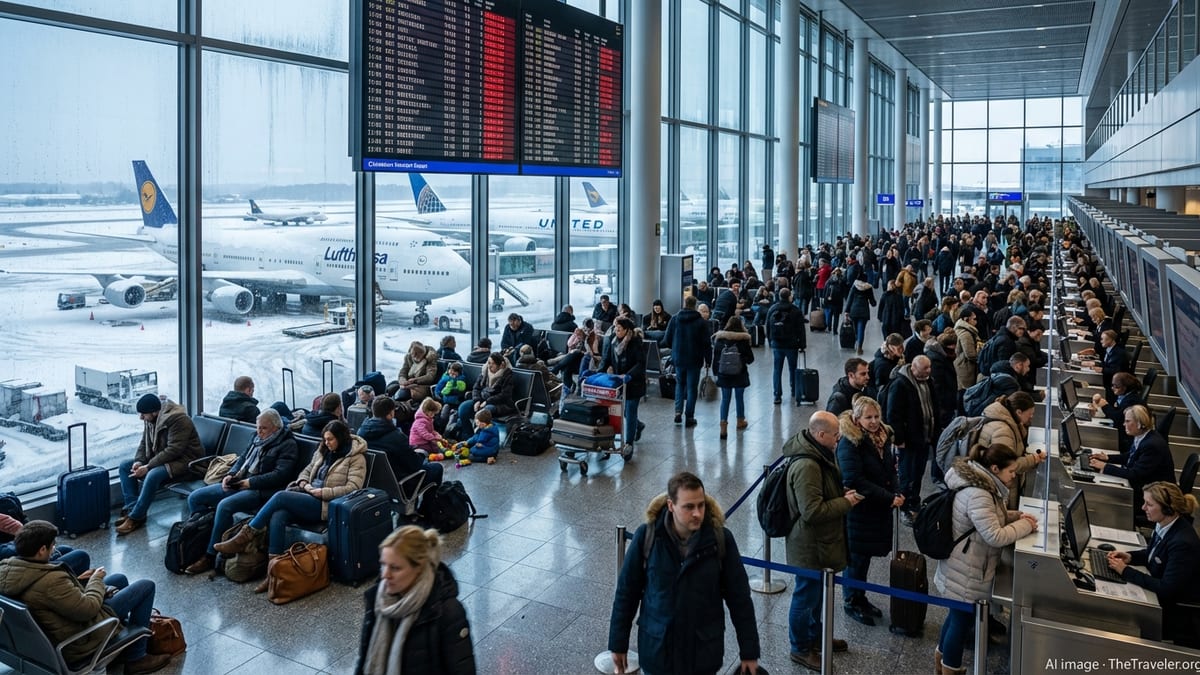
Winter Storm Hernando Slams Transatlantic Network
A fast-intensifying nor’easter, named Winter Storm Hernando, is sweeping across the northeastern United States, bringing heavy snow, strong winds and whiteout conditions to key aviation hubs. New York’s JFK and Newark Liberty, along with Boston Logan, are among the airports most affected, prompting airlines to preemptively ground services in and out of Germany to keep aircraft and crews out of the worst of the weather.
Over the weekend and into Monday, thousands of flights across the US Northeast were delayed or canceled as the storm moved up the coast. The impact has quickly rippled across the Atlantic, with Germany’s major airports in Frankfurt, Munich and Berlin seeing a wave of cancellations on routes to and from New York, Boston and other East Coast gateways. While some services are operating, schedules have been thinned out dramatically, and passengers are being warned to expect last-minute changes.
German carriers and US airlines alike are emphasizing that safety and operational stability are driving the cancellations. With forecasts calling for up to 50 to 60 centimeters of snow in some metropolitan areas and wind gusts over 60 miles per hour, air traffic controllers and airport authorities have constrained runway capacity, forcing airlines to choose which flights can safely operate and which must be cut.
For travelers, the result is a patchwork of disrupted journeys, missed connections and overnight delays. Even airports not directly in the storm’s path, including Copenhagen and other European hubs fed by Germany’s network, are feeling the knock-on effects as aircraft and crews arrive late or not at all.
Lufthansa, United and Delta Cancel Key Germany–US Flights
Germany’s flag carrier Lufthansa has confirmed that it has canceled multiple flights between Germany and the United States in response to the storm. Services from Frankfurt to New York and Boston, as well as the corresponding return flights from the US, are among those grounded today. The airline, which normally operates several daily departures from Frankfurt to Newark and JFK, has significantly trimmed its schedule while the blizzard conditions persist.
Lufthansa officials say they are working to rebook affected passengers on later services once weather conditions improve and airports return to normal capacity. However, they acknowledge that seat availability will be tight in the near term, particularly on the most popular transatlantic routes. Some passengers are being offered routings via alternative European hubs or deferred travel on future dates.
United Airlines, a major transatlantic partner at Newark and a key operator on routes between Germany and the US, has also canceled a number of flights touching German airports. Services linking Newark and Berlin, Frankfurt and Munich have seen cancellations and extended delays as the carrier rebalances its network around the storm. United has issued travel waivers allowing affected passengers to change their dates without standard penalties within specified windows.
Delta Air Lines is experiencing similar disruption on its routes connecting New York and other East Coast cities with Germany and broader Europe. While Delta’s German footprint is smaller than that of Lufthansa and United, the carrier is heavily exposed to East Coast weather and is prioritizing hub operations and crew positioning. Select flights that would have connected through German gateways to destinations such as Copenhagen are either canceled or significantly delayed.
Brussels Airlines and Partner Carriers Feel the Ripple Effect
The impact of the storm is not limited to airlines based in Germany or the United States. Brussels Airlines, a member of the Lufthansa Group, is also facing knock-on disruptions as its transatlantic flights to the East Coast run into airport closures and slot restrictions. Some flights between Brussels and New York are operating with substantial delays, while others have been canceled outright, stranding passengers mid-journey or forcing overnight stays.
Because Brussels Airlines, Lufthansa, Swiss and Austrian share extensive codeshare agreements and feed into one another’s hubs, disruption in one part of the network quickly pushes into the others. Travelers booked on itineraries that combine Germany with Belgium, Switzerland or Austria are finding that a canceled US-bound segment can upend an entire multi-leg itinerary, requiring significant re-routing or a full postponement of the trip.
Other transatlantic carriers using German hubs as key waypoints, including Condor and Singapore Airlines, are also adjusting operations. While some flights remain scheduled, aircraft may be rerouted, downgauged or subject to extended ground holds while crews and airport authorities assess runway conditions and de-icing capacity at both ends of the route. For passengers, that means even flights that are still listed as operating can see longer gate times and unexpected schedule changes.
Airlines are emphasizing that while cancellations are frustrating, they are often less disruptive in the long run than pressing ahead with flights that are likely to be diverted or stranded. By keeping aircraft and crews in more stable locations, carriers hope to resume normal operations more quickly once the storm passes, shortening the overall period of disruption for the wider network.
Munich, Frankfurt and Berlin Experience Ground Delays and Chaos
At Germany’s largest international gateway, Frankfurt Airport, departure boards on Monday showed a growing list of canceled or severely delayed flights to the United States and beyond. Passengers bound for Newark, JFK and Boston have been among those most affected, with entire rotations scrubbed from the schedule. Long check-in lines and crowded rebooking counters underscore the scale of the disruption, even as airport staff work to direct travelers to assistance desks and self-service tools.
Munich and Berlin are experiencing their own share of complications. Recent heavy snowfall in southern Germany has already tested Munich Airport’s resilience, and the latest wave of transatlantic cancellations adds further pressure. Some passengers heading to Scandinavian destinations such as Copenhagen via Munich or Frankfurt have found their journeys disrupted twice over, first by local weather constraints in Germany and then by the East Coast storm limiting available connection options.
Berlin Brandenburg Airport, a growing transatlantic gateway with nonstop services to Newark, has seen select departures canceled or delayed as United and partner airlines cut capacity to match the US weather constraints. While short-haul intra-European services are largely continuing, the reduction in long-haul options has left some connecting passengers with few viable alternatives, particularly those attempting same-day connections to North America.
Airport operators in Germany are urging passengers not to travel to the airport until they have confirmed that their flight is operating. They note that rebooking is often faster and easier via airline apps, call centers or online channels than at crowded airport counters, where staff are dealing with high volumes of distressed travelers.
Knock-On Disruptions Hit Copenhagen and Other European Hubs
The complex web of European connections means that disruption in Germany is quickly spilling over into neighboring hubs, including Copenhagen. Scandinavian-bound passengers who were scheduled to connect via Frankfurt or Munich are seeing missed connections and canceled onward segments, particularly on flights scheduled to arrive in or depart from East Coast airports affected by the storm.
Copenhagen Airport, which serves as a major Nordic hub, is reporting delays on selected transatlantic services and a cascade of late-arriving aircraft from central Europe. While local weather around Copenhagen remains manageable, carriers are juggling late-night crew rest requirements and aircraft positioning issues, particularly for flights that would normally arrive from storm-stricken US cities in the early morning hours.
Other European airports, including those in Dublin, London and Brussels, are wrestling with similar challenges. With airports like JFK and Newark operating on restricted capacity and occasionally suspending operations entirely during the worst of the blizzard conditions, carriers across the continent have little choice but to cancel entire rotations rather than risk extended tarmac delays or diversions to secondary airports with limited handling capacity.
The result is a patchwork of cancellations and delays across Europe that may not immediately appear connected to the US weather in online search results, but which are in fact downstream consequences of the same storm system. Travelers connecting through multiple hubs should be prepared for rolling disruptions even if their immediate departure and arrival cities seem unaffected by the blizzard.
How Airlines Are Handling Rebookings and Travel Waivers
In response to the scale of the disruption, several major airlines have activated flexible travel policies for customers affected by the storm. United Airlines has issued travel waivers for passengers scheduled to fly to, from or through key German and European airports on specified dates, allowing customers to move their trips without the usual change fees, provided they stay within certain rebooking windows.
Lufthansa and its group partners, including Swiss, Austrian and Brussels Airlines, are rolling out similar measures. Passengers whose flights have been canceled are generally entitled to rebooking on the next available service or, in some cases, refunds if travel is no longer feasible. However, high demand on alternative flights means that immediate re-accommodation on the same day is often impossible, and some travelers are being rebooked one or more days later.
Delta and other US carriers are also offering waivers on affected routes, although the specific conditions vary by airline. Some are waiving both change fees and fare differences for a limited time, while others allow penalty-free changes but may still charge if the new itinerary is significantly more expensive. Industry observers note that travelers who can be flexible with dates and are willing to route through secondary hubs may have the best chance of securing timely alternatives.
Airlines are strongly advising passengers to use digital tools to manage their bookings. Mobile apps and websites often update more quickly than airport departure boards, and many now allow customers to rebook themselves onto alternative flights without waiting on hold or standing in line. Nonetheless, for complex itineraries involving multiple airlines or regions, speaking directly with an agent may still be necessary to find workable solutions.
What Affected Travelers Should Do Right Now
For travelers scheduled to fly between Germany and the United States, or onward to cities like Copenhagen, the most important step is to verify the status of their flights before leaving for the airport. Even if a flight appears on time, conditions can change quickly during major winter storms, and last-minute cancellations are common when visibility or runway conditions deteriorate.
Passengers should monitor notifications from their airline via app, email and text, and consider proactively rebooking to a later date if their travel is not time-sensitive. In many cases, moving a trip by one or two days can significantly reduce the risk of extended airport waits, overnight disruptions and multiple missed connections. Travelers who must travel urgently should build in extra connection time and avoid tight layovers wherever possible.
At the airport, experts recommend that passengers keep essential items, including medications, chargers, important documents and a change of clothes, in their carry-on in case they are stuck on board an aircraft or in the terminal for longer than expected. Recent incidents in Germany have highlighted how quickly a manageable delay can turn into an uncomfortable overnight ordeal if staff and ground equipment are stretched thin by weather conditions.
Travelers should also review their rights under European air passenger regulations, which can provide compensation or additional assistance in some circumstances of delay or cancellation. However, severe weather events are often classified as extraordinary circumstances, which may limit eligibility for compensation. Even when compensation is not required, airlines typically provide vouchers for meals or hotel stays when passengers are forced to overnight due to disruptions within the airline’s control.
Outlook for the Coming Days on Germany–US Routes
Meteorologists expect Winter Storm Hernando to weaken as it moves further inland after dumping significant snow on coastal cities, but residual impacts on the aviation system are likely to persist beyond the most intense phase of the storm. Airline planners warn that aircraft and crews will be out of position for several days, and it may take time to fully restore normal timetable operations on busy corridors between Germany and US East Coast hubs.
For Tuesday and Wednesday, airlines are cautiously optimistic that more flights will be able to operate, but they are still building in buffers and may continue to cut frequencies to avoid knock-on delays. Travelers with bookings later in the week should not assume that they are unaffected, as high demand from rebooked passengers could make it difficult to change plans if conditions deteriorate again or if new operational issues arise.
Industry analysts note that the episode underscores the vulnerability of the transatlantic network to winter storms that strike at key hub airports. With major carriers relying heavily on connecting traffic between Europe and North America, a single day of severe weather at airports such as JFK or Newark can cascade into days of disruption across multiple continents, affecting passengers far from the original storm zone.
For now, the best advice for travelers remains simple: stay informed, stay flexible and build redundancy into travel plans. As airlines and airports in Germany, the United States and across Europe work to clear backlogs and reposition aircraft, passengers who remain adaptable and closely monitor updates will be best placed to navigate one of this winter’s most significant travel disruptions.