

More news on this day
Canada’s busiest airports are again grappling with a wave of disruptions, as fresh data show more than a dozen flight cancellations and scores of delays affecting Toronto, Vancouver, Montreal and Calgary.
Air Canada, Jazz Aviation, WestJet and several regional carriers are all impacted, leaving thousands of passengers facing missed connections, overnight stays and changing travel plans at the height of the winter travel season.
More News
- Caribbean Travel to U.S. Upended by New Visa Freezes and Expanded Bans
- Mexico Restores E-Visas for Brazilians, Paving the Way for Borderless Tourism
- Philippine Airlines Joins Regional Carriers Powering Southeast Asia’s Tourism Boom
Fresh Disruptions Hit Canada’s Key Hubs
On February 3 and 4, 2026, operations at Toronto Pearson, Vancouver International, Montreal–Trudeau and Calgary International have been strained by a combination of winter weather and operational bottlenecks. Flight-tracking tallies compiled from airport boards and aviation data providers point to dozens of delayed departures and arrivals across these four major hubs, alongside more than a dozen outright cancellations.
Toronto Pearson, Canada’s largest airport, is reporting one of the heaviest burdens, with well over one hundred delays and multiple cancellations in the most recent 24-hour period. Montreal–Trudeau is seeing a similar pattern, with dozens of delayed flights and more than twenty cancellations following a potent winter system that swept through southern Quebec and Ontario.
In Western Canada, Vancouver International and Calgary International have each logged a smaller number of cancellations but a significant volume of late departures, as ground operations contend with low visibility, gusty winds and the knock-on effects of congestion at eastern hubs. While full-day totals fluctuate as airlines update schedules, the combined picture is of a network struggling to regain its rhythm.
Airport spokespersons stress that safety remains the guiding principle behind any delay or cancellation decision, and that runway and taxiway conditions are being monitored in real time. Nonetheless, the surge in disrupted flights is testing both passenger patience and airline contingency plans.
Air Canada, Jazz and WestJet at the Center of the Turbulence
The lion’s share of affected flights belong to Air Canada and its regional partner Jazz Aviation, together with WestJet and its affiliates. These three players dominate domestic and transborder connectivity through Toronto, Montreal, Vancouver and Calgary, meaning any disturbance to their schedules quickly ripples across the country.
According to operational updates and flight-board snapshots, Air Canada and Jazz have collectively accounted for dozens of delayed flights in and out of Toronto and Montreal since February 3, with a notable cluster of cancellations on short-haul domestic and regional routes. Connections to Halifax, St. John’s, Ottawa, Quebec City and mid-sized Western cities have been especially vulnerable, as carriers prioritize maintaining key long-haul and international services.
WestJet, which uses Calgary as its primary hub and maintains substantial operations in Vancouver and Toronto, has also recorded numerous delayed departures and a number of cancellations as crews and aircraft are repositioned. Some flights linking Western Canada with Toronto and Montreal have been rescheduled or consolidated, forcing passengers to accept later departure times or rebooking through alternative hubs.
Regional and specialist carriers, including operators serving northern and coastal communities, are not immune. With large hubs in Ontario, Quebec and British Columbia struggling to operate on-time, aircraft rotations and crew duty windows for smaller airlines are being squeezed, occasionally triggering last-minute scrubs of low-frequency routes that have limited backup options.
Winter Weather and Operational Strain Combine
The latest wave of disruptions is rooted in a familiar Canadian culprit: winter weather. A band of heavy snow and high winds pushed across southern Ontario and Quebec in recent days, complicating approaches and departures at Toronto Pearson and Montreal–Trudeau. Ground teams have been locked in a near-continuous cycle of runway de-icing and snow clearance, which slows operations and can quickly create a backlog when traffic volumes are high.
Visibility issues, crosswinds and slick surfaces have, in several cases, forced airlines to push back departure times or hold arriving aircraft in airborne or ground delays until conditions improve. Even when weather improves, the recovery can be slow. Crews may time out under duty rules, aircraft may be out of position, and terminal gates can remain congested as flights scheduled hours apart converge into the same time window.
In Vancouver and Calgary, weather impacts have been more varied, shifting from low cloud and rain to intermittent snow and icy conditions. While these airports are well equipped to handle winter, they are nonetheless affected by the cascading impacts of delays and cancellations in the east. When an inbound aircraft or crew from Toronto or Montreal arrives late, the knock-on effect shows up in delayed departures to the United States, Asia and other Canadian destinations.
Airline planners note that the timing of these storms within peak winter travel periods magnifies the effect. Flights are running fuller, alternative seats are harder to find, and slack in the system is limited after several years of tight capacity growth following the pandemic.
Passengers Stranded, Rebooked and Rerouted
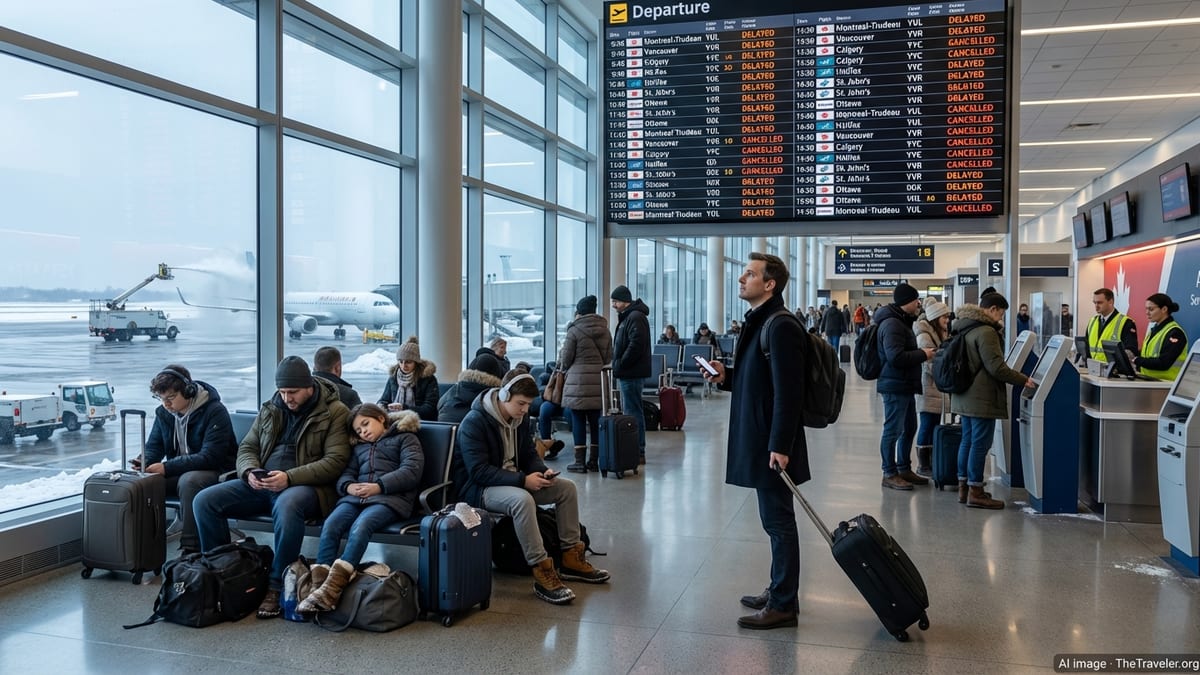
For travelers on the ground, the statistics translate into long waits in departure halls and mounting uncertainty. At Toronto Pearson and Montreal–Trudeau, departure boards have featured long stretches of orange and red status updates, with delayed departure times repeatedly revised as de-icing queues grow and congestion shifts between runways, gates and taxiways.
Families returning from winter holidays have found themselves stuck overnight as late-evening flights were canceled when weather windows narrowed or crew legal limits were reached. Early morning passengers, believing they were ahead of the worst, have instead discovered that displaced aircraft failed to arrive overnight, forcing airlines to cancel or combine the first wave of departures.
At Vancouver and Calgary, reports from travelers speak of lengthy lineups at airline counters and self-service kiosks as carriers rebook disrupted passengers. Some outbound travelers to Toronto and Montreal are being offered options via alternate hubs or even next-day departures, particularly on routes with limited daily frequencies.
Hotels close to major airports are once again filling with stranded passengers, with some travelers turning to social media to express frustration over limited food options, lack of proactive information and extended waits to speak with customer service. Others report more positive experiences, with airlines handing out meal vouchers, arranging ground transportation and clearly explaining rebooking options under Canada’s passenger protection rules.
Travel Policies and Passenger Rights in Focus
The disruption has brought renewed attention to the Air Passenger Protection Regulations, which outline compensation and care obligations when flights are delayed or canceled. Under these rules, airlines must, in many circumstances, provide rebooking, refreshments, accommodation or even monetary compensation if a delay or cancellation falls within the carrier’s control and meets certain thresholds.
In the current situation, many of the delays and cancellations have been attributed to adverse weather and safety-related operational decisions, which often limits monetary compensation. However, even when events are categorized as outside an airline’s control, carriers typically must still assist with rebooking and, in some cases, basic care such as refreshments and communication access for affected travelers.
Major carriers, including Air Canada, Jazz and WestJet, have activated flexible travel policies around the storm system affecting Toronto, Montreal and Atlantic Canada. These policies are allowing passengers with tickets on affected dates and routes to change their travel plans without standard change fees, and in some cases to adjust their origin or destination within a defined geographic zone.
Consumer advocates are urging passengers to document their experience, retain boarding passes and receipts, and review the specific terms of both the regulations and their airline’s contract of carriage. For some, especially those with very long delays or missed connections leading to overnight stays, there may be grounds later to seek compensation or reimbursement through formal complaints or small-claims avenues if obligations were not met.
How the Disruptions Affect Future Travel Plans
While airlines are working to normalize schedules, the aftershocks of large-scale delays and cancellations can endure for days. Aircraft and crew repositioning, maintenance windows and gate availability all need to be realigned, a process that can leave pockets of fragility in the network even after the weather has improved.
Travel planners advise that passengers booked through the remainder of the first week of February remain alert to schedule changes, especially on connections involving Toronto, Montreal, Vancouver or Calgary. Even minor timetable adjustments can affect minimum connection times, leaving tight layovers vulnerable if taxi or de-icing delays reoccur.
Business travelers may want to build in additional buffer time for essential trips, consider earlier departures in the day when recovery options are greater, and prepare contingency plans for meetings or events that could be impacted by rolling disruptions. Leisure travelers, particularly those starting or ending cruises or group tours, are being encouraged to arrive a day early when possible, to avoid a storm-driven cancellation turning into a missed departure.
Travel agents and corporate travel managers, who often have access to dedicated airline support lines and rebooking tools, are once again proving valuable as intermediaries who can navigate complex fare rules and alliance options when self-service channels are overwhelmed.
What Travelers Can Do Right Now
For those scheduled to travel in the coming days, preparation and vigilance are key. Experts consistently recommend that passengers check their flight status frequently through official airline channels, sign up for text or email alerts, and use airline mobile apps to monitor any gate changes, delays or rebooking options that might appear.
Arriving at the airport early remains a critical piece of advice, especially in winter when de-icing operations can slow down departure flows and security or check-in lines may lengthen without warning. Building in extra time not only reduces stress, it may also increase the chances of being accommodated on earlier flights or alternative routings when cancellations begin to mount.
Travelers are also urged to pack essential medications, chargers, a change of clothes, basic toiletries and snacks in their carry-on luggage in case a short delay unexpectedly turns into an overnight stay. Those connecting through multiple hubs, or traveling with young children or elderly relatives, can benefit from pre-identifying quiet areas, family zones and airport hotels.
Finally, reviewing fare rules, travel insurance policies and credit card coverage before departure can help set realistic expectations. Some premium cards and standalone travel insurance plans offer trip interruption benefits that can reimburse hotels, meals or alternative transportation when flights are significantly disrupted, filling in some of the gaps that airline policies may not cover.
FAQ
Q1. Which Canadian airports are currently seeing the most flight cancellations and delays?
Toronto Pearson and Montreal–Trudeau are experiencing the heaviest disruptions, with Vancouver International and Calgary International also reporting multiple delays and a smaller but notable number of cancellations.
Q2. Which airlines are most affected by the current situation?
Air Canada and its regional partner Jazz Aviation, along with WestJet and its affiliates, are at the center of the disruptions because they operate the majority of flights through Toronto, Montreal, Vancouver and Calgary.
Q3. What is causing the latest wave of cancellations and delays?
The main drivers are winter weather conditions, including heavy snow, high winds and reduced visibility around Toronto and Montreal, combined with operational challenges such as de-icing backlogs, crew duty limits and aircraft being out of position.
Q4. How long are delays typically lasting right now?
Delay times vary by route and time of day, but many affected flights are seeing hold-ups ranging from 30 minutes to several hours, particularly during peak morning and evening periods when runway and de-icing demand are highest.
Q5. Are passengers entitled to compensation under Canadian regulations?
Depending on the cause and length of the delay or cancellation, some passengers may be eligible for compensation or care under the Air Passenger Protection Regulations, though events deemed outside the airline’s control, such as severe weather, generally reduce eligibility for monetary compensation.
Q6. What are airlines doing to help affected travelers?
Major carriers have implemented flexible travel policies that allow eligible passengers to change their flights without standard change fees, and many are providing rebooking assistance, meal vouchers and, in some cases, accommodation when overnight disruptions occur.
Q7. How can I best protect my travel plans if I am flying this week?
Travelers should monitor flight status frequently through airline apps or official communication channels, arrive at the airport early, keep essential items in carry-on bags, and consider building extra time into itineraries in case of cascading delays.
Q8. Is it safer to book direct flights rather than connections during these disruptions?
Direct flights generally reduce the risk of missed connections and overnight stranding, so when weather-driven disruptions are likely, choosing nonstop routes can offer a more resilient option, even if departure times need to be adjusted.
Q9. What should I do if my flight is canceled at the last minute?
Passengers should immediately check for self-service rebooking options in the airline’s app or website while simultaneously lining up for assistance at the airport, and may also contact their travel agent or corporate travel desk if they booked through a third party.
Q10. Will these disruptions have ongoing effects beyond the current storm system?
Yes, the ripple effects of large-scale delays and cancellations can linger for several days as airlines work to reposition aircraft and crews, so travelers over the next week should remain prepared for schedule changes and potential minor disruptions even after weather improves.