

More news on this day
Hundreds of passengers were left stranded in Canada today as a powerful winter storm battered Calgary, forcing airlines including Air Canada, WestJet, Jazz and Porter to cancel 82 flights and delay 88 more, disrupting connections to major hubs such as Vancouver, Toronto, Edmonton, Chicago and Atlanta.
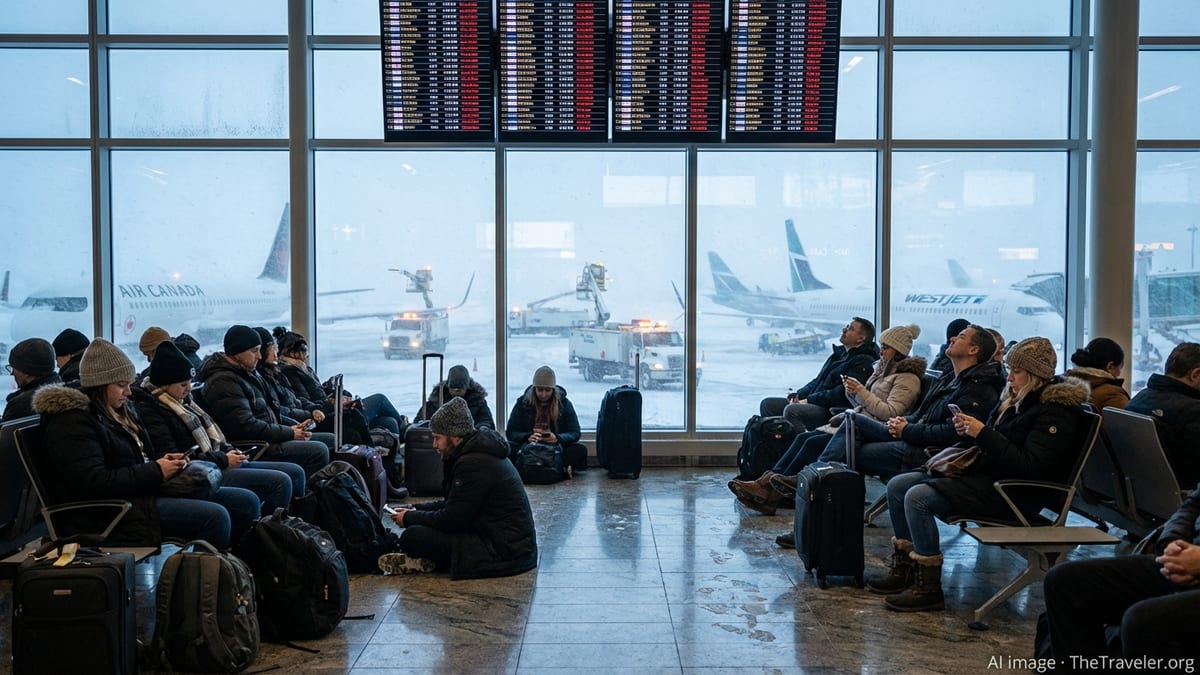
Whiteout Conditions Snarl Operations at Calgary International
Calgary International Airport struggled to keep runways and taxiways open as heavy snow, gusty winds and dropping temperatures pushed ground crews and airlines to the limit. De icing operations slowed departures to a crawl while low visibility forced incoming aircraft into extended holding patterns or diversions, triggering a cascade of cancellations and rolling delays across the day’s schedule.
Flight tracking data showed 82 cancellations and 88 delays linked to Calgary alone, a sharp spike that quickly rippled through domestic and transborder networks. The hardest hit flights were short haul services connecting Calgary with other Western Canadian cities, but disruptions soon spread to longer haul services to Eastern Canada and the United States.
Inside the terminal, departure boards flickered constantly between “Delayed” and “Cancelled” notices as airlines pulled flights from the schedule in waves. Security queues occasionally thinned as passengers received last minute notifications on their phones that their flights were no longer operating, prompting weary travelers to turn back toward airline counters in search of alternatives.
Airport officials said snow removal teams and de icing crews were working around the clock, but that safety considerations meant traffic had to be throttled. Ground handling, baggage and catering operations were also slowed by the bitter wind chill and snow packed ramp areas, adding further strain to an already stressed operation.
Air Canada, WestJet, Jazz and Porter Among Worst Hit Carriers
Canada’s largest airlines bore the brunt of the storm related fallout, with Air Canada and WestJet cancelling and delaying dozens of departures into and out of Calgary. Their regional affiliates and competitors, including Jazz and Porter, also saw significant disruption as tightly timed banked schedules unraveled.
For Air Canada, Calgary serves as a key Western hub feeding domestic and international routes via Vancouver and Toronto. The loss of multiple Calgary rotations in a single day meant missed onward connections across the country and into the United States, particularly for passengers bound for major American hubs such as Chicago and Atlanta.
WestJet, headquartered in Calgary and with a large portion of its fleet based there, faced particular operational challenges. Aircraft and crew rotations carefully planned to cycle through Calgary across the day were suddenly out of position, forcing the airline to proactively cancel flights in other cities to prevent further knock on disruptions late into the night and into tomorrow’s schedule.
Regional operators Jazz and Porter, which rely heavily on quick turns and frequent short haul sectors, struggled as de icing, runway closures and air traffic control restrictions stretched turn times well beyond normal limits. Even when aircraft were ready to depart, crew duty time limits meant that some flights had to be cancelled outright rather than risk operating beyond regulated working hours.
Nationwide and Cross Border Ripple Effects
Although Calgary was the epicenter of the weather system, the impact extended far beyond Alberta. Major Canadian hubs including Vancouver and Toronto reported growing numbers of delayed and cancelled flights as Calgary bound and Calgary originated aircraft failed to arrive on time. Passengers connecting through these hubs faced missed onward services and long waits for rebooking.
In Vancouver, airlines were forced to consolidate some Western Canada flights as aircraft scheduled to operate short hops to and from Calgary remained grounded. This created crowding at gates and customer service desks as travelers tried to secure seats on the reduced number of operating services. Some passengers opted to abandon air travel altogether and instead turned to long distance buses or rental cars where conditions allowed.
Toronto, already busy with winter season traffic, saw its departure boards peppered with delays on routes tied to Calgary operated by Air Canada, WestJet and their partners. While Toronto itself was not under the same severe weather at mid day, air traffic control flow restrictions imposed to manage Calgary’s constrained arrival and departure rates meant flights left Ontario later than scheduled, compressing already tight connection windows for cross country travelers.
Transborder routes also felt the strain. Services linking Calgary with U.S. hubs such as Chicago and Atlanta faced cancellations and multi hour delays, affecting not only Canadian travelers but also international passengers using those American cities as onward gateways to Latin America and Europe. Some U.S. bound passengers were rebooked via alternative routings through Vancouver or Toronto, further crowding those hubs and adding complexity to baggage handling and customs processing.
Travelers Face Long Lines, Thin Answers and Limited Options
For passengers caught in the disruption, the day quickly turned into an endurance test. Long lines formed at airline service counters as cancellation tallies mounted and travelers sought new itineraries, hotel vouchers or refunds. Many reported waiting more than an hour simply to speak with an agent, with some turned away and asked to use digital channels due to overwhelming in person demand.
Families traveling with young children clustered on the floor near power outlets, trying to keep devices charged as they waited for updates that often pushed departure times back in 30 or 60 minute increments. For some, the prospect of multiple missed connections and overnight delays meant vacations were effectively lost before they began, while business travelers scrambled to reschedule critical meetings or switch to virtual options.
Airlines urged customers to use mobile apps and websites to track flight status, change bookings and request refunds where eligible. However, high traffic volumes slowed some digital platforms, and travelers without reliable internet access or familiarity with self service tools found themselves at a disadvantage compared with frequent flyers more accustomed to navigating irregular operations.
Hotels near the airport began filling by late afternoon as airlines issued accommodation vouchers for passengers whose flights would not depart until the following day. Others, particularly those traveling on lower cost fares or separate tickets, reported being told that hotel costs would be at their own expense, adding financial strain to an already stressful experience.
Operational Challenges Behind the Numbers
Behind the departure board statistics lay a complex web of operational constraints that make winter storms particularly disruptive to modern air travel. Even when runways remain technically open, airlines must slow their schedules to allow extra time for de icing, taxiing through snow and ensuring safe separation between aircraft in reduced visibility, which reduces the total number of flights that can operate in a given hour.
In Calgary, periods of heavy snowfall triggered runway clearing operations during which take offs and landings were temporarily halted while snowploughs and sweepers worked in convoy. Each closure, though relatively short, created a backlog of aircraft waiting to depart or arrive, which then had to be sequenced carefully to avoid overloading de icing pads and gate space.
Crew scheduling presented another bottleneck. Pilots and flight attendants are subject to strict duty time limits designed to prevent fatigue. When delays stretch into hours, crews designated for a particular flight can “time out,” forcing cancellations even if passengers and aircraft are ready to go. Reassigning stand by crews in the midst of a fast moving storm is challenging, particularly when the weather affects multiple cities at once.
Maintenance and positioning of aircraft also became more complicated. Planes that ended the day in the wrong city compared with their planned overnight location meant further knock on changes to tomorrow’s timetable. Airlines weighed whether to operate near empty “repositioning” flights to rebuild their networks quickly or accept a slower recovery in exchange for lower operating costs, decisions that directly affect how soon normal service can resume.
Guidance and Rights for Stranded Passengers
As the disruption dragged on, consumer advocates reminded passengers that Canadian air passenger protection regulations set out specific obligations for airlines, although weather related events are generally categorized as outside a carrier’s control. In those cases, compensation for inconvenience is limited, but airlines must still provide rebooking or a refund when a flight is cancelled and a traveler chooses not to travel.
Travel experts urged passengers to document all expenses and communications, keep boarding passes and receipts, and take screenshots of flight status messages. While weather may exempt airlines from paying monetary compensation in many cases, clear records can be useful if disputes arise over whether a disruption was solely due to weather or compounded by operational issues.
For those still seeking a way out of Calgary or onward to final destinations, specialists recommended checking availability not only on the original airline but also on competing carriers, even if it meant using separate tickets. Passengers with flexible travel plans were advised to consider routing via less congested hubs or delaying their trips by a day or two until the worst of the storm related backlog clears.
Travelers booked through tour operators or corporate travel agencies were encouraged to lean on those intermediaries for support. Agents often have access to dedicated airline help lines and reservation tools that can secure alternative flights more quickly than individual customers waiting in public queues or on hold.
Airlines Activate Recovery Plans as Storm System Moves East
By late afternoon, meteorologists reported that the most intense band of snow over Calgary was beginning to shift, though intermittent flurries and biting winds were expected to persist into the evening. Airlines signaled that large scale cancellations would continue through the remainder of the day to allow operations to stabilize before attempting a full schedule the following morning.
Recovery plans included operating additional flights on key routes once conditions improved, upgauging to larger aircraft where possible to accommodate backlogged passengers, and extending staffing at customer service centers to handle rebooking requests. Some carriers indicated they would temporarily relax certain change fee rules and fare differences for affected customers in an effort to ease the rebooking process.
Airport authorities cautioned, however, that clearing the backlog would likely take at least another day and potentially longer if the weather system continued to affect other Canadian hubs or U.S. partner airports. Travelers with non essential trips were urged to consider postponing travel, while those with critical journeys were advised to build in substantial buffer time for connections.
For the hundreds of passengers who had already spent much of the day in limbo, the promise of eventual recovery was cold comfort. Many faced the prospect of sleeping in airport chairs or nearby hotels before finally boarding flights that, just a day earlier, had seemed routine. The storm once again underscored how vulnerable tightly wound global air networks remain to sudden bursts of severe winter weather, particularly at key hubs like Calgary that connect travelers across Canada and beyond.