

More news on this day
Hundreds of travelers were left stranded across Canada on February 18, 2026, as a powerful winter storm sweeping the Prairies forced WestJet, Air Canada and other carriers to suspend 22 flights and trigger dozens more delays, with Calgary International Airport among the hardest hit hubs.
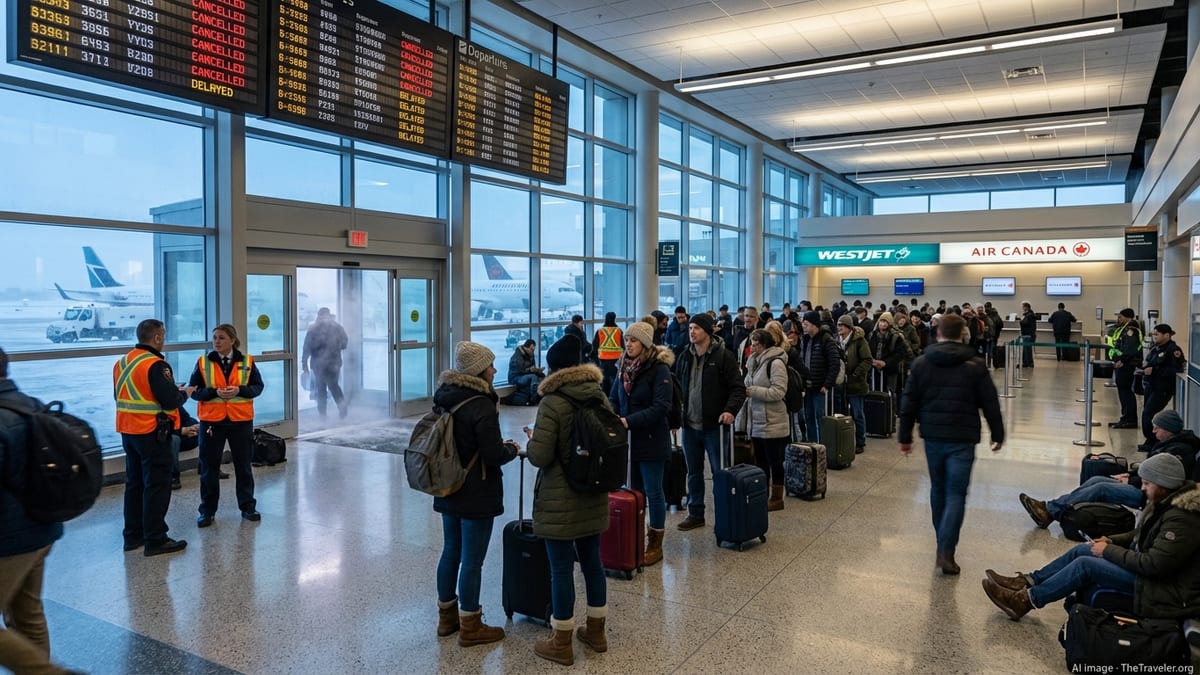
Storm Disrupts Operations at Calgary International Airport
Harsh winter weather closing in on Alberta early Tuesday quickly translated into severe disruptions at Calgary International Airport, where airlines struggled to keep tightly scheduled operations running. According to airport and aviation data services, at least 22 flights were cancelled and more than 70 delayed at Calgary alone, as temperatures plunged, winds picked up and visibility periodically deteriorated on February 18.
WestJet and its regional affiliate WestJet Encore bore the brunt of the cancellations, reflecting their dominant presence at the Calgary hub. The two brands together accounted for the vast majority of scrubbed departures and arrivals, while Air Canada and its regional partners also reported a smaller but still disruptive number of cancellations and late operations into and out of the city.
Airport delay statistics showed roughly one in three departures experiencing significant hold ups, with average delays stretching close to an hour for some outbound services. While a number of flights still managed to depart on time, the accumulated disruption across the morning and early afternoon created a backlog of passengers in departure halls and at check in counters, where lines snaked well beyond normal weekday volumes.
Calgary’s frigid conditions, with temperatures near minus 26 degrees Celsius reported in the morning and biting winds out of the north, made ramp operations and aircraft de icing particularly challenging. Ground crews rotated in shorter shifts as they battled both the cold and a constant flow of aircraft needing attention before takeoff.
WestJet and Air Canada Among Carriers Hit Hardest
Network wide, Canadian carriers spent much of the day revising schedules and issuing travel advisories as the storm’s impact became clear. WestJet, which uses Calgary as its primary hub, reported dozens of cancellations and delays across its domestic network, particularly on short haul links funneling traffic into Alberta from British Columbia, Saskatchewan and Manitoba.
Several regional rotations that normally connect smaller centres to Calgary were either consolidated or cancelled outright, leaving passengers in communities such as Regina, Saskatoon, Kelowna and Abbotsford facing last minute itinerary changes. Flight tracking data showed multiple WestJet services from these cities to Calgary as cancelled or heavily delayed over the February 17 to 18 period, a reflection of the weather system’s broader footprint across the Prairies and interior British Columbia.
Air Canada, which maintains a significant operation at Calgary in addition to its main Toronto and Montreal hubs, also reported cancellations and notable delays on eastbound services. Flights to Toronto and Montreal were singled out in airport updates as among those affected, forcing many travelers to rebook missed onward connections to Atlantic Canada, Europe and the United States.
Other airlines operating into Calgary, including major U.S. carriers and Canadian competitors such as Porter Airlines, saw a smaller number of disrupted services but nonetheless contributed to a departure board dominated by yellow and red status updates. The combined effect across carriers amplified the number of passengers stuck in terminals or seeking alternative travel dates.
Passengers Face Long Lines, Scarce Seats and Frayed Nerves
For travelers on the ground, the statistics translated into a day of uncertainty, crowding and difficult choices. With aircraft and crew out of position and spare capacity limited, many passengers were told that same day rebooking options were scarce and that they might need to wait until later in the week to secure confirmed seats out of Calgary.
Families returning from school breaks, business travelers on tight schedules and international visitors all converged at customer service desks, where agents tried to juggle voluntary changes, involuntary rebookings and requests for hotel and meal vouchers. Social media posts from Calgary and other affected airports showed packed departure lounges and travelers stretched out across rows of seats as they waited for updates.
Some passengers arriving on delayed flights into Calgary discovered that their onward legs had already departed or been cancelled, forcing unplanned overnight stays. Hotels near the airport reported a spike in last minute bookings, while others filled quickly as airlines arranged accommodation for stranded customers.
In many cases, frustrated travelers cited communication as a major pain point, saying that flight status notifications and gate announcements lagged fast moving operational decisions. Although airlines encouraged customers to use mobile apps and websites for the latest updates, overwhelmed systems and fluctuating conditions meant information sometimes arrived after passengers had already made their way to the airport.
Ripple Effects Across Canada’s Major Hubs
While Calgary was one of the epicentres of disruption, the winter system that hammered the Prairies also rippled through Canada’s broader aviation network. Toronto Pearson, Montreal Trudeau and Vancouver International all reported elevated levels of cancellations and delays, in part because of the knock on effects of aircraft and crews failing to arrive as scheduled from Calgary and other western cities.
Data compiled on February 18 indicated that hundreds of flights were either cancelled or delayed nationwide, affecting passengers at major hubs as well as mid sized airports including Ottawa, Halifax, Quebec City, Regina, St. John’s and Thunder Bay. Toronto Pearson alone accounted for a substantial share of the cancellations, underlining how quickly a storm focused on one region can cascade through tightly interlinked schedules.
On the West Coast, Vancouver saw a mix of weather related and flow control delays as airlines adjusted their operations to account for missing aircraft from Calgary and the interior. Travellers connecting through Vancouver to Asia Pacific and U.S. West Coast destinations faced longer than usual connection times and, in some cases, missed onward flights.
In Atlantic Canada and Quebec, where conditions were less severe on Tuesday, the disruptions were more a matter of timing than temperature. Flights arriving late from western Canada often landed after their outbound aircraft had already been reassigned or their time slots had lapsed, forcing airlines to consolidate lightly booked services or hold aircraft overnight in anticipation of a return to more normal operations.
Airlines Activate Weather Waivers and Flex Policies
As forecasts crystalized earlier in the week, airlines moved to activate travel waivers and flexible rebooking policies designed to reduce the number of people arriving at airports only to find their flights cancelled. WestJet issued an advisory covering Regina and Saskatoon for February 17 and 18, offering fee free changes for affected travelers and urging customers to alter their plans at least two hours before departure.
Similar waivers were available across much of the domestic network, particularly for flights to or from Calgary and other Prairie cities expected to see the worst of the storm. Under typical policies, passengers could move their travel to a different date within a limited window without incurring change fees, although fare differences still applied when shifting to more expensive flights.
Air Canada, meanwhile, highlighted its own suite of flexible options for customers facing severe weather, from free date changes to alternative routings through different hubs where capacity permitted. The carrier emphasized that safety remained the primary factor in deciding whether to operate, delay or cancel a given flight, and it encouraged travelers to verify their flight status before leaving for the airport.
Despite these efforts, many travelers who had not adjusted their plans before conditions deteriorated found themselves caught in the thick of the disruption. For them, the waivers primarily facilitated rebooking rather than averting airport trips altogether, underscoring the limits of advance planning when winter weather systems intensify rapidly.
Calgary’s Role as a Hub Magnifies the Impact
Calgary’s status as WestJet’s main hub and a major connecting point for domestic and international traffic meant that even a relatively contained weather event had outsized consequences. Many of the 22 cancelled flights at the airport were not simply point to point services but links in longer journeys that depended on precise connections.
Travelers heading from smaller western communities to destinations in the United States, Mexico or Europe frequently funnel through Calgary, relying on brief transfer windows to keep overall travel times manageable. When those feeder flights are cancelled or significantly delayed, whole itineraries can unravel, requiring complex rebookings across multiple airlines and alliances.
The disruption on February 18 also intersected with broader capacity adjustments already underway in Canada’s aviation market. WestJet has been cutting back some Canada United States services and trimming seasonal sun routes out of Calgary in response to shifting demand patterns and competitive pressures, leaving fewer backup options when weather strikes.
As a result, airlines had less spare aircraft and crew capacity to deploy as relief when the storm hit. That translated into longer waits for rebooked flights and fewer opportunities to reroute passengers through alternative hubs without significant detours or overnight stops.
Weather Volatility Highlights Ongoing Operational Challenges
The latest round of cancellations and delays came on the heels of other weather related disruptions earlier in February, notably a significant snow event in southern Ontario that snarled operations at Toronto Pearson. For both Air Canada and WestJet, the cumulative effect of repeated storms has been to stretch staff, equipment and recovery plans during what is already a demanding winter travel period.
Industry analysts note that Canadian carriers have also been grappling with lingering staffing constraints and aircraft availability issues following the pandemic era, factors that can slow the pace of recovery when operations are thrown off balance. While airlines have rebuilt much of their capacity, they often run leaner than before, with fewer spare aircraft on standby and more tightly optimized crew schedules.
At airports like Calgary, where winter weather is a regular feature rather than an exception, infrastructure such as de icing pads, snow clearing equipment and runway lighting is robust. Yet even well prepared facilities can see throughput fall sharply when extreme cold and heavy snowfall coincide during peak departure banks, as safety margins and regulatory requirements demand more time between movements.
The events of February 18 offered another reminder that, despite technological advances in forecasting and operations, severe weather still has the power to bring even sophisticated aviation networks to a near standstill for hours at a time, with knock on effects measured in days rather than minutes.
What Stranded Travelers Can Do Next
For passengers still grappling with the aftermath of the storm, airlines and travel experts recommend a combination of persistence and flexibility. The most immediate step is to confirm whether a flight is operating by checking official airline channels and signing up for disruption notifications, then using mobile apps or websites to rebook where possible rather than waiting in long airport lines.
Travelers whose flights have been cancelled are generally entitled to a choice between rebooking at the earliest available opportunity or receiving a refund for the unused portion of their ticket, though specific rights and timelines vary depending on the circumstances and applicable regulations. In cases where passengers are stranded overnight due to airline controlled issues, many carriers provide hotel and meal vouchers, though such support can be more limited when weather is deemed the primary cause.
Those with time sensitive plans are often advised to ask about alternative routings, including connections through different hubs or even nearby airports, accepting longer itineraries in exchange for getting closer to their destinations sooner. For some, especially those traveling domestically within western Canada, ground transport alternatives such as intercity buses or rental cars may offer a more predictable timeline once conditions on the highways improve.
In the longer term, frequent winter travelers through Calgary and other Canadian hubs may look to build more buffer time into their itineraries during peak storm season, avoiding the tightest possible connections and considering travel insurance products that cover weather related delays and cancellations. While such measures cannot eliminate the risk of disruption, they can soften the impact when the next storm inevitably arrives.