

More news on this day
A powerful winter storm that buried the US Northeast in deep snow is still wreaking havoc on air travel, with Delta, United, JetBlue and other carriers canceling hundreds of flights on Tuesday and disrupting key routes to Boston, Newark, Miami, New York LaGuardia, Fort Lauderdale, Dublin and other major destinations.
Airlines Slash Schedules Again After Historic Blizzard
US air travel remained severely disrupted on February 24 as airlines worked to recover from a historic blizzard that has hammered flight operations since the weekend. Data from flight-tracking services shows more than 2,000 flights within, into or out of the United States canceled on Tuesday morning, following more than 6,000 cancellations on Monday and thousands more on Sunday as the storm swept across the Northeast.
JetBlue, which is heavily exposed to Northeast hubs, has been among the hardest hit, canceling a substantial share of its schedule after temporarily grounding most of its operations at Boston Logan, New York’s LaGuardia and John F. Kennedy airports. Delta Air Lines, United Airlines and American Airlines have also cut significant numbers of flights, particularly at their East Coast bases, as they reposition aircraft and crews stranded by the storm.
In total, US airlines have now canceled more than 12,000 flights since Sunday, an extraordinary level of disruption even by winter storm standards. While Tuesday’s cancellation count is lower than Monday’s peak, airlines and airport officials are warning travelers that rolling impacts could persist for several days as operations slowly normalize and aircraft return to their normal rotations.
Carriers have issued broad travel waivers across affected regions, allowing customers to rebook without change fees on many itineraries. However, limited seat availability, especially on popular business and leisure routes, means many passengers are still facing multi-day delays and forced changes to their travel plans.
Key Hubs From Boston to Miami Under Strain
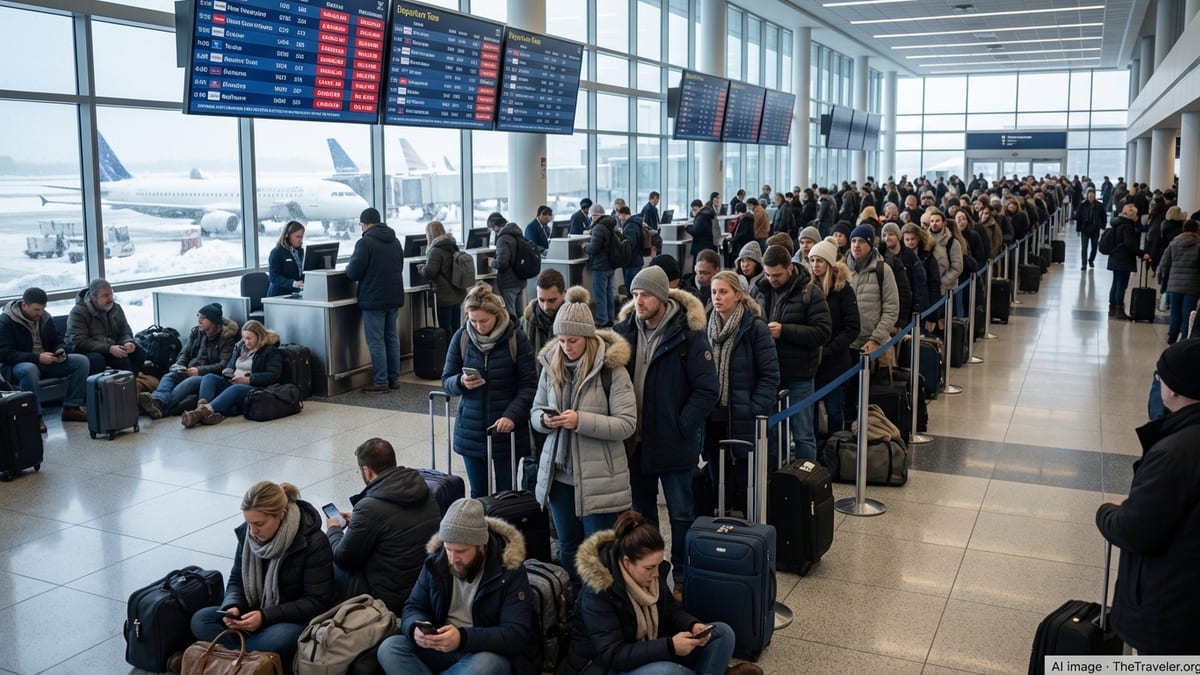
Boston Logan International Airport has been one of the epicenters of the current disruption, with roughly half of departures canceled or delayed at various points in the recovery. Images from the airport on Monday and early Tuesday showed long lines of stranded travelers, with departure boards filled with red “canceled” notices as snow continued to blanket runways, taxiways and aircraft.
New York’s LaGuardia and Newark Liberty International airports are also operating on sharply reduced schedules. Airlines concentrated cancellations on short-haul and regional services into these congested hubs, a strategy that helps maintain some long-haul connectivity but leaves many domestic travelers scrambling to find alternatives. Crews and aircraft that would normally rotate through Northeast hubs are out of place, compounding the effect of weather-related closures.
Farther south, Florida gateways including Miami and Fort Lauderdale are feeling secondary impacts, even though they escaped the worst of the snow. Flights to and from the Northeast make up a significant portion of traffic at these airports, and knock-on disruptions from Boston and the New York area have led to higher-than-usual cancellation and delay rates. Travelers attempting to connect through Florida to Latin America and the Caribbean are reporting missed connections and last-minute reroutings.
Other major hubs, including Washington Reagan National, Philadelphia and Orlando, have seen gradual improvement since Monday, but operations remain fragile. Short bursts of additional bad weather or fresh air traffic control constraints could trigger new waves of delays and cancellations as airlines continue to work through a large backlog of displaced passengers.
International Routes to Dublin and Beyond Disrupted
The ripple effects of the storm are extending well beyond US borders, with transatlantic services among those affected. Flights linking major East Coast gateways to Dublin and other European cities have been canceled or consolidated as operators prioritize limited aircraft and crew resources. With many widebody jets and long-haul crews out of position due to earlier disruptions, airlines are selectively trimming frequencies to rebuild network reliability.
Travelers scheduled to connect via Boston, Newark or New York to international destinations are especially vulnerable to abrupt itinerary changes. In some cases, passengers headed to Ireland and the United Kingdom have been rebooked onto later departures or rerouted through less affected hubs in the Midwest and South. For those with time-sensitive plans, such as business meetings or onward rail connections in Europe, the uncertainty is adding significant stress.
Airlines say they are working with partners across alliances to create additional options where possible, but the sheer volume of affected customers is limiting flexibility. Some carriers are encouraging travelers whose trips are not essential to postpone until later in the week, when conditions and schedules are expected to stabilize.
International airports on the receiving end of disrupted US routes are also adjusting. Ground handlers, customs teams and airport operators are contending with sudden surges and gaps in arrivals as aircraft arrive off-schedule or not at all, leading to uneven passenger flows through terminals.
What Today’s Disruptions Mean for Travelers
For travelers with flights booked over the next 48 hours, industry analysts say the single most important step is to assume plans may change at short notice. Even airports that are technically open are seeing last-minute cancellations as airlines reassess conditions, crew availability and aircraft positioning throughout the day. Early morning and late evening departures remain particularly vulnerable, given the tight turnaround windows required in winter conditions.
Airlines are encouraging passengers to use mobile apps and text alerts to track real-time changes rather than relying on printed boarding passes or airport display boards, which can lag behind schedule adjustments. Many carriers have also expanded self-service rebooking tools, allowing travelers on canceled flights to switch to alternative services or airports without waiting for an agent. However, in heavily affected markets such as Boston, New York and South Florida, remaining seats can be scarce on popular time slots.
Consumer advocates note that while US regulations do not require airlines to provide compensation for weather-related cancellations, passengers are still entitled to refunds if a flight is canceled and they choose not to travel. Travelers who accept credits or vouchers instead of cash should read the fine print carefully, including expiration dates and any restrictions on future use.
Hotel availability near major hubs is tightening as stranded travelers compete for rooms, particularly around Boston and the New York metropolitan area. Some airlines are offering hotel and meal vouchers on a case-by-case basis, especially when cancellations cascade into multi-day disruptions, but these are generally framed as goodwill gestures rather than formal obligations when weather is the root cause.
When Will US Air Travel Return to Normal?
Meteorologists expect the core of the powerful winter storm to move away from the Northeast later on Tuesday, with snowfall easing but strong winds lingering into the early hours in some coastal areas. That forecast should help airports gradually restore full runway capacity, but it does not mean an immediate return to normal for airlines or travelers.
Operational experts say it may take several days for carriers to fully reset their networks. Aircraft must be repositioned, pilots and cabin crews need to be brought back into legal duty windows after unscheduled layovers, and maintenance checks deferred during the storm must be completed. Until those pieces fall back into place, schedules are likely to remain thinner and more fragile than usual, especially at the hardest-hit hubs.
Delta, United, JetBlue and other major airlines have indicated that they expect significant improvement by late in the week if weather conditions hold. In the meantime, they are trimming some lower-demand frequencies and adjusting aircraft types to rebuild resilience, even at the expense of short-term capacity. Industry analysts say this strategy, while frustrating for some passengers in the moment, can prevent even more severe knock-on problems if another bout of bad weather arrives.
The current disruption underscores how dependent US air travel remains on a handful of congested Northeast hubs, where winter storms can quickly paralyze national and international networks. For now, travelers with flexibility are being advised to avoid tight connections, build in extra time, and consider alternative routings through less affected airports while the system recovers.