

More news on this day
Air passengers across Western Europe faced major disruption on Sunday as a fast-moving winter storm and knock-on operational issues triggered extensive delays and cancellations for carriers including Ryanair, KLM and British Airways, with at least 272 flights reportedly delayed and 32 cancelled across key hubs in France, the Netherlands, Germany and the United Kingdom, affecting routes in and out of London, Munich and other major cities.
Get the latest news straight to your inbox!
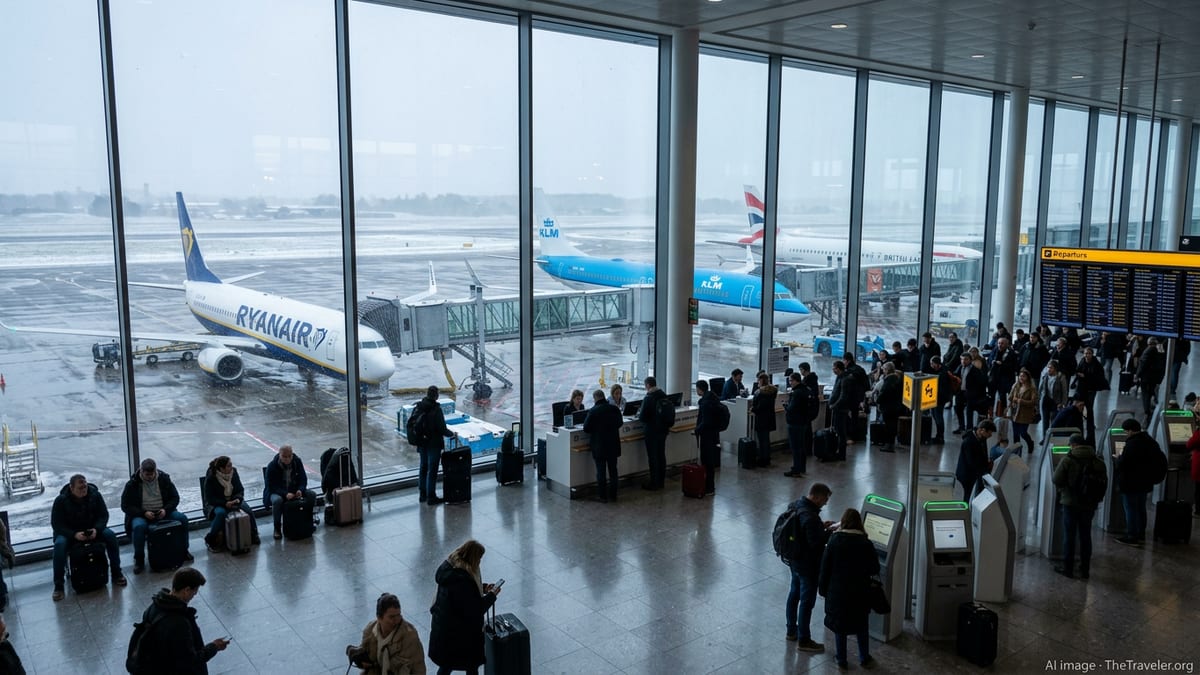
Storm Conditions Paralyse Key European Hubs
Publicly available weather and aviation data indicate that a deep low-pressure system sweeping across Western Europe has brought heavy snow, high winds and poor visibility to parts of France, the Netherlands and Germany, creating difficult operating conditions at some of the region’s busiest airports. Airports serving Paris, Amsterdam and major German cities have reported waves of disruption as ground operations slowed and runway clearances struggled to keep pace with the snowfall.
Reports from aviation trackers and European network monitoring bodies show that the storm has led to a spike in air traffic flow management restrictions, particularly in French and German airspace, where pre-existing capacity constraints have been compounded by the weather. This has resulted in holding patterns, extended taxi times and an accumulation of late-running aircraft, feeding into a broader pattern of network-wide delays.
In the Netherlands, Amsterdam Schiphol has once again been highlighted as a hotspot for disruption as winter weather interacts with already stretched airport resources. Earlier in the season, similar conditions at Schiphol led to hundreds of cancellations and delays, and the current storm is reviving concerns about the vulnerability of major European hubs to recurring seasonal shocks.
Germany has also seen significant disruption, with Munich and other airports reporting reduced arrival and departure rates as snow and ice control operations temporarily limit runway capacity. The resulting backlog has affected both intra-European services and long-haul connections, leaving transfer passengers particularly exposed to missed onward flights and extended layovers.
Ryanair, KLM and British Airways Among Most Affected Carriers
Low-cost and full-service airlines alike have been caught in the latest wave of disruption, but Ryanair, KLM and British Airways feature prominently among the affected carriers due to the scale of their European networks and their reliance on weather-exposed hubs. Ryanair’s extensive point-to-point operations across secondary and primary airports in France and Germany mean that localized weather problems can quickly cascade into a large number of delayed sectors.
KLM, heavily dependent on Amsterdam Schiphol as its primary hub, has faced repeated operational challenges during recent winter storms, with earlier episodes producing sustained cancellations and knock-on disruptions lasting several days. Current reports suggest that the airline has once again been forced to thin out its schedule and consolidate services as the storm passes over the Netherlands, in order to manage crew positioning and aircraft rotations.
British Airways, operating from London Heathrow and London City among other airports, has also encountered renewed disruption. Online passenger accounts and recent coverage of UK operations describe a pattern of short-notice cancellations and substantial delays when winter weather coincides with busy travel periods, and similar conditions appear to be unfolding as the latest storm affects approaches into London and the wider South East of England.
The mix of low-cost and legacy carriers caught up in this event underscores the extent to which Europe’s aviation system functions as a tightly interlinked network. When a storm constrains one or two major hubs, aircraft and crews are displaced across multiple countries, leaving airlines with limited flexibility to recover schedules quickly.
London, Munich and Other Gateways See Passenger Backlogs
London and Munich have emerged as two of the most visible flashpoints in the latest disruption, although smaller airports across France, Germany and the Benelux region have also seen significant impacts. In London, high winds aloft and intermittent ground holds have slowed arrival and departure flows, with Heathrow and other airports using schedule reductions and tactical spacing between flights to maintain safety margins.
Passenger reports from recent disruption episodes suggest that once a storm hits, terminal congestion and limited rebooking options rapidly compound the initial operational impact. Travellers arriving to find their flights delayed or cancelled often face long queues at service desks, while alternative routes via nearby hubs such as Paris, Amsterdam or Frankfurt can themselves be under strain from the same weather system.
In Munich, snow and low temperatures have hampered ground handling and aircraft de-icing, leading to a series of late departures and missed connection windows. Germany’s role as a central transit corridor for flights between Southern, Central and Northern Europe means that even relatively short local delays can have outsized effects on itineraries that involve multiple legs.
Regional airports in France and the Netherlands have not been spared, with available data and local coverage indicating a familiar pattern: early-morning cancellations at smaller fields to free up aircraft and crews for later trunk routes, followed by rolling delays as airlines attempt to rebuild their operations once the worst of the weather has passed.
Knock-on Effects Expected to Linger for Several Days
While the most intense weather is forecast to move away from Western Europe within a relatively short period, operational experts and previous disruption patterns suggest that the knock-on effects for airlines and passengers may persist for several days. Aircraft and crew will often be left in the wrong locations after mass delays and cancellations, requiring careful rescheduling and, in some cases, further tactical cancellations as carriers work to restore normal rotations.
European network monitoring updates have recently highlighted that France and Germany already account for a substantial share of en-route and airport-related delays due to a mixture of capacity constraints, staffing issues and infrastructure works. The addition of a major winter storm to this backdrop increases the risk that recovery will be gradual rather than immediate, particularly on busy cross-border routes.
Travellers with itineraries involving London, Munich, Amsterdam, Paris or other major hubs over the coming days are likely to feel the aftershocks even if local weather appears calm at the time of travel. Late-arriving aircraft, displaced crews and residual slot restrictions can all manifest as fresh delays or schedule changes long after the original weather event has passed.
Recent experience with significant European windstorms has shown that the most severe disruption often occurs on the day of impact, but fragmented recovery, uneven staffing and high seasonal demand can keep punctuality below normal levels for much of the following week. The current disruption appears to be following a similar pattern, with airlines cautioning that schedules remain highly subject to change.
Passenger Rights and Practical Advice for Affected Travellers
The scale of the disruption has renewed attention on passenger protections under European and UK air travel regulations. Under long-established regimes that govern compensation and assistance for delays and cancellations, travellers departing from airports in the European Union and the United Kingdom, or flying with EU or UK carriers, are entitled to specific forms of care and, in some circumstances, financial compensation.
However, publicly available legal guidance makes clear that severe weather and certain air traffic control restrictions are generally classified as extraordinary circumstances, which can limit eligibility for compensation even when the disruption is extensive. In such cases, airlines are still expected to provide basic assistance such as meals, refreshments and, where necessary, accommodation, but they may not be required to pay additional cash compensation for delays or cancellations directly attributed to the storm.
Consumer advocates typically recommend that passengers first verify their flight status through official airline channels or airport websites before leaving for the airport, particularly during active weather events. If a cancellation or significant delay occurs, keeping documentation of expenses and communications can be important for subsequent claims under airline policies or travel insurance, especially in situations where disruption continues after the initial weather event has passed.
With Western Europe once again experiencing storm-driven aviation chaos, travellers are being reminded that winter remains a volatile period for air travel in the region and that building additional flexibility into itineraries, such as longer connection times and contingency plans for overland alternatives, can help manage the risks associated with sudden network-wide disruptions.