

More news on this day
A powerful late February blizzard has triggered a severe winter travel meltdown at Newark Liberty International Airport, where 103 flights were delayed and 476 cancelled on Tuesday, cascading disruptions across major United States hubs from New York City and Philadelphia to Boston and beyond in the wider Northeast.
Newark Becomes Epicenter of Ongoing Flight Chaos
By late morning on Tuesday, February 24, Newark Liberty International Airport had emerged as one of the hardest-hit facilities in the wake of the historic Northeast blizzard. Flight tracking data showed 476 cancellations and just over 100 delays clustered around the airport, which serves as a critical hub for both domestic and international traffic in the New York metropolitan area.
The Port Authority of New York and New Jersey, which operates Newark Liberty, warned travelers to check directly with airlines before heading to the airport, noting that crews were still battling deep snow, high winds and limited visibility following Monday’s near shutdown of regional air travel. AirTrain service at Newark was suspended for hours, with shuttle buses deployed between terminals and rail stations, adding another layer of disruption for passengers attempting to rebook or retrieve luggage.
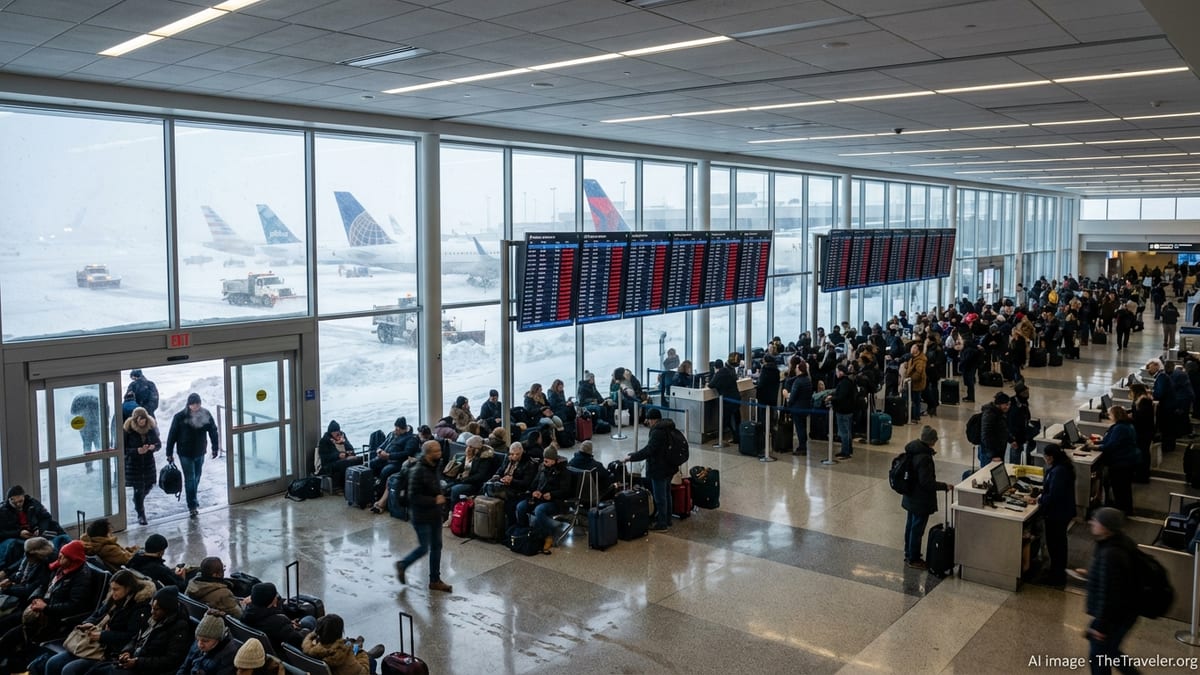
On the airfield, airlines leaned heavily on preemptive cancellations in a bid to avoid the kind of rolling delays that can tie up aircraft and crews for days. While departure boards displayed pockets of activity, the vast majority of flights scheduled for the morning and early afternoon remained scrubbed, leaving concourses filled with stranded travelers camped out on floors, clustered around power outlets and waiting on overtaxed customer-service desks.
Ground operations staff reported slow going despite round-the-clock snow removal, with plows, de-icing trucks and safety teams working in tight coordination to gradually reopen runways and taxiways. With airlines already planning reduced schedules into midweek, aviation officials cautioned that the system-wide recovery would lag well behind the storm’s eventual departure.
United, Delta, American and JetBlue Hit Hard Across the Northeast
The storm’s impact rippled far beyond Newark, battering airline networks throughout the Northeast corridor. United Airlines, which operates one of its largest hubs at Newark, logged nearly 200 cancellations there alone on Tuesday, a significant share of its national schedule. Regional partner Republic and other contract carriers operating United-branded flights also recorded high cancellation percentages, amplifying the disruption for connecting passengers.
Delta Air Lines, American Airlines and JetBlue Airways each faced their own operational crises as Boston Logan International, New York’s John F. Kennedy and LaGuardia airports, and Philadelphia International suffered mass groundings. Data from Monday showed cancellation rates of more than 90 percent at several of these airports at the height of the blizzard, with many aircraft and crews still out of position as Tuesday’s reduced schedules began.
JetBlue, with a heavy concentration of flights in Boston and New York, has been particularly exposed. The carrier has already canceled hundreds of flights since the weekend and warned customers of elevated disruption through at least Wednesday, while touting flexible rebooking options and fee waivers for affected travelers. American and Delta have implemented similar policies, allowing passengers whose flights are canceled or significantly delayed to change plans without penalties within defined travel windows.
Airline operations planners emphasized that the storm’s timing, arriving at the tail end of a busy winter travel period and hitting multiple major hubs simultaneously, created a cascading effect. With crews hitting duty-time limits and aircraft scattered across closed or constrained airports, restoring normal connectivity from the Northeast to the Midwest, South and West Coast is expected to take several days.
New York City, Philadelphia and Boston Airports Struggle to Reopen
Newark’s woes are mirrored across the broader Northeast aviation network. In New York City, JFK and LaGuardia continued to post hundreds of cancellations and dozens of delays on Tuesday, even as some runways gradually reopened. Boston Logan and Philadelphia International, both slammed by heavy snow and strong winds on Monday, remained in recovery mode with constrained schedules and long lines at security and check-in for the limited flights still operating.
Local and state officials in New York, New Jersey, Massachusetts and Pennsylvania have all declared states of emergency at various points since Sunday, restricting nonessential road travel and urging residents to stay home while cleanup crews dig out streets, rail lines and airport access roads. Airlines have coordinated closely with airport authorities to phase in departures and arrivals carefully, trying to balance the urgent demand from stranded passengers with safety constraints on de-icing, runway friction and visibility.
Inside terminals, airport staff have scrambled to manage crowding, with rows of cots and makeshift rest areas appearing in some gate areas. Food and beverage outlets have struggled to keep up with demand as passengers endure overnight waits brought on by missed connections and limited hotel availability in surrounding cities. Public transit limitations, including temporary suspensions and delays on regional rail and bus networks, have compounded the difficulties of reaching or leaving affected airports.
Officials at several facilities stressed that even once runways are fully cleared, travelers should anticipate a period of persistent irregular operations. With aircraft and crews needing to be repositioned, some destinations may see only partial service restored through the middle of the week, especially on secondary routes that rely on regional jets and commuter carriers.
System-Wide Shock to U.S. Air Travel
Nationally, the blizzard has dealt a significant blow to an already stretched U.S. air travel system. Across Sunday and Monday, tens of thousands of flights were either canceled or delayed as the storm swept from the Mid-Atlantic into New England, affecting everything from transcontinental routes to short-haul business shuttles. By Tuesday, thousands more flights had already been scrubbed in advance, reflecting airlines’ shift from reactive to preventative scheduling in the face of prolonged bad weather.
Major carriers have noted that this storm ranks among the most disruptive weather events in recent years, not only in terms of raw cancellation numbers but also in geographic concentration. With major hubs in New York, Boston and Philadelphia all hit simultaneously, backup options that airlines typically rely on when one city is impacted have been limited, leaving few alternative routings for passengers.
The meltdown has also spilled into other modes of transport. Amtrak has canceled or curtailed numerous services along the busy Northeast Corridor between Washington, New York and Boston, citing snow-clogged tracks, downed trees and power issues. Intercity bus operators have reported curtailed schedules and slower travel times, while highway authorities have repeatedly warned of treacherous driving conditions on key interstates.
Travel analysts expect the financial hit to airlines and airports to be significant, though partially offset by the industry’s ability to consolidate passengers onto later flights and maintain yields on remaining capacity. For now, the focus remains firmly on safety and operational recovery, with carriers careful to emphasize that they will not ramp up flying beyond what staff and equipment can handle in still-challenging winter conditions.
What Stranded Travelers Should Expect in the Coming Days
For passengers caught in the middle of the disruption, the path forward is likely to remain bumpy. Airlines are urging travelers to rely on mobile apps and text alerts rather than airport departure boards alone, since schedules continue to change in real time as runways reopen, aircraft reposition and crew availability fluctuates. Many carriers recommend avoiding airport visits until a new flight is confirmed, to minimize crowding and reduce stress on limited customer-service resources.
Those whose flights have been canceled are generally being offered either no-fee rebooking onto later dates or refunds, depending on the airline and fare type. However, seats on remaining departures from heavily affected airports such as Newark, JFK, LaGuardia, Boston and Philadelphia are in high demand, and some travelers are being rebooked days out or rerouted through secondary hubs including Chicago, Atlanta, Charlotte and Dallas.
Travel experts advise flexibility on routes and times, suggesting that passengers willing to accept early-morning or late-night departures and connections through less affected airports may have better luck finding seats. They also encourage documenting expenses related to hotels, meals and ground transport, as policies on reimbursements and vouchers vary between carriers and may be updated as the scale of the disruption becomes clearer.
With winter weather still in the forecast for parts of the Northeast and airlines warning of rolling schedule adjustments, Newark Liberty International Airport and its counterparts in New York City, Philadelphia and Boston are bracing for several more days of challenging operations. For now, the overwhelming message from aviation officials is one of caution, patience and close communication between travelers and airlines as the region slowly digs out from a paralyzing storm.