

More news on this day
Visitors planning bucket-list sunrise or stargazing trips to the summits of Mauna Kea and Mauna Loa are being urged to stay away this week, as a powerful Kona low brings a winter storm threat, whiteout conditions and dangerous winds to Hawaii’s highest volcanoes.
Get the latest news straight to your inbox!
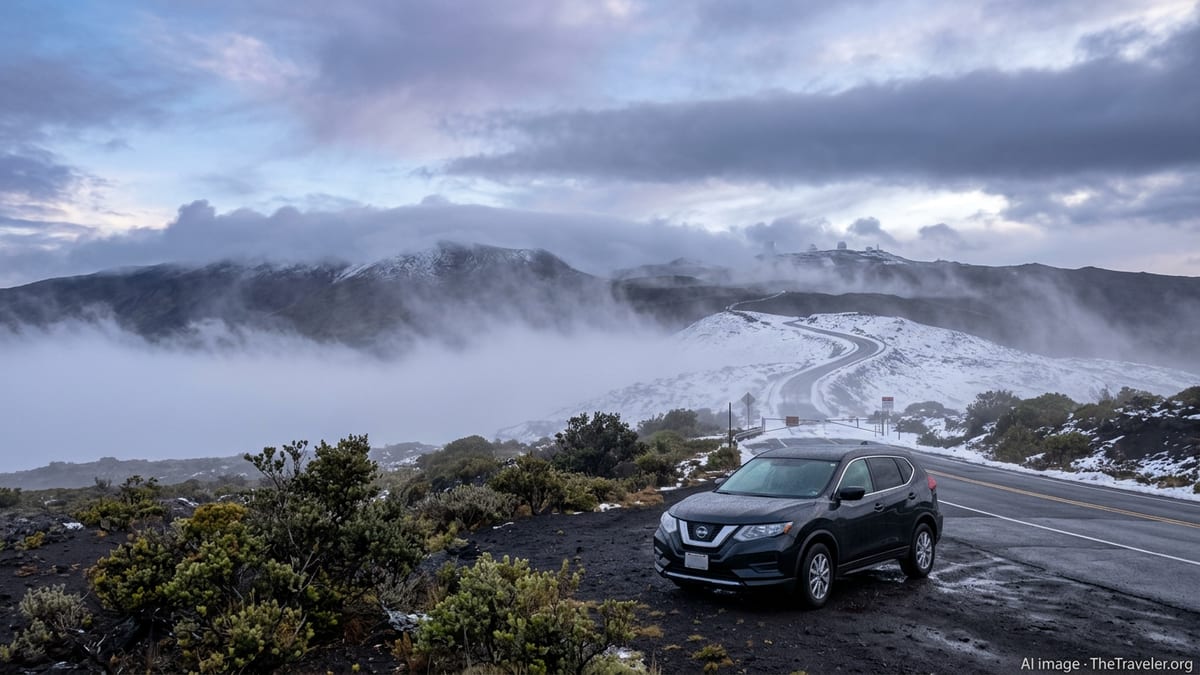
Winter Storm Watch Issued for Hawaii’s Highest Peaks
The National Weather Service has placed the summits of Mauna Kea and Mauna Loa under a winter storm watch as a Kona low deepens northwest of the islands and funnels moisture and strong winds across the state. Forecasters warn that heavy snow, freezing rain, severe icing and gusts strong enough to topple high-profile vehicles are possible on the upper slopes over the coming days.
At elevations above 11,000 feet, rapidly deteriorating conditions are expected, with periods of near-zero visibility in blowing snow and dense cloud, along with wind chills well below freezing. While snow atop Hawaii’s tallest volcanoes is not unusual in winter, this storm system is forecast to be particularly potent, coinciding with statewide high wind alerts and widespread heavy rain at lower elevations.
Officials stress that the winter storm watch is a serious safety warning, not a scenic snow advisory. Travelers are being asked to treat the summits as closed to casual visitation until conditions improve and local agencies announce that access is safe again.
Road Closures, Access Limits and What Travelers Can Expect
Hawaii County and state agencies are preparing for full or partial closures of summit roads serving Mauna Kea and Mauna Loa, including the steep, unpaved sections that require four-wheel drive even in good weather. During previous winter weather events, authorities have blocked public access at lower elevation checkpoints, and officials indicate similar measures are likely as this storm intensifies.
Drivers should be prepared for sudden shutdowns of access roads due to black ice, drifting snow and rockfall, as well as potential closures of key cross-island routes if conditions worsen. Plows and road crews have limited capability at extreme elevation, and high winds can quickly undo clearing efforts, leaving stretches of road impassable or extremely hazardous.
Summit facilities, including astronomy centers and support buildings, may operate on restricted staffing or close entirely during the height of the storm. Commercial tour operators, who are required to follow county and state safety directives, are already canceling or rescheduling summit excursions for at least several days, and visitors holding reservations are being advised to monitor messages from their providers closely.
Even if skies briefly clear between bands of precipitation, authorities caution that road conditions can remain treacherous long after snow stops falling. Travelers are urged not to attempt to drive around barricades or follow tracks left by four-wheel drive vehicles, as emergency responders may be unable to reach stranded motorists quickly in whiteout conditions.
Why Authorities Urge Visitors to Postpone Summit Trips
Local emergency managers and the Hawaii Tourism Authority are strongly recommending that visitors postpone any summit plans until the winter storm watch is lifted and weather conditions stabilize. The combination of high winds, freezing temperatures and rapidly changing visibility at altitude poses risks even for experienced drivers, and far exceeds what most vacationers are prepared to handle.
Health and altitude risks are also top of mind. Sudden drops in temperature can lead to hypothermia for those dressed for a beach vacation rather than an alpine environment, while gusts can knock pedestrians off balance near steep drop-offs or rocky terrain. At more than 13,000 feet, the reduced oxygen levels on Mauna Kea and Mauna Loa make it harder for the body to cope with cold stress, increasing the risk of altitude sickness.
Rescue operations at these elevations are complex, resource-intensive and often delayed by the very conditions that trigger distress calls. During previous storms, authorities have reported stranded vehicles, minor collisions and medical incidents involving visitors unprepared for ice and snow. By postponing summit trips, travelers can help reduce the burden on emergency services already bracing for island-wide impacts from the Kona low, including flooding and landslides at lower elevations.
Officials emphasize that postponement is a short-term inconvenience that protects both visitors and residents. Once the storm passes and roads are inspected, access typically reopens, often revealing a striking snowcapped landscape that can be enjoyed more safely under clearer skies.
Safety Guidance for Visitors Already on Hawai‘i Island
For travelers currently on Hawai‘i Island, the key message is to stay flexible and prioritize safety over fixed itineraries. Visitors with rental cars are advised to avoid attempting any summit drive while the winter storm watch is in effect or while road restrictions remain in place, even if navigation apps appear to show routes as open.
Hawaii County Civil Defense advisories urge residents and visitors alike to monitor local radio, television and official social media channels for real-time updates on road closures, weather alerts and any changes to access rules. Hotel front desks and visitor information centers can also help interpret warnings and suggest alternative activities that are less impacted by the storm.
If you encounter heavy rain, ponding water or falling debris on mountain roads below the summit, authorities recommend turning around before conditions worsen. Travelers should keep fuel tanks topped up, carry water and warm clothing in the vehicle, and avoid driving at night in unfamiliar terrain while the Kona low remains in the region.
Those who have already booked sunset or stargazing tours should contact operators promptly to discuss rebooking or refunds. Many companies update their status daily in response to National Weather Service briefings and county guidance, and some may pivot to safer low-elevation experiences while summit access is restricted.
Alternative Plans While the Storm Impacts the Summits
While the winter storm watch temporarily places Hawaii’s iconic snowcapped summits off-limits, there are still many ways for visitors to experience the island’s landscapes and culture safely. Experts suggest focusing on lower-elevation activities that can be adjusted quickly in response to changing weather, such as exploring historic towns, visiting museums and cultural centers, or touring coffee farms and botanical gardens.
On clearer intervals between rain bands, coastal drives and short walks at sea level may still be possible, provided travelers respect any high surf or flood advisories. Volcano enthusiasts can often find safer vantage points at lower elevations within Hawaii Volcanoes National Park, subject to real-time alerts about closures, air quality and road conditions issued by park authorities.
Stargazing experiences can sometimes be relocated away from the highest summits to darker, more sheltered sites at mid-elevations, although visibility will depend on cloud cover as the Kona low evolves. Many local guides are adept at reading conditions and may offer last-minute changes that keep guests safe while still showcasing Hawaii Island’s famed night skies.
For now, officials and tourism leaders are united in their appeal: respect the winter storm watch, stay off the summits, and use this period to explore the many other facets of Hawai‘i Island until Mauna Kea and Mauna Loa are once again safe to visit.