

More news on this day
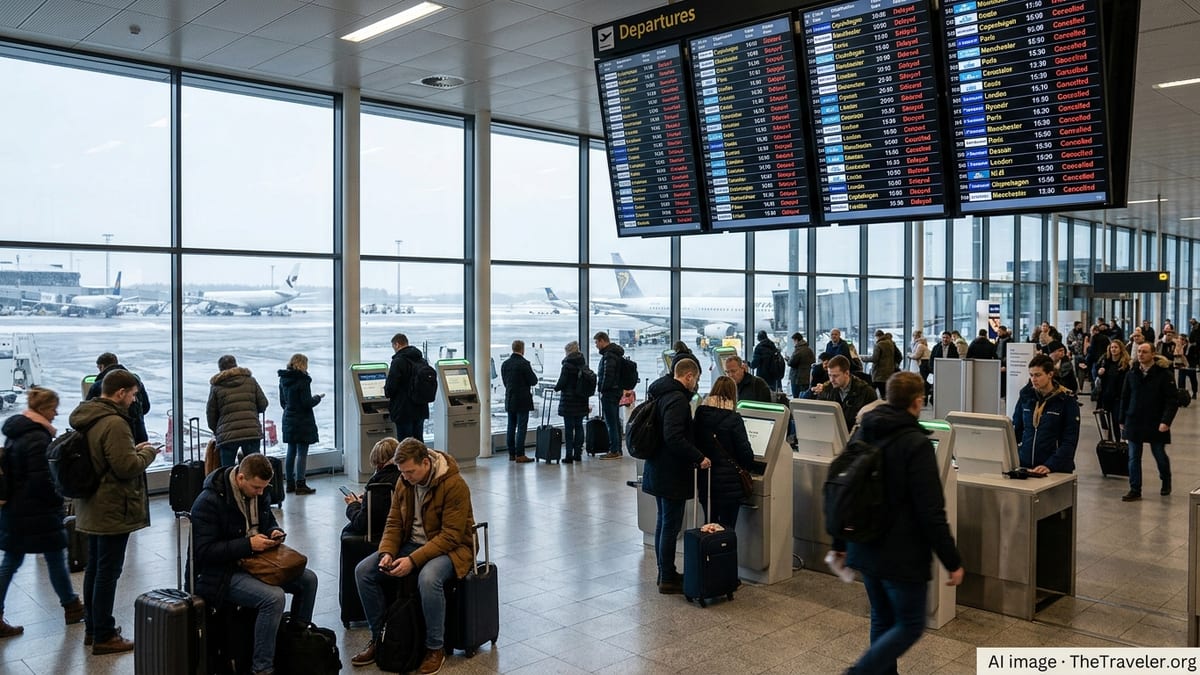
Air travellers across northern Europe are facing another day of disruption as winter weather and operational constraints delay an estimated 360 flights and force at least 20 cancellations, affecting services operated by Finnair, KLM, Ryanair and several other carriers at airports including Copenhagen and Manchester.
Get the latest news straight to your inbox!
Weather Systems Put Pressure On Northern European Hubs
Recent winter storms tracking across the North Sea and Baltic regions have created challenging conditions at several key European airports. Snow, shifting crosswinds and periods of low visibility have prompted tighter spacing between aircraft, temporary runway closures for de-icing and slower ground handling, all of which contribute to knock-on delays across airline networks. Publicly available aviation data and operational updates indicate that northern hub airports have been especially exposed, with schedules in Denmark, the United Kingdom and parts of France affected.
At Copenhagen Airport, one of Scandinavia’s busiest gateways, strong winds and intermittent snowfall have reduced runway capacity at peak times. Airlines have responded by thinning out schedules, consolidating passengers onto fewer departures and, in some cases, cancelling rotations entirely to avoid further congestion. Similar patterns have been reported at Manchester and other UK airports, where airlines have cited a combination of weather-related constraints and limited de-icing resources during early morning and late evening waves.
While many flights are still operating, the cumulative effect of minor delays has grown through the day. Industry data suggests that several hundred services across the region have departed late, with average delays extending beyond typical winter baselines. Travellers connecting through European hubs have been particularly exposed as missed connections ripple through already stretched networks.
In France, weather-linked restrictions at smaller regional airports and along key air traffic corridors have added further complexity. Adjusted flow rates over French airspace can slow traffic bound for northern Europe, leading to additional holding and further schedule slippage for airlines attempting to maintain regular operations.
Finnair, KLM And Ryanair Among Airlines Adjusting Schedules
Finnair, KLM and Ryanair feature prominently among the carriers adapting their operations to the latest bout of disruption. Publicly available tracking data shows that these airlines, which maintain dense short-haul networks across northern and western Europe, have all seen clusters of delayed departures and arrivals, alongside selected cancellations, as conditions deteriorated at key airports.
For Finnair, Copenhagen and other Scandinavian gateways play an important role as feeder points into the carrier’s Helsinki hub. When runways or taxiways at regional airports require extended clearance times, aircraft can arrive late into Helsinki, compressing turnaround windows and threatening onward connections. To stabilise rotations, Finnair has occasionally chosen to cancel individual flights and re-accommodate passengers on later services rather than risk extended rolling delays across multiple sectors.
KLM’s extensive network radiating from Amsterdam means that even modest constraints at outstations such as Manchester or Copenhagen can quickly accumulate. Reports from recent weeks describe passengers facing rebookings via alternate hubs when initial legs were cancelled or heavily delayed. Public discussion on consumer forums highlights growing frustration with long call centre queues and inconsistent app notifications during disruption, underscoring how quickly operational challenges can evolve into broader customer service concerns.
Ryanair, which typically operates tight turnarounds and high aircraft utilisation, has also been forced to adapt. Where crosswinds or runway conditions have restricted operations at secondary airports, the airline has pre-emptively cancelled a small number of rotations rather than risk aircraft and crews being displaced from their scheduled bases. Such decisions may limit wider network disruption but leave certain routes temporarily without service, particularly on thinner off-peak frequencies.
Impact Felt At Copenhagen, Manchester And Other Key Airports
The heaviest disruption has been concentrated at a handful of focal airports, with Copenhagen and Manchester among those experiencing notable operational strain. At Copenhagen, early-morning banks of departures have been especially vulnerable, as overnight snow and ice require extensive surface treatment before aircraft can begin taxiing. Slower de-icing cycles and intermittent runway inspections have extended departure queues, with some aircraft pushed into later slots or reassigned to alternative times.
Manchester has seen a similar pattern during periods of low cloud and gusty winds. Aircraft requiring specific runway directions or longer separation in turbulent conditions have compressed available capacity, leading to minor but persistent delays. In several instances, when downstream connections or crew working-hour limits could not be maintained, airlines opted to cancel individual flights to prevent schedule instability later in the day.
Other airports across Denmark, France and the wider UK have reported more localised effects. Some regional fields have temporarily suspended operations during the heaviest snowfall or while clearing accumulated ice, before reopening with reduced schedules. In these cases, passengers have often been rerouted through larger hubs or shifted onto rail and coach alternatives where available.
European air traffic management advisories point to a fluid situation, with flow restrictions lifted or reimposed as weather cells move across the continent. This has made it challenging for airlines to provide firm guarantees on departure times, particularly for multi-leg journeys that depend on smooth passage through several sectors of congested airspace.
Travellers Face Missed Connections, Rebookings And Compensation Questions
For passengers, the operational pressures translate into missed connections, unplanned overnight stays and complex rebooking decisions. Travellers connecting through northern European hubs have described itineraries that suddenly vanish or reappear in airline apps as flight plans are revised. Some have chosen to secure alternative tickets on their own when rebooking options did not materialise quickly, later questioning how this might affect eligibility for refunds or compensation.
Consumer-facing guidance notes that, under European and UK air passenger regulations, travellers on cancelled or significantly delayed flights may be entitled to assistance such as meals, accommodation and re-routing, regardless of whether the underlying cause is classed as extraordinary. Cash compensation, however, often depends on whether the disruption is deemed within an airline’s control, a distinction that can become contentious in borderline weather and operational cases.
Recent public discussions referencing the January snow chaos at several northern airports illustrate how travellers continue to pursue claims months after major events. Contributors have argued that while severe weather may trigger initial cancellations, broader planning and resource decisions, particularly around de-icing capacity and staffing, can influence how quickly operations recover.
Travel advisers generally recommend that affected passengers keep documentation of boarding passes, delay notifications and any additional expenses, as these records can support later claims. They also suggest monitoring both the operating airline’s channels and independent flight-status platforms to cross-check information during rapidly evolving disruption.
What Passengers Can Do As Disruptions Continue
With winter weather still forecast to affect parts of northern Europe, further disturbances to flight schedules remain possible. Travellers planning to fly to or from affected regions in the coming days are being encouraged by publicly available advisories and airline updates to build in additional time, particularly when making tight connections or onward rail and ferry links.
Checking in as early as permitted, enabling app notifications and verifying contact details with airlines can help passengers receive rebooking options quickly if flights are rescheduled. At the airport, staff are often able to confirm gate changes or updated boarding times once new slots have been allocated, although queues at service desks can lengthen during wider disruption.
Where practical, some travellers have opted for more resilient routing strategies, such as choosing direct flights over multi-stop itineraries or selecting departures earlier in the day, when schedules are less affected by rolling delays. Others have considered alternative modes of transport for shorter intra-European journeys, particularly on corridors with robust high-speed rail links.
Industry analysts note that repeated episodes of winter disruption are likely to intensify scrutiny of airline and airport preparedness, particularly at northern hubs that routinely experience snow and freezing conditions. For now, however, passengers heading through Copenhagen, Manchester and other key airports are advised to stay flexible, keep a close eye on live updates and be prepared for plans to change at short notice.