

More news on this day
Winter storms sweeping across Norway have thrown air travel into disarray, with major disruptions reported at Oslo, Trondheim and Stavanger airports as airlines cancel flights, struggle with de-icing backlogs and warn passengers to expect significant delays throughout the weekend.
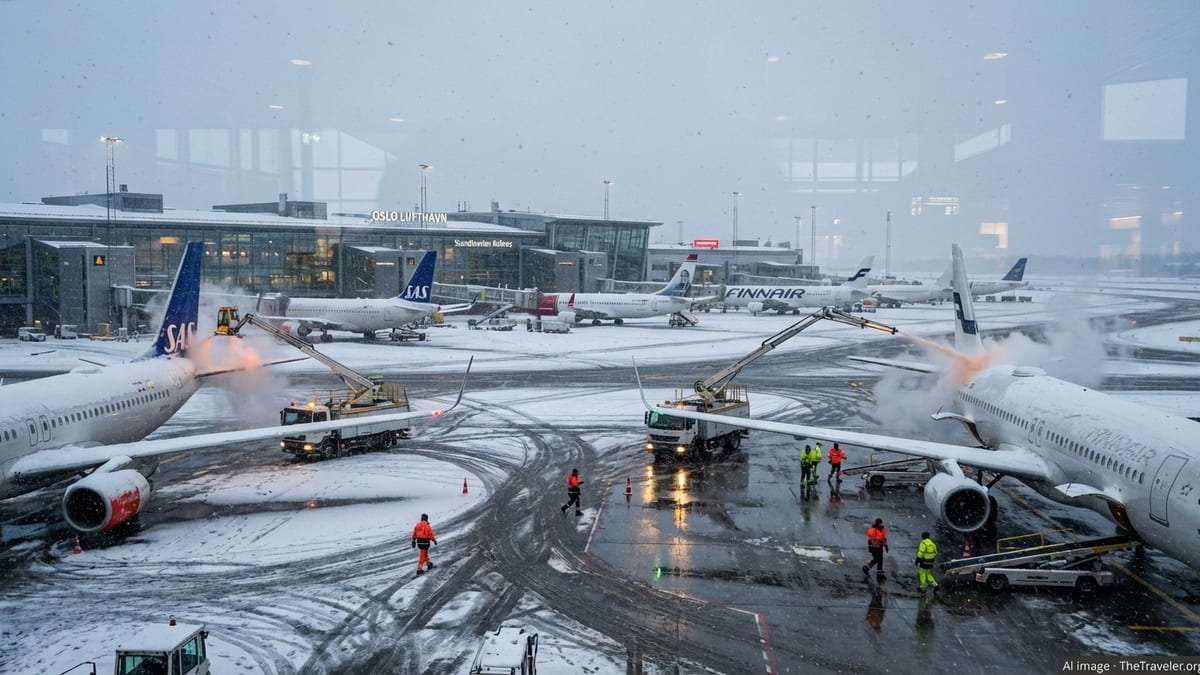
Storm Systems Bring Norway’s Aviation Network to a Standstill
Norway’s normally resilient winter aviation network has come under intense pressure as a series of storm systems moved across the country, combining heavy snow, gusty winds and intermittent freezing rain. The challenging conditions have hit the country’s busiest airports, including Oslo Gardermoen, Trondheim Værnes and Stavanger Sola, leading to a surge of cancellations and rolling delays on both domestic and international routes.
Airport operator Avinor and multiple airlines have spent the day juggling limited runway capacity, constrained de-icing resources and quickly changing weather windows. Operations teams have been forced to pause ground handling repeatedly while snowplows clear taxiways and runways and while visibility drops below the minimum required for safe takeoffs and landings. Even when flights can operate, lengthy queues for de-icing have pushed departure times back by hours.
The result has been a patchwork of partial closures, temporary suspensions and heavily reduced schedules. Aviation analysts note that although Norway is accustomed to operating in wintry conditions, the intensity and duration of the current storms have created a bottleneck that has rippled through the country’s tightly scheduled domestic network.
Oslo Gardermoen Sees Wave of Cancellations and Long Delays
Oslo Gardermoen, Norway’s primary international gateway, has experienced the brunt of the latest disruption. Airlines serving the capital reported a high volume of delayed departures, with dozens of flights leaving significantly behind schedule after crews waited for both runway clearance and de-icing slots. Multiple services were outright cancelled as carriers struggled to reposition aircraft and crews within legal duty time limits.
Ground staff described a stop-start operating pattern throughout the day, with short windows of improved visibility enabling a limited number of departures and arrivals before snow squalls and gusty crosswinds forced temporary slowdowns. Passenger information screens at Oslo Gardermoen displayed rows of amber and red status indicators as flights to domestic destinations such as Bergen, Trondheim and Tromsø, as well as key European hubs, slipped further behind schedule.
Avinor urged passengers to arrive early but to rely primarily on information provided by their airlines, noting that gate assignments and boarding times were changing frequently. While the main terminal remained open, congestion built up around security checkpoints and departure gates as travelers waited out extended delays, many sitting on the floor when seating areas filled to capacity.
Trondheim Værnes and Stavanger Sola Struggle to Maintain Schedules
Further north, Trondheim Værnes Airport has battled a combination of blowing snow and intermittent low cloud ceilings that have reduced visibility and limited the number of safe movements per hour. Arriving flights have faced holding patterns or diversions during the most intense bursts of snow, while departing aircraft queued on the apron for their turn at de-icing bays.
Although Trondheim typically sees fewer daily flights than Oslo, the disruptions have been deeply felt by regional travelers who rely on frequent short-haul services for business, government and university-related trips. Even a relatively small number of cancellations has had outsized impact, as passengers attempting same-day returns or tight connections found their plans derailed.
On Norway’s southwest coast, Stavanger Sola has also reported a spike in delays and selected cancellations as strong winds combined with wet snow and rain showers. The region’s offshore energy industry depends heavily on predictable air links, and disruptions to both fixed-wing flights and helicopter connections have forced companies to rework crew rotations to and from North Sea installations. Airlines operating from Sola have prioritized safety, sometimes opting to cancel marginal flights rather than risk operating in unstable wind conditions around the coast.
Major Carriers Cut Flights and Adjust Crews Amid Weather Chaos
The latest wave of winter disruption has affected a broad mix of airlines serving Norway. Scandinavian carriers have been among the most heavily impacted, with regional operators and mainline brands both reporting difficulty keeping aircraft and crews in the right place at the right time. Once morning rotations were delayed by the weather, knock-on effects cascaded throughout the day’s schedule.
Industry observers point out that winter operations in Scandinavia require finely tuned coordination between airlines, ground handlers and airport authorities. When storms linger longer than forecast, de-icing fluid stocks, crew duty hours and available stand space can all become simultaneous constraints. This creates a chain reaction in which one delayed inbound aircraft can disrupt several subsequent departures.
International carriers linking Oslo, Trondheim and Stavanger to European hubs have also trimmed schedules or faced lengthy waits for departure clearance. Some airlines have encouraged passengers to voluntarily rebook onto later dates without change fees, in an attempt to reduce demand on already stretched operations. Others have shifted to larger aircraft on select routes to consolidate passengers and minimize the number of individual flights exposed to disruption.
Passengers Face Overnight Stays, Missed Connections and Mounting Frustration
For travelers caught in the storm-driven disruption, the experience has been marked by uncertainty and long waits. Families heading out for winter holidays, commuters returning from business trips and tourists connecting through Norway have all reported spending hours in terminals as departure times slipped repeatedly.
At Oslo and Trondheim, airport hotels quickly filled as evening cancellations mounted, forcing some passengers to seek accommodation further afield or to spend the night in terminal seating areas. Local taxi services and regional trains experienced a rush of last-minute demand from travelers trying to bypass the worst of the disruption by switching modes of transport.
Social media posts from stranded passengers highlighted both moments of frustration and examples of staff going beyond normal duties to assist. While some travelers complained about limited information and long queues at service desks, others praised frontline employees who stayed late to help rebook flights, distribute meal vouchers and direct passengers to temporary rest zones.
Operational Challenges: De-icing, Runway Clearing and Crew Constraints
Behind the scenes, the operational complexity of running airports in severe winter weather has been on full display. Snowplow convoys have worked in continuous rotations to keep runways, taxiways and aircraft stands clear, pausing movements whenever accumulated snow or slush threatened to compromise braking action. Even brief interruptions to clearing efforts can trigger delays that take hours to unwind once the backlog has built.
De-icing has been a central bottleneck. Aircraft require thorough treatment of wings and tail surfaces before departure to ensure safe aerodynamics, and that process slows down boarding and turnaround times significantly. When storms cycle between snow and freezing drizzle, de-icing treatment windows become even shorter, sometimes forcing aircraft to return to the stand if takeoff cannot occur within a prescribed time limit.
Airlines have also confronted crew availability issues as pilots and cabin staff reached legal duty hour limits while waiting for weather-related clearances. Once crews time out, flights must be cancelled or reassigned, further complicating already fragile schedules. In some cases, carriers have positioned reserve crews to Norway’s major hubs, but these contingencies have not always been sufficient to offset the scale of the disruption.
Authorities Urge Flexible Travel Plans and Extra Time at Airports
Norwegian aviation authorities and airport operators have advised travelers to plan for continued disruption while the current storm systems move through. Passengers are being urged to build additional buffer time into their journeys, especially those requiring tight connections onto long-haul flights or onward train and bus services.
Airports have reinforced the message that the most accurate, up-to-date information on individual flights comes directly from the airlines, through their apps, text alerts and customer service channels. While central departure boards provide a general snapshot of the situation, rapid operational changes mean that gate displays can lag behind last-minute adjustments.
Travel experts recommend that passengers consider rebooking nonessential trips, particularly short leisure journeys, to later dates if flexible tickets allow. For those who must travel, carrying essential items such as medications, chargers, warm clothing and basic toiletries in cabin baggage is advised, in case flights are delayed or baggage delivery is disrupted in the chaos.
Tourism and Business Travel Brace for Broader Knock-On Effects
The impact of the winter storms on Norway’s aviation network is expected to echo beyond the terminals of Oslo, Trondheim and Stavanger. Tourism operators, hotels and conference venues are bracing for a wave of late arrivals, no-shows and last-minute cancellations as guests struggle to reach their destinations. Winter tourism hotspots that rely on smooth air links, from city-break markets to ski resorts, may see a dip in occupancy during what is normally a peak season period.
Business travel has also been significantly affected, with meetings, site visits and corporate events postponed or shifted to virtual formats. Companies with critical operations tied to punctual travel, including those in the energy and maritime sectors, are reevaluating contingency planning to account for more frequent extreme weather episodes during the winter months.
Economists note that while the immediate financial impact of a few days of disruption is limited in the context of Norway’s overall economy, repeated weather-related shutdowns can erode confidence among international visitors and investors. Aviation and tourism stakeholders are therefore watching closely to see how quickly operations can normalize once the current storm pattern eases.
Outlook: Gradual Improvement but Persistent Vulnerability
Meteorologists expect conditions to improve gradually as the latest storm systems move east, but caution that residual snow showers and gusty winds could continue to affect flight schedules in the short term. Even after weather conditions return to more typical winter patterns, it is likely to take time for airlines to reposition aircraft and crew, clear the backlog of stranded passengers and restore normal frequencies on key domestic routes.
Norway’s aviation sector has long been recognized for its ability to operate safely in harsh winter environments, supported by robust infrastructure and experienced staff. The current wave of storms, however, underscores the limits of that resilience when several adverse factors converge at once. As climate scientists warn of more volatile weather patterns in northern latitudes, airports and airlines may be compelled to invest further in winter operations capacity, from expanded de-icing facilities to enhanced real-time planning tools.
For now, travelers planning to fly into or out of Oslo, Trondheim or Stavanger are being advised to closely monitor their bookings, remain flexible and prepare for the possibility that winter in Norway may increasingly mean that even the best-laid travel plans are subject to the shifting whims of the weather.