

More news on this day
Wizz Air is preparing for a surge in European leisure and city-break demand by expanding its network at Berlin Brandenburg Airport for the 2026 summer season, adding new destinations and capacity across Central and Eastern Europe.
Get the latest news straight to your inbox!
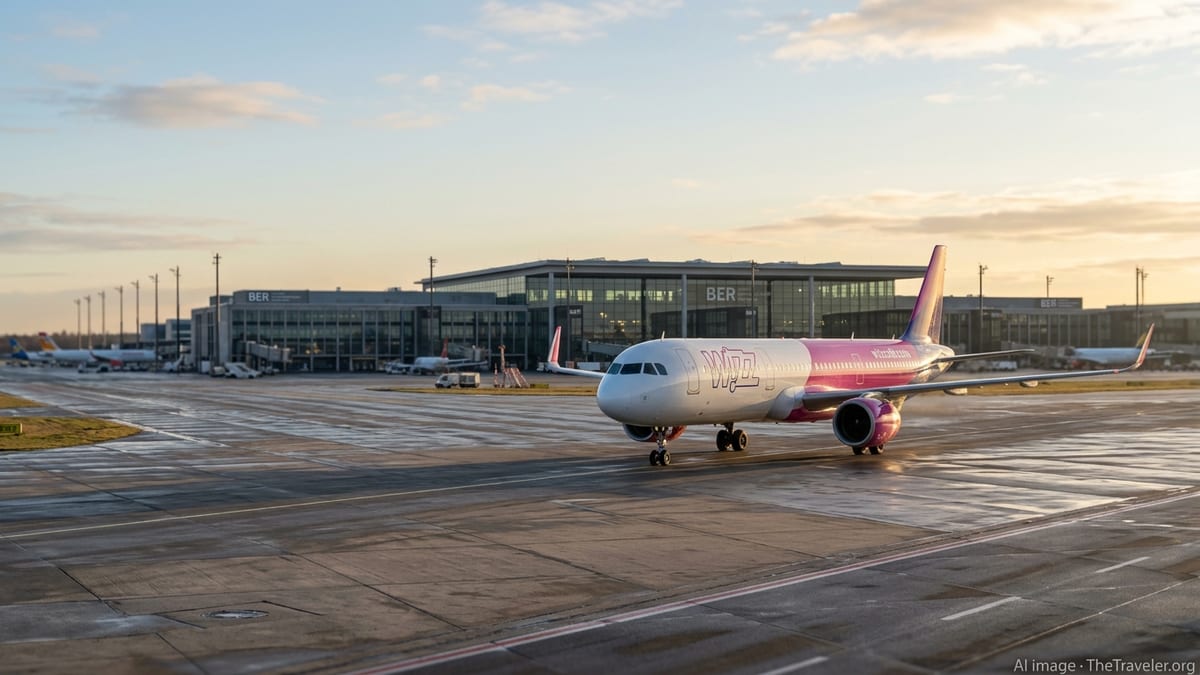
New Destinations from Berlin for Summer 2026
Publicly available schedule data and airport communications indicate that Wizz Air will add Bratislava in Slovakia and Tuzla in Bosnia and Herzegovina to its Berlin Brandenburg Airport network at the start of the 2026 summer timetable. Bratislava flights are planned to begin on 16 March 2026 with four weekly frequencies, while Tuzla is due to join the schedule on 30 March 2026 with three weekly services.
The new routes build on the carrier’s already strong presence in Central and Eastern Europe and are positioned to capture demand from city-break travelers and visiting friends and relatives traffic. Bratislava offers a compact capital city experience on the Danube, while Tuzla provides a link into northeastern Bosnia and Herzegovina, a region that has seen rising interest from price-sensitive travelers looking beyond traditional Western European hotspots.
These additions at Berlin come alongside broader network growth across Europe as the airline prepares for what industry observers describe as a busy 2026 summer peak, driven by resilient leisure demand, flexible work arrangements and a continued appetite for low-cost travel.
Winter Growth Sets the Stage for Summer Expansion
The summer 2026 build-up at Berlin Brandenburg follows a period of pronounced growth in the 2025 to 2026 winter schedule. Information published by the airport and trade outlets shows that Wizz Air has recently added a Berlin to Bucharest route and significantly increased frequencies to Varna, Chisinau and Tirana.
For the winter season, the airline is reported to be operating roughly one third more flights from Berlin than in the previous year, with seat capacity rising by more than 40 percent. This growth is supported by the deployment of larger, more efficient Airbus A321neo aircraft on many rotations, improving both unit costs and emissions performance per passenger compared with older types.
The build-up during winter is widely viewed as an indicator that Berlin is becoming a more important base in the carrier’s German strategy. By strengthening its position ahead of the summer rush, the airline is aiming to secure market share on routes where rival low-cost and full-service carriers also see opportunity.
Regional Connectivity Across Central and Eastern Europe
Wizz Air’s Berlin expansion is part of a broader pattern of connectivity growth linking Germany with Central and Eastern Europe. In parallel with new Berlin routes, airport announcements in Romania show that the airline plans to start a Cluj Napoca to Berlin route at the beginning of the 2026 summer season, with three weekly flights from late March.
This two-way growth strengthens Berlin’s role as a gateway for both inbound and outbound traffic. Passengers from secondary and regional cities such as Cluj Napoca gain direct access to the German capital, while Berlin-based travelers receive more options for reaching emerging city-break destinations that are often not served by legacy carriers.
Sector data and network comparisons suggest that these links are especially attractive to passengers traveling to visit friends and relatives, a segment that has remained robust even during periods of economic uncertainty. At the same time, increased seat supply on these routes can help keep average fares competitive during the peak summer holiday months of July and August 2026.
Fleet Strategy and Capacity for the 2026 Travel Surge
The Berlin growth is being underpinned by a wider fleet and capacity strategy. Industry coverage notes that Wizz Air is operating more than 1,000 daily flights across Europe as of 2025, supported by a rapidly expanding A321neo fleet. Public information on the airline’s plans for 2026, including newly acquired airport slots in several markets, points to further capacity increases in time for the summer season.
In Berlin, the use of high-density, single-aisle jets allows the carrier to add capacity without the need for a large number of additional daily movements. This is particularly relevant at slot-constrained airports where peak-time access is limited. For passengers, the strategy translates into more seats and, potentially, more fare options on key leisure and migrant-worker corridors.
Travel analysts indicate that the airline’s emphasis on cost efficiency and aircraft utilization positions it to compete aggressively on price in summer 2026, at a time when many travelers are still highly sensitive to airfare levels. The Berlin network build-out, including the new Bratislava and Tuzla services, fits within this broader push to consolidate its role as a major low-cost player in continental Europe.
Implications for Berlin Brandenburg as a Low-Cost Hub
The latest expansion by Wizz Air reinforces Berlin Brandenburg Airport’s status as a growing hub for low-cost and value-focused airlines. Alongside other budget carriers that already operate extensive point-to-point networks from the German capital, the additional Wizz Air capacity broadens the airport’s reach into southeastern and eastern Europe.
For the region, more direct links are expected to support both outbound tourism from Germany and inbound tourism to Berlin, as well as business and student mobility. Travel industry observers note that the combination of competitive fares and an increasingly dense route map could make Berlin an even more attractive starting point for multi-city itineraries across Central and Eastern Europe during the 2026 summer period.
As airlines finalize their timetables and adjust frequencies in the months leading up to March 2026, the scale of the summer travel surge will become clearer. For now, the announced Wizz Air routes and capacity increases at Berlin Brandenburg suggest that the airport will be one of the key beneficiaries of renewed demand for affordable European air travel next year.