

More news on this day
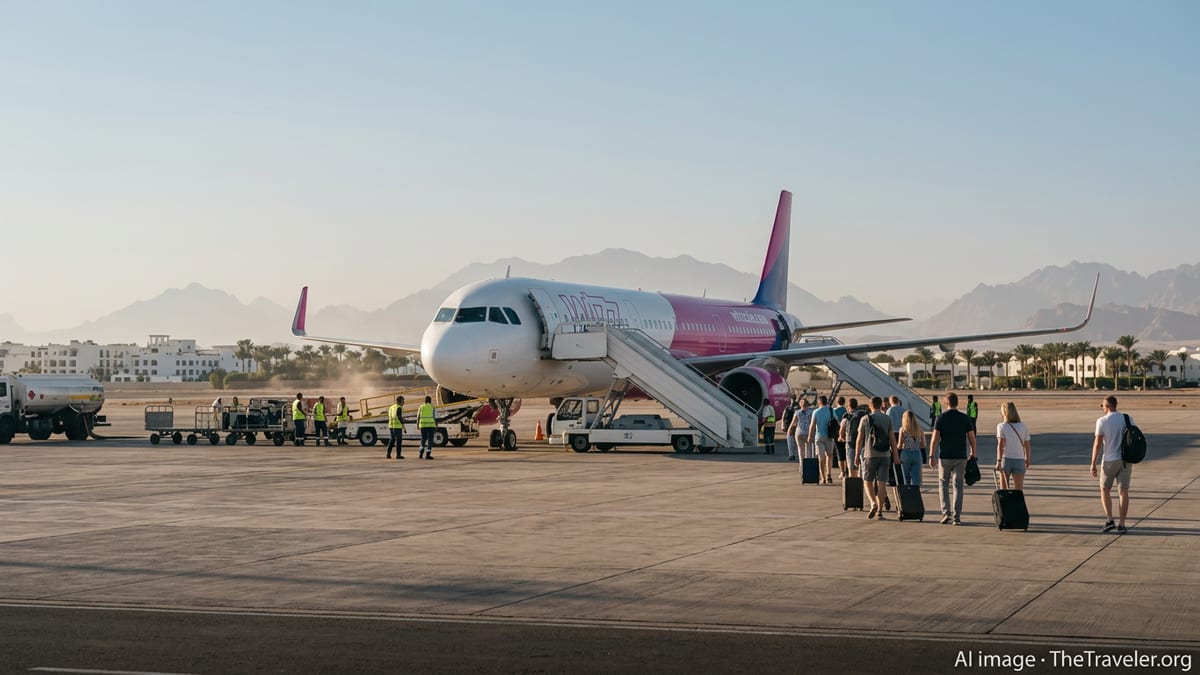
European low cost carrier Wizz Air has sharply curtailed its Middle East network in response to the escalating US Israeli conflict with Iran, grounding services to Israel and key Gulf cities while rapidly scaling up an emergency “escape corridor” of flights into the Egyptian resort of Sharm El Sheikh.
Core Routes Suspended as Regional Conflict Escalates
The latest round of Middle East turmoil, triggered by large scale US and Israeli strikes on Iran on March 1, has upended airline schedules across the region and pushed Wizz Air into another abrupt strategic pivot. With airspace closures and missile alerts affecting multiple Gulf states and Israel, the Budapest based carrier has halted commercial flights on several of its most visible Middle Eastern routes.
Wizz Air has suspended services to and from Israel, Saudi Arabia, Dubai, Abu Dhabi and Amman at least until March 7, citing operational risks linked to the widening conflict and closely coordinated government travel advisories. The decision effectively severs a number of ultra low cost links between Tel Aviv and European capitals that Wizz Air had spent years building and had recently been preparing to reinforce with a planned base in Israel.
The move comes just months after Wizz Air completed a broader exit from Abu Dhabi, where it closed its joint venture base in 2025 following repeated airspace disruptions, intense summer operating conditions and constrained market access. That withdrawal had already reduced the airline’s exposure to Gulf volatility, but the latest conflict has now forced a much deeper retrenchment across its remaining Middle East footprint.
For passengers, the sudden suspensions add to a broader picture of chaos. Tens of thousands of travelers who would normally funnel through Gulf and Levant hubs are now scrambling for alternatives as regional giants such as Emirates, Etihad and Qatar Airways keep most commercial services grounded or heavily curtailed pending clearer security assessments.
Sharm El Sheikh Becomes a Strategic Escape Valve
Against that backdrop, Wizz Air is directing scarce capacity into Sharm El Sheikh, turning the Red Sea resort into a critical pressure valve for disrupted traffic between Israel and Europe. The airline has announced a sharp increase in flights from Budapest, Rome and London to Sharm, boosting weekly frequencies from 24 to 52 and positioning the destination as a practical overland gateway for those unable to fly directly to or from Israel.
Located roughly 225 kilometers from the Israeli border town of Eilat, Sharm El Sheikh can be reached by road in around three hours in normal conditions. That geography, combined with Egypt’s relatively stable airspace and longstanding role as a mass market sun destination, makes the resort an attractive staging point for evacuation style travel even as conflict rages further north and east.
Wizz Air says the additional flights are designed to provide more options for passengers whose direct services between Israel and Europe have been canceled. Travel agents in central and eastern Europe report a surge in inquiries for Sharm itineraries that can be combined with cross border ground transport into Israel when security restrictions allow, effectively creating an improvised multi leg bridge in place of suspended nonstops.
The airline also stresses that all new Sharm El Sheikh flights are being coordinated with aviation authorities and airport operators to secure what it describes as safe operating windows and routings. That is increasingly complex as large sections of Middle Eastern and Gulf airspace remain closed or restricted, forcing airlines to thread their way through narrow international corridors and pushing up flight times and fuel burn.
From Gulf Retreat to Red Sea Realignment
Wizz Air’s rapid reweighting toward Sharm El Sheikh caps a longer, uneasy chapter in its Middle East expansion. The carrier’s Abu Dhabi venture, launched in 2020 with high hopes of tapping Gulf demand and east west flows, never fully recovered from repeated bouts of regional instability, including earlier clashes between Israel and Iran and sporadic missile threats affecting commercial routes.
By mid 2025, the airline concluded that its Abu Dhabi operation was structurally unprofitable. Recurrent airspace closures undermined schedule reliability, high desert temperatures drove up maintenance costs for its Airbus A321 fleet, and regulatory hurdles blocked growth into large markets such as India and Pakistan. Wizz Air opted to shut the base from September 1, 2025, and redeploy aircraft back into its core central and eastern European network and select Mediterranean leisure routes.
Even as it pulled back from the Gulf, however, Wizz Air doubled down on Israel as a key growth market once conditions allowed. It restored multiple Tel Aviv routes after earlier suspensions and has been in talks with Israeli authorities over establishing a local base, framing its ultra low fares as an antidote to high ticket prices on incumbent carriers. The renewed conflict with Iran has now frozen that strategy and underlined just how exposed foreign airlines remain to abrupt geopolitical swings.
The pivot to Sharm El Sheikh reflects this recalibration. Rather than betting on Gulf or Israeli hubs that can be rapidly pulled into the center of a crisis, Wizz Air is leaning on an Egyptian resort that is familiar to European holidaymakers and, at least for now, sits on the periphery of the most acute security threats while still offering a practical link to Israel by land.
Passengers Face Difficult Choices Amid Patchwork Advisories
For travelers, the creation of an informal Sharm El Sheikh escape corridor offers a partial solution but also raises difficult questions. Governments in Europe and North America have issued layered advisories that in some cases urge citizens to avoid non essential travel to parts of the Middle East, and in others explicitly recommend leaving certain countries while commercial options still exist.
Those conflicting signals mean that some passengers are racing to use Wizz Air’s extra Sharm capacity as a way out of the region, while others are opting to postpone or reroute trips entirely. Tour operators selling Red Sea packages are fielding a wave of calls from clients seeking clarity on whether Sharm El Sheikh is considered safe, even as flights into the resort continue to operate normally and Egyptian authorities stress that tourist zones remain secure.
Airlines, meanwhile, are trying to strike a balance between maintaining vital connectivity and avoiding any perception of downplaying risks. Wizz Air has repeatedly emphasized that it bases its security decisions on multiple independent government and private intelligence sources and that crew, passenger and aircraft safety cannot be compromised, a stance that has now guided its latest suspensions and redeployments.
Travel industry analysts say that the current patchwork of cancellations, pop up evacuation flights and ad hoc escape routes such as the Wizz Air Sharm corridor could persist as long as regional airspace remains fragmented. For many would be visitors to the Middle East, and especially to Israel and the Gulf, the result is likely to be a prolonged period of uncertainty in which flexibility and careful monitoring of airline and government updates become essential parts of any itinerary.