

More news on this day
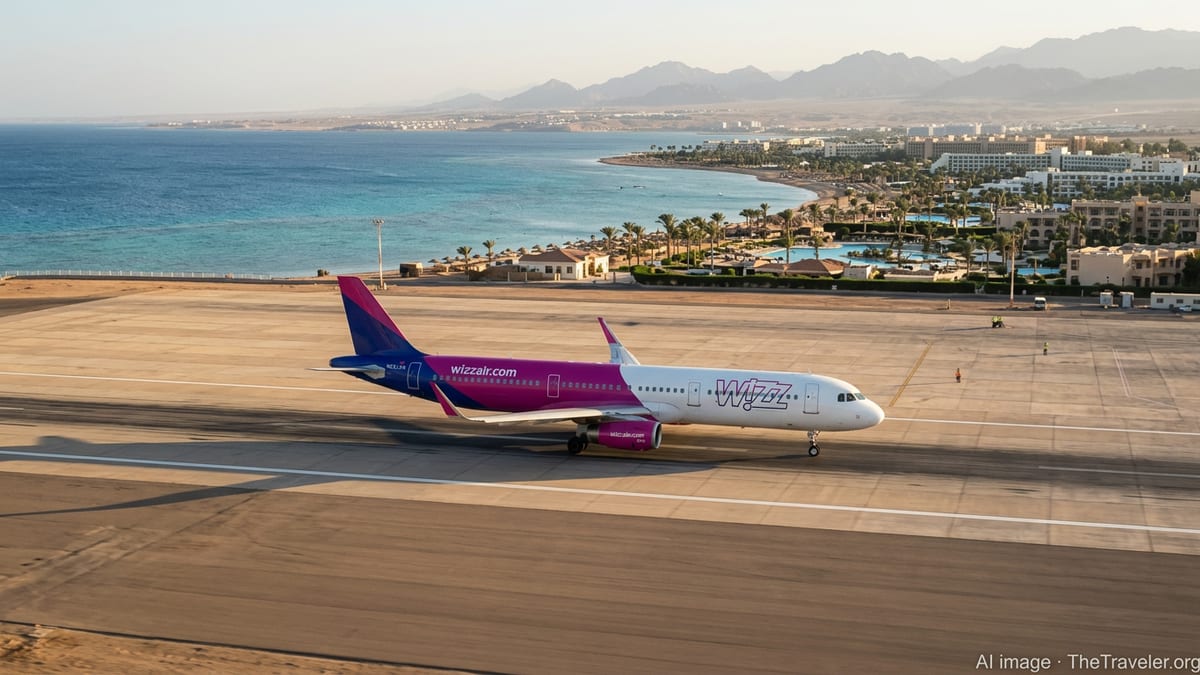
Middle East air travel has entered a new phase of volatility as Wizz Air halts key routes touching Israel, the Gulf and Jordan, while quietly steering leisure demand toward Egypt’s Red Sea resort of Sharm El Sheikh, creating a narrow escape corridor for European holidaymakers amid widening regional conflict and airspace closures.
Fresh Suspensions Compound a Region on Edge
Low cost carrier Wizz Air has become one of the most visible symbols of the latest Middle East aviation turmoil, after it suspended all flights to and from Israel, Dubai, Abu Dhabi and Amman until at least March 7, 2026. The move follows renewed strikes and airspace shutdowns involving Iran, Israel, Iraq and neighboring states at the end of February, which have triggered a wave of cancellations and reroutings across global networks.
The sharp pullback hits some of the busiest budget travel corridors linking Europe with the Gulf and the Levant, just as regional airspace had begun to stabilize following earlier interruptions in January. Passengers who relied on Wizz Air for relatively affordable links into Tel Aviv, Jordan and the United Arab Emirates now face a patchwork of options on legacy carriers, longer routings through alternate hubs and sharply higher fares where seats remain.
The latest suspensions come on top of a broader retreat by Wizz Air from Middle Eastern markets. In September 2025 the airline shut its Abu Dhabi joint venture and effectively ended its locally based operations in the region, citing geopolitical instability, war risk premiums and the harsh operating environment for its Airbus A321neo fleet. The decision marked a strategic pivot back to Europe that is now accelerating as conflict once again reshapes the regional map.
Industry analysts say the combination of war risk, surging fuel burn from detours and complex crew logistics is squeezing already thin margins. For a carrier built on ultra low costs and fast aircraft utilization, repeatedly threading changing air corridors or holding aircraft on the ground is commercially difficult to sustain.
From Growth Market to Patchwork of No-Go Zones
Wizz Air’s rapid expansion into the Middle East earlier in the decade had been heralded as a new chapter for budget travel, with Jordan, the UAE and Saudi Arabia positioned as gateways linking European city-breakers and Gulf residents. That narrative has unraveled at speed as airspace closures and missile alerts have turned large swaths of the region into de facto no-go zones for many Western and low cost airlines.
After Iran temporarily closed its airspace in mid-January, European carriers, including Wizz Air, Lufthansa and British Airways, shifted flights away from Iranian and Iraqi skies, threading aircraft through narrower corridors over Saudi Arabia, the Sinai and Central Asia. Even after Iran reopened its airspace, many operators continued to avoid it on safety grounds, locking in longer flight times and higher fuel bills.
Jordan’s skies and Amman’s Queen Alia International Airport have technically remained open and, at times, undisrupted. Yet Wizz Air’s inclusion of Amman in its blanket suspensions until early March illustrates how quickly a commercially attractive spoke can be sidelined once airlines view an entire region through a single risk lens. Where regulators allow flights, finance and insurance often make the final call.
For travelers, the practical effect is a Middle East that now feels like a fragmented patchwork rather than a connected network. Even passengers flying between Europe and Asia with no intention of stopping in the region are feeling the consequences as detours add up to 90 minutes to flight times and funnel traffic through congested slivers of safer airspace.
Sharm El Sheikh Emerges as a Red Sea Escape Valve
Against this backdrop of grounded jets and shuttered city pairs, Sharm El Sheikh on Egypt’s Red Sea coast is emerging as a relative bright spot and a de facto escape corridor for European holidaymakers. Situated well south of the most volatile airspace and long established as a leisure charter favorite, the resort has seen airlines concentrate capacity there even as they pull back from other regional points.
For Wizz Air, which has already trimmed or reshaped some Egyptian routes such as Hurghada in recent months, Sharm El Sheikh offers a way to keep serving winter sun demand in the broader Middle East neighborhood without overflying the most contested skies. The route profile aligns with the airline’s strengths: high-density leisure traffic, short turnaround times and strong ancillary sales from baggage, seat selection and activities.
Egyptian Red Sea airports have benefitted before when conflict made other destinations less attractive, notably during previous flare ups around Israel and Lebanon. Today the pattern is repeating as tour operators and online travel agencies increasingly market Sharm El Sheikh as an alternative to suspended city-break favorites like Tel Aviv or multi-country itineraries that once combined Jordan, Israel and Gulf stopovers.
Local hoteliers report a rise in short-lead bookings from European markets as travelers whose original trips were disrupted look for quick substitutes that do not require complex rerouting. With capacity tight elsewhere in the region and many carriers avoiding Iranian and Iraqi airspace, seats into Sharm El Sheikh are quickly becoming one of the few ways for tourists to salvage winter and spring escapes without transiting multiple hubs.
Stranded Passengers, Scrambling States and Shifting Risk Calculus
The ripple effects of Wizz Air’s suspensions extend well beyond those holding the airline’s tickets. The latest conflict-related closures have stranded tens of thousands of travelers across the Middle East, prompting governments in Europe, North America and Asia to organize special repatriation flights and to urge citizens to leave affected countries while commercial options still exist.
For many, the absence of low cost capacity eliminates the most affordable routes home. Some have turned to full service carriers at premium prices, while others remain stuck amid a fast-shifting patchwork of permissions, temporary openings and ad hoc rescue flights. Travel insurers and travel management companies report a surge in calls from both tourists and corporate clients seeking to rebook staff away from the region altogether.
Airlines now face a delicate balance between maintaining a presence in growth markets and protecting crews and passengers from evolving threats such as missile attacks, GPS interference and rapidly changing airspace directives. Carriers that built their brands on serving secondary cities and offering direct point to point links are finding those advantages harder to sustain when the underlying geography is repeatedly redrawn by conflict.
In boardrooms, the question is less when suspended routes will resume and more whether some will return at all. After years of promoting the Middle East as a linchpin of its network, Wizz Air is now using the region primarily as a cautionary case study in geopolitical exposure, reallocating aircraft to what its leadership calls “benign” European markets where regulatory and security risks are easier to model.
What Travelers Should Expect in the Months Ahead
For passengers planning trips involving the Middle East in the coming months, industry experts advise preparing for a more fragile, last minute environment. Flight schedules published for spring and early summer may change with little notice as airlines respond to new advisories, and low cost operators in particular are likely to prioritize flexibility over firm commitments on marginal routes.
Travelers who still intend to transit the region are being encouraged to build in longer connection times, favor single-ticket itineraries on one airline or alliance, and monitor carrier announcements closely in the days before departure. Sharm El Sheikh, along with a handful of other Red Sea and Eastern Mediterranean airports, is expected to remain one of the more stable options for leisure travel, but tightening capacity could push fares higher during peak holiday periods.
For now, Wizz Air’s grounded Middle East routes and its tactical focus on a Sharm El Sheikh corridor encapsulate a wider reality: a region once marketed as a seamless bridge between continents has become a patchy, high-stakes landscape where aviation decisions are increasingly driven by risk maps rather than route maps. As conflicts ebb and flow, airlines and travelers alike are learning that the shortest path to sunny beaches may now take a long detour around some of the world’s most contested skies.