

More news on this day
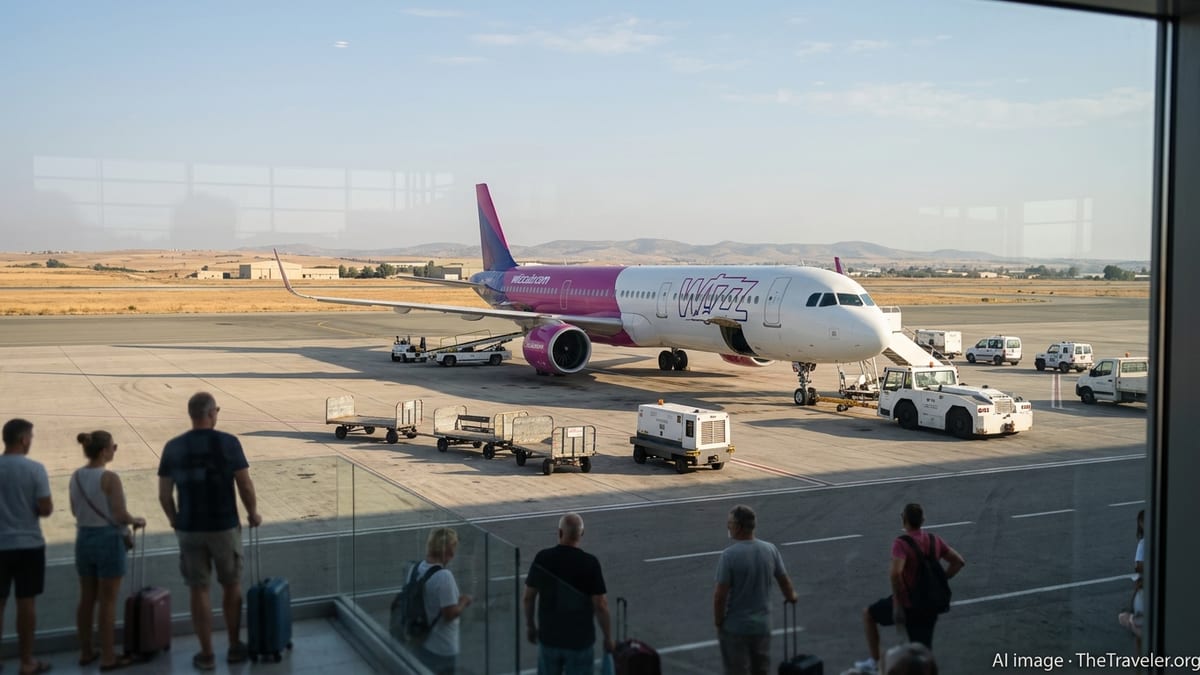
Wizz Air’s long-running troubles with Pratt & Whitney geared turbofan engines are spilling into the 2026 summer season, with travellers across the Balkans reporting sudden suspensions and cancellations on key routes to Cyprus and other Mediterranean destinations as the airline struggles to balance capacity constraints with booming leisure demand.
Get the latest news straight to your inbox!
Engine Inspections Still Rippling Through 2026 Schedules
Publicly available financial reports and industry coverage show that Wizz Air entered 2026 with a substantial portion of its Airbus A320neo-family fleet still affected by mandatory Pratt & Whitney PW1100G geared turbofan inspections. The problems, which first intensified in 2023 due to powder metal defects, led to dozens of aircraft being grounded across 2024 and 2025. As of late 2025, multiple analyses indicated that around 15 to 20 percent of the carrier’s fleet had at times been out of service, putting sustained pressure on network planning and reliability.
While the airline has reported gradual progress in reducing the number of grounded jets, engines cycling through lengthy shop visits continue to limit operational flexibility in early 2026. Maintenance turnaround times approaching 300 days per engine, cited in previous annual disclosures and trade press summaries, mean that aircraft are often unavailable for months at a time. This structural shortfall has forced Wizz Air to trim frequencies, consolidate routes and periodically withdraw entire city pairs as it attempts to protect higher-yield markets.
The impact is particularly acute for bases and routes where the airline had grown aggressively before the engine crisis. With a strategy heavily focused on rapid expansion using a young, fuel-efficient fleet, Wizz Air has less older, unaffected capacity to fall back on than some rivals, leaving it more exposed when a large sub-fleet is grounded for technical reasons.
Industry observers note that Wizz Air has sought compensation and support from Pratt & Whitney while at the same time committing to additional GTF-powered aircraft, including long-range A321XLRs. This dual track underscores the carrier’s long-term confidence in the technology, even as the short- and medium-term disruption continues to reshape its European network.
Balkan–Cyprus Links Hit by Sudden Suspensions
In March 2026, passengers across online travel forums began flagging abrupt cancellations and schedule wipes on Wizz Air services between Balkan cities and Cyprus, including routes from Bosnia and other regional gateways. Travellers reported that summer-season flights they had booked or been tracking disappeared from sales channels, often without clear public explanation beyond standard notifications of schedule changes.
These developments follow a wider pattern seen over the past two years in which Wizz Air has thinned out marginal or seasonal routes when engine-related groundings intensify. Public schedules show that the airline has historically connected several Western Balkan cities with Larnaca, pairing diaspora traffic with growing leisure flows to Cypriot beaches. When capacity tightens, such secondary leisure routes are among the first to be paused in favour of denser trunk links from major hubs.
Available commentary in local media and community discussions suggests that many affected passengers initially assumed geopolitical or airspace issues were behind the Cyprus suspensions. However, Cyprus is not listed among current conflict-related no-fly zones, and the pattern of pulled flights more closely mirrors a capacity-management response to fleet limitations. The widespread cancellation of specific summer rotations, rather than a uniform regional ban, further points to an internal rebalancing of aircraft rather than external regulatory constraints.
For travellers in smaller Balkan markets, the result is a sharp reduction in low-cost non-stop options to Cyprus just as peak holiday planning gets underway. Many now face longer journeys involving connections through Budapest, Warsaw or other hubs, or must switch to competing carriers where available, often at higher fares and with less schedule flexibility.
Network Retrenchment Extends Beyond Cyprus
The strain on Wizz Air’s fleet is not confined to Balkan–Cyprus routes. Recent schedule changes in early 2026 include the closure of the airline’s Vienna base in March, prompting the removal or reshaping of multiple Central European routes visible in public booking systems. Travellers have also reported cancellations on long-thin leisure routes such as Rome to Jeddah and other point-to-point services that rely on precise aircraft utilisation.
Industry analysis indicates that this pattern aligns with a broader effort by Wizz Air to concentrate scarce GTF-powered aircraft where they can generate the strongest returns. High-density intra-EU leisure corridors and key migrant-worker routes typically receive priority, while thinner seasonal links from secondary cities to destinations like Cyprus, the Gulf or North Africa are more vulnerable to short-notice cuts.
Reports in aviation trade publications over 2024 and 2025 describe Wizz Air experimenting with measures such as short-term wet leasing and tactical capacity swaps to cover gaps created by engine inspections. However, limited availability of suitable aircraft across the market and the cost of such arrangements make it difficult to fully shield passengers from disruption. The company’s financial disclosures for recent fiscal years show compressed margins and weaker profits, with engine issues and associated operational complexity frequently cited as major headwinds.
As the airline continues to take delivery of new Airbus aircraft, including long-range narrowbodies, it faces the challenge of integrating this capacity while legacy engine issues still constrain day-to-day operations. The result, visible in public schedules and traveller experiences, is a network that remains fluid and occasionally unpredictable, particularly on routes outside Wizz Air’s strongest core markets.
What Travellers in the Region Are Experiencing
For passengers in the Balkans, the most immediate consequence of the engine crisis is uncertainty. Social media and travel forums in March 2026 feature accounts of itineraries disappearing from apps, email notices of cancelled flights and difficulties rebooking on comparable dates and times. Some customers report re-accommodation offers on alternative Wizz Air flights days earlier or later than planned, while others are steered toward refunds and left to make their own arrangements.
These individual stories align with the broader statistics that have frequently placed Wizz Air among Europe’s most delay- and cancellation-prone airlines during the height of the GTF disruption. With tight turnarounds and high utilisation built into its ultra-low-cost model, any unplanned aircraft withdrawal or cascading delay can swiftly translate into schedule instability across multiple routes, including those linking smaller Balkan cities to Cyprus.
Consumer advocates and passenger-rights commentators consistently remind affected travellers that European air passenger regulations apply regardless of an airline’s internal technical challenges. However, accounts circulating online suggest that navigating reimbursements, compensation claims and alternative transport can be time-consuming, particularly when cancellations occur weeks or months before departure and are framed as strategic schedule changes rather than last-minute operational failures.
For the wider tourism ecosystem, the volatility is another headwind as destinations like Cyprus, which rely heavily on affordable direct air links from Central and Eastern Europe, attempt to plan for the 2026 high season. Hoteliers and local operators monitoring public flight timetables face a moving target as they try to anticipate how many visitors low-cost carriers will ultimately deliver from Balkan markets this summer.
Outlook for Summer 2026 and Beyond
Analysts following Wizz Air’s financial updates note that the airline and Pratt & Whitney have outlined a multi-year roadmap to return grounded aircraft to service, with some guidance suggesting that the worst of the GTF-related groundings could ease by 2027. In the interim, schedules for late 2026 and 2027 published to date still reflect cautious growth, with the company signalling that its ability to add capacity will be shaped by the pace of engine shop visits and the arrival of new aircraft.
For Balkan travellers eyeing Cyprus and similar Mediterranean destinations, this means that the coming summer will likely remain characterised by thinner route maps and the possibility of late adjustments. While some suspended links could reappear if additional engines return to service faster than expected, there is no firm public timeline for the restoration of specific city pairs such as those from Bosnia and neighbouring states to Cypriot airports.
Travel planners in the region are increasingly advising holidaymakers to build in flexibility, consider alternative routings via major hubs and monitor bookings closely for changes as departure dates approach. The experience of recent seasons suggests that early booking does not fully insulate passengers from schedule shifts when an airline is managing a prolonged technical crisis of this scale.
As 2026 progresses, the evolution of Wizz Air’s network will provide a visible barometer of how quickly the GTF engine issue is being resolved in practice. For now, the sudden disappearance of much-anticipated Balkan–Cyprus flights underlines how a global engineering problem that began deep inside a turbofan continues to ripple out to beach destinations, family reunions and summer holidays across southeastern Europe.