

More news on this day
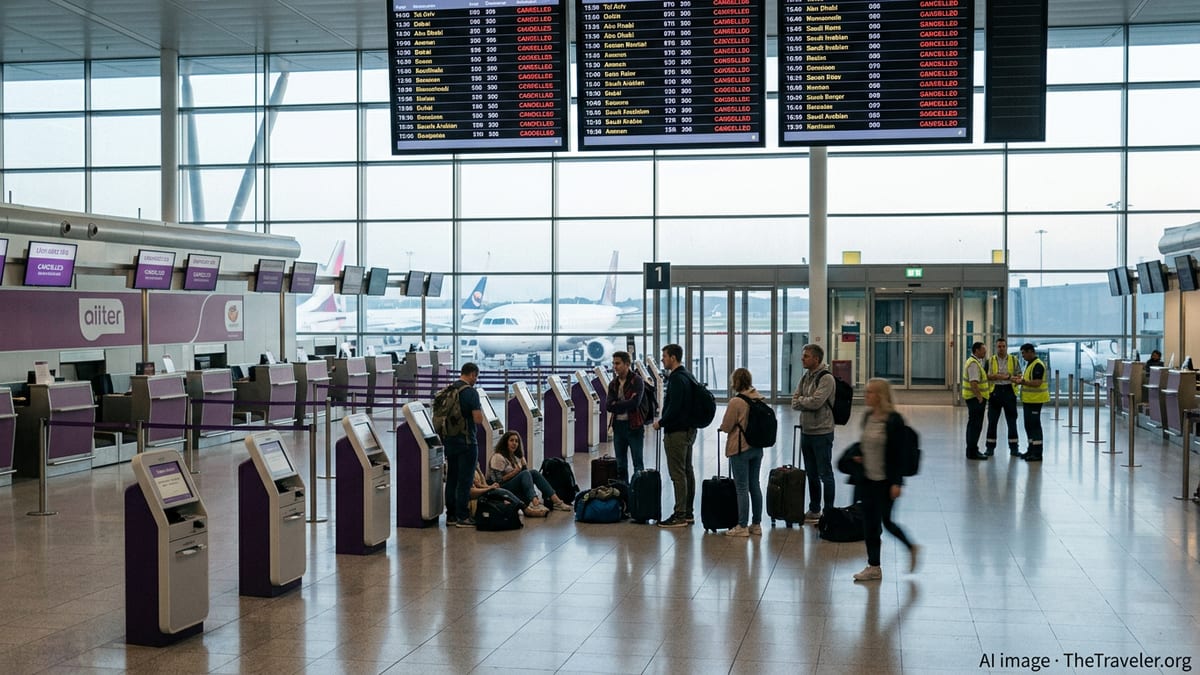
Wizz Air has dramatically extended its suspension of flights to Israel, Dubai, Abu Dhabi, Amman and multiple destinations in Saudi Arabia until March 2026, as escalating conflict and airspace closures across the Middle East push airlines into unprecedented long-term safety measures.
From Short-Term Suspension to Long-Haul Freeze
Low cost carrier Wizz Air was among the first European airlines to pause services to key Middle Eastern markets after a wave of missile strikes, retaliatory attacks and widespread airspace closures late in February 2026. Initially, the airline announced that all flights to and from Israel, Dubai, Abu Dhabi and Amman would be suspended up to and including 7 March, positioning the move as a temporary, precautionary disruption.
In the days that followed, however, the security environment deteriorated rather than stabilised. Governments in Israel, Jordan, Saudi Arabia, the United Arab Emirates and several neighbouring states imposed partial or full closures of their skies, forcing thousands of cancellations and diversions and leaving passengers stranded at major hubs from Dubai to Doha. Faced with a volatile risk picture and little clarity on when normal air traffic might safely resume, Wizz Air has now moved far beyond its initial week-long pause.
The carrier has confirmed that all services linking its European network with Israel, the United Arab Emirates, Jordan and Saudi Arabia will remain off its schedule until March 2026. The decision effectively writes off an entire year of expansion in some of the airline’s fastest growing leisure and migrant-worker markets, underlining how deeply the conflict is reshaping global aviation planning.
Safety First as Airspace Across the Region Tightens
Airlines operating in and around the Middle East frequently adjust routings during periods of tension, but the current situation has produced a scale of disruption rarely seen outside the early stages of the pandemic. Multiple states, including Israel, Jordan, Saudi Arabia, Iran, Iraq, Kuwait, Qatar and the United Arab Emirates, have either formally closed sections of their airspace or imposed severe restrictions, sharply limiting available corridors for civilian overflights.
For a low cost operator like Wizz Air, which relies on short ground times, direct routings and predictable slot allocations to keep fares low, the combination of closed skies and rapidly changing security advisories is particularly challenging. Rerouting aircraft around large no-fly zones adds distance and fuel burn, while uncertainty over sudden closures risks forcing diversions to airports without existing crew and maintenance support.
By freezing its Israel and Gulf operations for a full 12 months, Wizz Air is effectively choosing strategic clarity over a rolling series of ad hoc cancellations. Company statements emphasise that passenger and crew safety remains the overriding priority, and that any future resumption will depend on sustained improvements in the security outlook and the reopening of critical airspace corridors rather than on fixed commercial targets.
Impact on Passengers, Tourism and Diaspora Travel
The suspension will be felt across several traveller segments that had come to rely on Wizz Air’s dense schedule of low cost flights linking Central and Eastern Europe with Middle Eastern cities. In Israel and Jordan, the airline had become a key player in bringing European city-break tourists and religious pilgrims to Tel Aviv, Eilat and Amman, while also carrying outbound leisure traffic to Mediterranean and Central European destinations.
In the United Arab Emirates and Saudi Arabia, Wizz Air’s growth strategy was heavily focused on price-sensitive travellers, including expatriate workers commuting between the Gulf and secondary cities in Europe. With these routes now frozen until March 2026, those passengers will be pushed towards legacy carriers and regional airlines, where prices are likely to rise as capacity tightens and routing options remain constrained.
Travel agents across Europe and the Middle East are bracing for a prolonged period of rebooking and refund requests. Many customers whose flights were originally cancelled in late February and early March have already accepted vouchers or alternative itineraries, only to see the situation escalate again. Consumer advocates are urging passengers to review their rights under local and European regulations, especially in cases where package holidays hinged on now-cancelled Wizz Air legs.
Wider Aviation Fallout as Carriers Rework Networks
Wizz Air is far from alone in pulling back. Full service airlines from Europe, Asia and North America have cancelled or rerouted services to Tel Aviv, Dubai, Abu Dhabi, Doha, Amman and a string of Saudi and Gulf destinations as the conflict flares. Some have introduced limited evacuation or repatriation flights under government charters, but regular commercial schedules across much of the region remain heavily curtailed.
Industry analysts note that the Gulf’s major hubs, particularly Dubai and Abu Dhabi, have long served as critical connectors between Europe, Asia, Africa and Australasia. The loss or severe restriction of those hubs forces airlines to rethink everything from long haul connecting banks to aircraft rotations and crew basing. For point to point focused low cost carriers like Wizz Air, suspending entire route groups can be more operationally straightforward than attempting to rebuild schedules around constantly changing constraints.
The long horizon of Wizz Air’s suspension also raises broader questions about investment and fleet deployment. Aircraft that had been earmarked for Middle Eastern growth are likely to be redeployed into European or other regional markets, potentially intensifying competition on popular intra-European leisure routes in peak summer. At the same time, airport operators and tourism boards in Israel, the UAE, Jordan and Saudi Arabia face the prospect of at least a year without one of their most aggressive low cost partners.
Uncertain Timeline, Ongoing Monitoring
Although Wizz Air has drawn a clear operational line at March 2026, both the airline and regional authorities stress that the timeline could change in either direction depending on how the situation evolves. A sustained easing of hostilities, verified security guarantees for civilian aviation and the coordinated reopening of key flight corridors could allow for an earlier partial return, while further escalation or attacks involving civil aviation infrastructure could lead to additional caution.
For now, the carrier says it will continue to monitor intelligence briefings, work closely with aviation safety agencies and follow the guidance of national and international regulators. Passengers holding bookings to Israel, Dubai, Abu Dhabi, Amman or Saudi destinations beyond the initial suspension window are being contacted in phases, with options ranging from full refunds to rebooking on unaffected routes within the Wizz Air network.
With no quick resolution in sight and the region’s airspace map redrawn overnight, Wizz Air’s extended halt illustrates the new reality facing both airlines and travellers. In an environment where security assessments can shift within hours, carriers are increasingly opting for long term certainty over short term opportunism, even when that means stepping away from some of the world’s most dynamic emerging travel markets.