

More news on this day
Wizz Air is expanding its presence in northern Italy with the deployment of a new Airbus A321neo at Venice Marco Polo Airport, adding around five hundred thousand seats annually and announcing five new routes including services to Spain and Naples that are expected to significantly strengthen regional connectivity.
Get the latest news straight to your inbox!
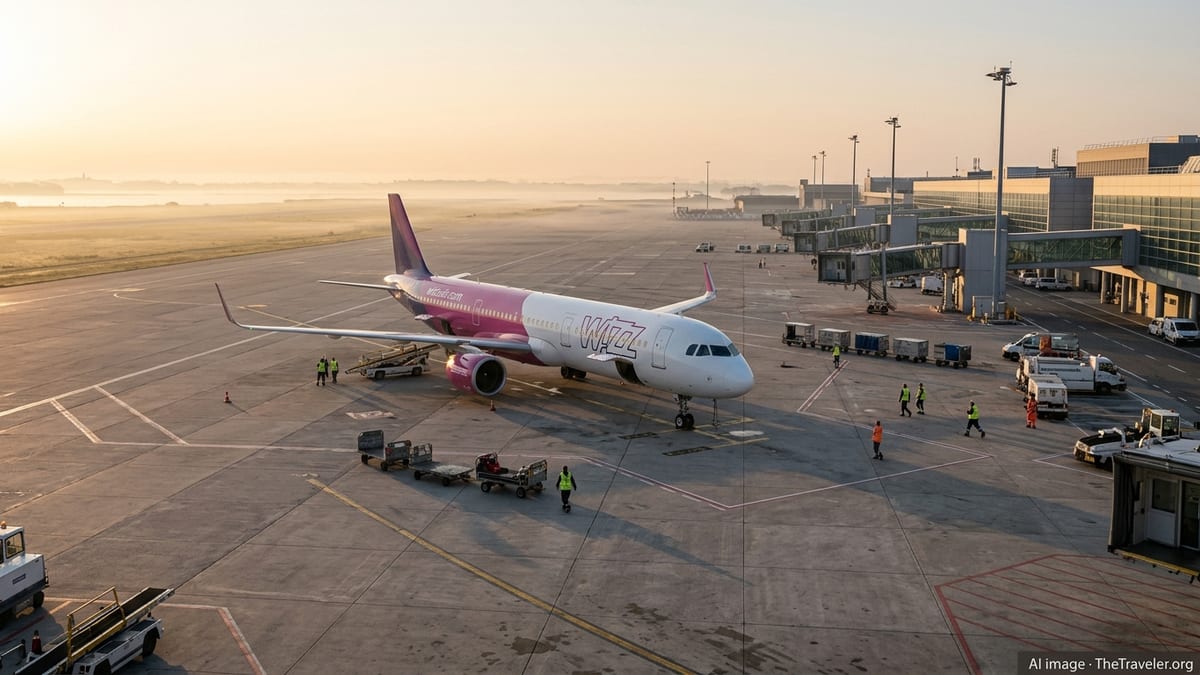
Capacity Boost at Venice Marco Polo
Publicly available information on Wizz Air’s network strategy indicates that the airline is shifting more capacity into key leisure and city-break markets, with Venice emerging as one of its focal airports in Italy. The latest move sees a new Airbus A321neo based at Venice Marco Polo, enabling a substantial increase in seats on both existing and newly announced routes. Industry coverage suggests that the added capacity is equivalent to around half a million extra seats per year, a significant uplift for a single base in the low-cost segment.
The Airbus A321neo, configured with nearly 240 seats in Wizz Air’s high-density layout, allows the carrier to offer more capacity without adding additional daily movements. For Venice, which faces slot and infrastructure constraints during peak periods, this upgauging strategy aligns with broader trends among European airlines seeking to maximise airport access while keeping costs per seat low.
By basing another aircraft at Venice, Wizz Air is signalling long-term confidence in demand from the broader Veneto region and neighbouring northeast Italian catchment areas. The expansion also positions the airline to compete more directly with other low-cost and hybrid carriers that have built strong positions in nearby airports such as Treviso and Bologna.
Five New Routes Linking Spain and Southern Italy
According to recent route announcements and schedule filings, the additional A321neo capacity will support five new routes that connect Venice with Spanish destinations and the southern Italian city of Naples. The Spain services are aimed squarely at the short-haul leisure market, targeting year-round city trips and peak-season beach demand, while the Venice–Naples link strengthens domestic connectivity between two of Italy’s most visited urban areas.
The new Spain routes are expected to focus on a mix of major gateway cities and high-demand holiday regions, reinforcing existing flows of Italian outbound tourism while also attracting inbound visitors who use Venice as their entry point to northern Italy. For Spanish travellers, the routes provide new non-stop options to reach the Veneto region without the need to transit via larger hubs such as Milan or Rome.
The Venice–Naples service, supported by the same A321neo-based capacity, enhances links between the north and south of the country and offers an alternative to rail for travellers seeking shorter journey times or lower fares. It also supports weekend and short-break travel patterns, with schedules that typically prioritise early-morning and late-evening departures to maximise day usage at destination.
Strengthening Regional and Cross-Border Connectivity
The seat increase at Venice is expected to have a wider impact than just the Veneto region. Venice Marco Polo serves a broad hinterland that includes parts of Friuli Venezia Giulia, Trentino-Alto Adige and even cross-border markets in Slovenia and Austria, where passengers often select airports based on route availability and fares rather than national boundaries.
With the A321neo deployment, Wizz Air can offer more frequencies and higher-capacity aircraft on key days of the week, which can be particularly important for price-sensitive passengers who plan travel around specific departure times. This improved availability supports not only leisure tourism but also visiting-friends-and-relatives traffic between Italy and Spain, as well as domestic flows to and from Naples.
Enhanced connectivity may also support regional economic activity by making it easier for small and medium enterprises to access nearby European markets. In addition, tourism boards in both Spain and Italy have, in recent years, prioritised air access from secondary cities as a means of spreading visitor flows beyond traditional hotspots, and the Venice expansion fits into that broader pattern.
A321neo Fleet Strategy and Environmental Considerations
Wizz Air’s decision to base another Airbus A321neo in Venice aligns with its fleet plan, as recent financial reports show a growing share of new-generation aircraft within the carrier’s overall operations. The A321neo provides lower fuel burn per seat compared with older models, contributing to reduced emissions intensity on busy leisure routes where load factors are typically high.
The larger gauge of the A321neo helps the airline lower unit costs, which can translate into competitive fares on new routes while still maintaining profitability targets. For Venice, the use of newer aircraft may also be viewed positively in discussions about the environmental impact of aviation around the lagoon city, where concerns about congestion and sustainability are increasingly prominent in local debates.
From a network-planning perspective, deploying the A321neo at Venice allows Wizz Air to test and scale new routes more flexibly. If a Spanish route, for example, demonstrates strong demand in peak months but softer performance in the shoulder season, schedules and capacity can be adjusted using the same aircraft, shifting seats between domestic and international services without major fleet changes.
Implications for Travellers and Competing Carriers
For travellers, the additional half a million seats from Venice are likely to manifest as more choice in departure days and times, particularly in the busy summer season. Low-cost carriers typically add early and late slots that enable long weekend trips, and the new Venice-based A321neo is expected to be used in a similar pattern, making short breaks to Spain and southern Italy more accessible.
The growth at Venice is also likely to sharpen competition on several flows. Other airlines operating between northern Italy and Spain or Naples may respond by adjusting capacity, pricing, or ancillary offerings to defend their market share. Historical patterns in the European low-cost sector suggest that such capacity injections often trigger short-term fare reductions, which can benefit price-sensitive travellers.
For Venice Marco Polo Airport, the expansion supports its ongoing role as a major gateway for northeast Italy. Additional base aircraft from a large low-cost operator tend to increase airport resilience by diversifying route portfolios and strengthening off-peak utilisation. Over time, consistent capacity growth from carriers such as Wizz Air can encourage further investment in terminal facilities and ground services geared toward high-volume, quick-turnaround operations.