

More news on this day
Wizz Air is preparing a significant expansion of its Italian network from 2026, with plans to connect Venice to Bilbao, Malaga, Alicante, Seville and Naples as part of a broader Mediterranean growth strategy.
Get the latest news straight to your inbox!
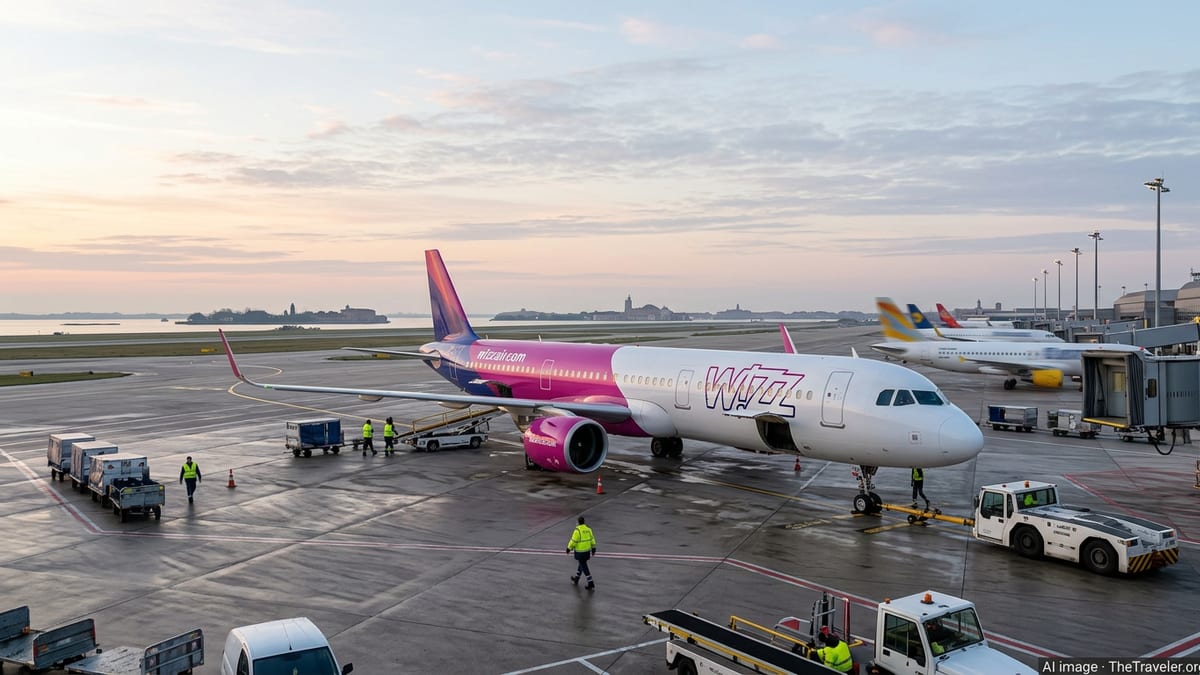
Venice Set to Become a Stronger Wizz Air Gateway
The Hungarian low cost carrier has been steadily growing its presence in northern Italy, and Venice Marco Polo is emerging as one of its key gateways. Airport operator data and the airline’s latest network materials show Venice already benefiting from a third based Airbus A321neo aircraft and a series of new domestic and international routes, including a high frequency link to Palermo from August 2026.
The planned addition of routes from Venice to Bilbao, Malaga, Alicante, Seville and Naples would deepen that strategy, giving the carrier a denser web of links between northeastern Italy and major leisure and city break destinations across Spain and southern Italy. The move aligns with Wizz Air’s broader pattern of shifting capacity away from weaker bases in central Europe and towards markets where demand for Mediterranean sun and city tourism remains strong.
Although detailed schedules and exact launch dates for the Venice connections have yet to be formally published in a full timetable, the appearance of these city pairs in Wizz Air’s latest 2026 destination planning materials points to a stepped up role for Venice within the airline’s network. Industry observers expect the routes to roll out progressively across the summer 2026 season, subject to slot coordination and aircraft availability.
Targeting Spain’s High Demand Coastal Markets
Bilbao, Malaga, Alicante and Seville are among Spain’s most popular airports for both inbound tourism and outbound leisure travel, and they have become highly contested markets among European low cost carriers. For Wizz Air, direct links from Venice to these cities would plug an important gap in its point to point offer, especially on routes that have so far been dominated by rival budget and legacy operators.
Malaga and Alicante in particular are classic year round leisure gateways on the Costa del Sol and Costa Blanca, generating steady demand from Italian visitors looking for mild winters and beach holidays as well as Spanish travellers heading in the opposite direction. Seville adds a cultural city break dimension, attracting tourists interested in Andalusia’s architecture, festivals and gastronomy, while Bilbao brings access to northern Spain and the Basque Country.
By entering these markets from Venice, Wizz Air will be competing for price sensitive travellers and weekend city breakers who are willing to travel light and accept a stripped back service in exchange for lower fares. The move is also likely to appeal to Spanish residents and expatriates in Italy who currently face limited nonstop options between the Veneto region and these specific cities.
Domestic Link to Naples Strengthens Italian Network
Alongside its push into Spain, the planned Venice to Naples route would tighten Wizz Air’s domestic Italian network, connecting two of the country’s most visited cities with a low cost option. Naples has already seen a wave of capacity expansion from the carrier, including new services to other Mediterranean destinations for summer 2026, and an additional link to Venice fits its strategy of building more density on high potential Italian corridors.
A Venice Naples service would cater to a mix of leisure and visiting friends and relatives traffic, as well as small business travellers seeking cheaper alternatives to legacy carriers on one of Italy’s busiest north south flows. With both airports serving as key gateways to wider regions the Veneto and the Dolomites in the north, Campania and the Amalfi Coast in the south the new route could quickly become a staple of Wizz Air’s Italian schedule.
The domestic addition would also help the airline improve aircraft utilization by slotting relatively short sectors between longer international flights from Venice. This operational flexibility has been a hallmark of Wizz Air’s growth model as it tries to maximize the productivity of its A321neo fleet while keeping unit costs low.
Fleet and Strategy Realignment Across Europe
The Venice expansion is unfolding against a backdrop of wider strategic shifts for Wizz Air across Europe. The airline has been scaling back or closing less profitable bases, such as Vienna, while redirecting aircraft to markets where it sees stronger long term potential. At the same time, it has been adding capacity in countries such as Italy, Romania and Poland, and preparing for the arrival of additional A321neo and future A321XLR aircraft.
Recent route announcements in Italy, including new domestic services and extra Mediterranean links from cities like Naples and Milan, suggest that the carrier views the Italian market as one of its main growth engines through the middle of the decade. Venice’s strengthened status, capped by the planned 2026 connections to Bilbao, Malaga, Alicante, Seville and Naples, is consistent with this approach.
For airports, the carrier’s strategy offers both opportunities and risks. While new routes can generate traffic and tourism growth, Wizz Air’s readiness to shift capacity quickly if performance falls short has already been seen in markets where bases have been scaled back. Venice and its new Spanish and Italian partners will be watching load factors and yields closely once the 2026 services begin operating.
What Travelers Can Expect in 2026
For travelers, the planned 2026 expansion from Venice promises more nonstop options at typically lower fares than traditional full service rivals. Passengers on the new routes can expect Wizz Air’s standard ultra low cost model, with a focus on unbundled fares, paid seat selection, priority boarding and onboard purchases, but also the benefits of newer aircraft with improved fuel efficiency and cabin comfort.
The increased choice of direct flights between Venice and key Spanish destinations, as well as Naples, is likely to shorten journey times that currently require connections through other hubs, making weekend trips and short holidays more feasible. It may also put downward pressure on competing fares, at least initially, as airlines jostle for market share on these newly contested city pairs.
Timings, weekly frequencies and seasonal patterns are expected to be clarified closer to the start of the 2026 summer season, once Wizz Air and its airport partners finalize slot allocations. Travelers looking to take advantage of the new link between Venice and Bilbao, Malaga, Alicante, Seville or Naples should keep an eye on the airline’s booking channels as schedules are progressively loaded over the coming months.