

More news on this day
Wizz Air has been named the world’s second-best ultra-low-cost airline for 2026 in a leading global ranking, underscoring the Budapest-based carrier’s strategy of pairing aggressive fares with a growing focus on safety, fleet efficiency and value-driven service.
Get the latest news straight to your inbox!
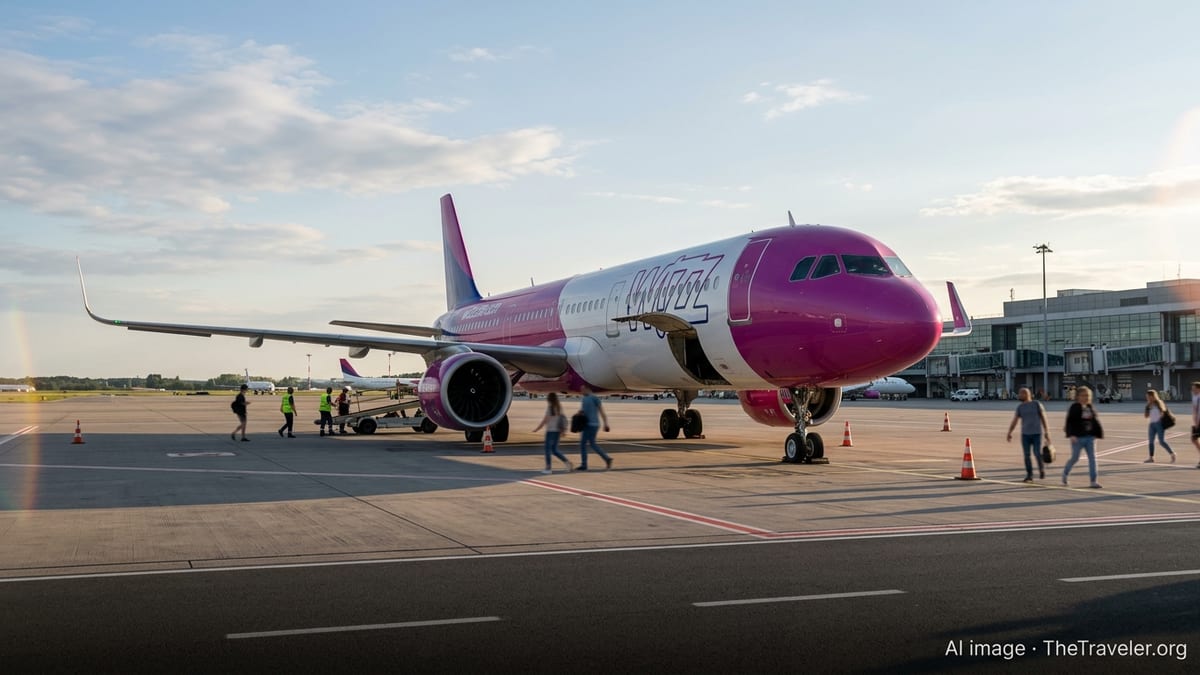
New Recognition in a Competitive Ultra-Low-Cost Field
The 2026 ranking, compiled by an aviation safety and product ratings agency and widely reported by international media, places Wizz Air just behind the top ultra-low-cost carrier worldwide. The assessment sits within a broader set of annual airline tables that evaluate full-service, low-cost and ultra-low-cost operators on safety performance, operational reliability and passenger-focused metrics.
According to published coverage, the ultra-low-cost category highlights carriers that run stripped-back, pay-as-you-go models while maintaining robust safety and operational standards. In this space, Wizz Air’s position in second place reflects how far the airline has evolved from a niche Central and Eastern European player into a sizeable pan-regional group serving Europe, the Middle East and parts of Central Asia.
The recognition follows a series of past appearances for Wizz Air in safety and low-cost rankings. Publicly available company reports describe the airline as one of Europe’s fastest-growing ultra-low-cost operators, a status supported by steady capacity growth and rising passenger volumes over recent financial years.
Wizz Air’s new accolade also comes as the ultra-low-cost segment continues to mature, with competition intensifying from rivals in Western Europe and the Gulf. Second place in an increasingly crowded field positions the airline as a reference point for budget-conscious travelers weighing price against reliability and perceived quality.
Safety, Young Fleet and Operational Discipline Under Scrutiny
While the 2026 ultra-low-cost ranking focuses primarily on value-focused carriers, it draws on similar safety-led criteria to those used in broader annual lists of the world’s safest airlines. Reports indicate that evaluators weigh factors such as incident history, results of safety audits, regulatory oversight, and the age and composition of each airline’s fleet.
Wizz Air’s publicly reported fleet strategy has for several years emphasized new-generation Airbus A320 and A321 family aircraft, with a growing share of more fuel-efficient neo variants. Company stock market filings show that the group has been systematically retiring older jets in favor of a more uniform, younger fleet, a move that can support both safety and maintenance predictability as well as lower fuel burn.
Industry analysis of the 2026 safety tables notes that leading low-cost and ultra-low-cost airlines are increasingly converging with full-service carriers in core safety performance. Within this context, Wizz Air’s placement near the top of the ultra-low-cost rankings signals that deep discounting and strong safety credentials are no longer viewed as mutually exclusive.
Operational discipline is another factor frequently highlighted in coverage of Wizz Air. High aircraft utilization, tight turnarounds and dense seating are central to its business model, but they also require precise planning and robust crew training. The airline’s consistent inclusion in high-profile rankings suggests that, despite periodic criticism from passengers over delays and fees, its overall safety record remains competitive within the industry.
Value Proposition: Ultra-Low Fares, Add-Ons and Network Reach
Recognition as the second-best ultra-low-cost airline for 2026 also reflects Wizz Air’s approach to value. The carrier’s model hinges on base fares that are often among the lowest on Europe’s point-to-point routes, combined with unbundled pricing for services such as cabin baggage, seat selection and airport check-in.
Publicly available financial reports show that ancillary revenue is a major contributor to the airline’s income, supporting both margin resilience and continued fare competition. For travelers, this means that headline prices can be very low, particularly when booking well in advance, but that total trip costs depend heavily on individual choices around luggage and flexibility.
Network reach further strengthens Wizz Air’s value proposition. The group operates from multiple bases across Central and Eastern Europe, with additional operating platforms in Malta and the Gulf region. Recent media coverage has highlighted plans to deepen its presence in key leisure and visiting-friends-and-relatives markets, including an intention to open a new hub in Israel by spring 2026 and ongoing expansion in the Middle East.
By focusing on secondary airports and underserved city pairs, the airline has been able to stimulate new demand and capture price-sensitive travelers who are prepared to trade central airport locations or schedule frequency for lower fares. The 2026 ultra-low-cost ranking effectively acknowledges that this strategy continues to resonate with a broad customer base.
Sustainability and Efficiency as Strategic Pillars
Alongside safety and pricing, Wizz Air has increasingly positioned sustainability and efficiency as central to its brand narrative. Company half-year and full-year reports emphasize targets for reducing carbon emissions per passenger kilometer, supported by fleet renewal and high seat densities that spread emissions across more travelers.
These efforts align with wider industry moves to showcase environmental performance as a differentiator, particularly in Europe where regulatory scrutiny and passenger awareness of aviation’s carbon footprint continue to rise. While ultra-low-cost carriers are sometimes criticized for stimulating additional flying, their newer aircraft and tightly packed cabins can result in comparatively low emissions per passenger compared with older, less efficient fleets.
In this context, Wizz Air’s ranking as the world’s second-best ultra-low-cost airline for 2026 can be viewed not only as a reflection of its cost base and network, but also of its progress in aligning commercial growth with environmental and efficiency benchmarks that matter increasingly to regulators and travelers.
Industry commentary suggests that airlines which marry low fares with strong safety records and credible sustainability strategies are likely to be better positioned in future rankings and in the competition for investment capital. Wizz Air’s latest recognition appears consistent with this broader shift in what constitutes “quality” in the budget travel sector.
What the 2026 Ranking Means for Travelers
For passengers, Wizz Air’s elevated position in the 2026 ultra-low-cost league table may provide an additional reference point when comparing options on busy intra-European and regional routes. While rankings are only one lens on airline performance, they can influence perceptions of safety and reliability in a segment where price often dominates decision-making.
Travel media commentary notes that ultra-low-cost carriers still require careful reading of fare rules and fee structures, and Wizz Air is no exception. Travelers who understand the model and plan around carry-on rules, online check-in requirements and change fees are typically best placed to capture the savings that underpin the airline’s appeal.
The 2026 recognition also arrives at a time when competition among low-cost and ultra-low-cost airlines remains intense, particularly on Mediterranean leisure routes and major migrant and student travel corridors. Being named the world’s second-best ultra-low-cost airline gives Wizz Air a marketing asset that can be deployed across these markets, even as the carrier continues to navigate capacity constraints, engine issues and broader economic uncertainty.
For the wider industry, Wizz Air’s position in the latest rankings illustrates how ultra-low-cost carriers have become integral to global air travel, not only as price leaders but increasingly as operators that meet, and in some cases shape, emerging standards in safety, efficiency and value.