

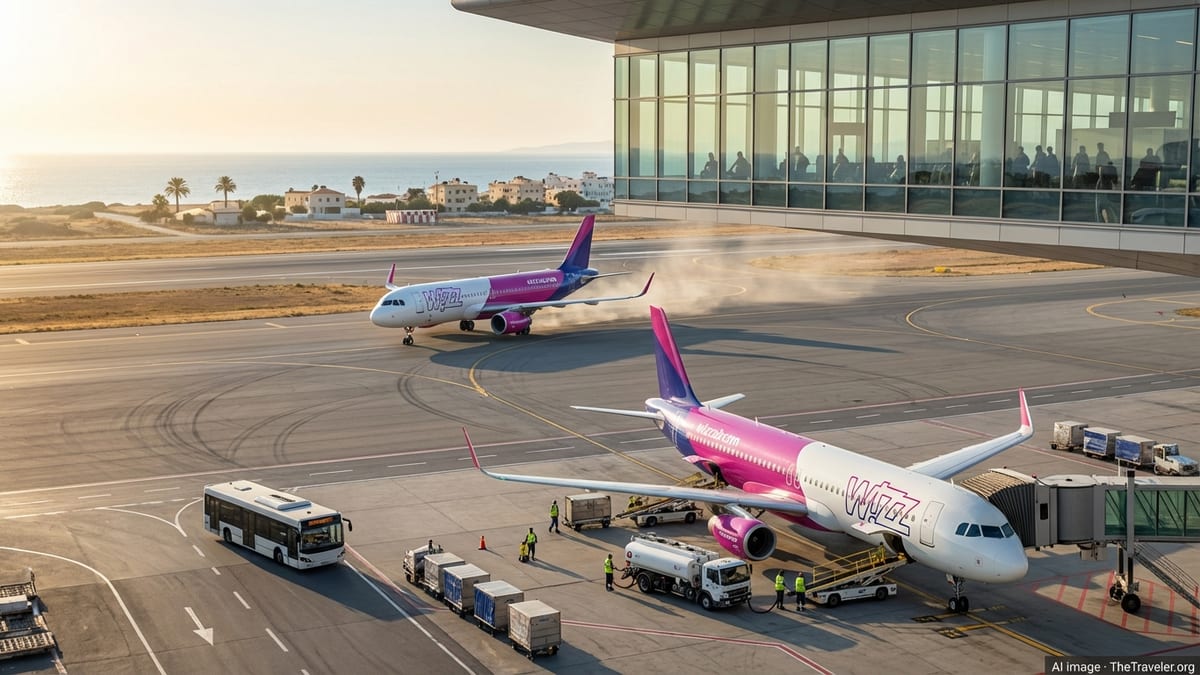
Cyprus is preparing for one of its busiest summers on record as Wizz Air sharply increases capacity and frequencies from Larnaca Airport for the 2026 peak season, cementing the island’s status as a low-cost gateway between Europe, the Middle East and beyond.
Larnaca’s Meteoric Rise From Regional Airport to Strategic Hub
Larnaca Airport has quietly become one of the Mediterranean’s fastest-growing gateways, and Wizz Air’s plans for summer 2026 are set to push it into a new league. Fresh traffic figures from Hermes Airports show that Larnaca handled more than 7.7 million passengers in the first nine months of 2025 alone, helping Cyprus’ two international airports set an all-time record of 10.7 million passengers over that period. That momentum follows a record-breaking 12.3 million passengers across Larnaca and Paphos in 2024, underscoring how quickly demand has accelerated.
The surge has been driven in part by geopolitical shifts in the wider region. As airlines re-route flights away from more volatile parts of the Middle East, Cyprus has emerged as a reliable, politically stable alternative for both point-to-point leisure traffic and connecting flows. Larnaca, in particular, has capitalized on this trend, becoming a practical bridge between Western Europe, the Balkans, the Gulf and the Caucasus, with low-cost carriers like Wizz Air at the forefront.
Hermes Airports has responded by upgrading infrastructure and planning capacity for up to 17.4 million passengers in the coming years, with Larnaca alone expected to handle as many as 12.4 million travelers annually once expansion work is complete. That investment aligns with Wizz Air’s decision to deepen its presence on the island, positioning Larnaca as a core base within the airline’s pan-European network as it looks ahead to the 2026 high season.
While official published schedules for summer 2026 are still being finalized, booking data and airline announcements indicate that Wizz Air is layering in more frequencies on key leisure routes and consolidating its role as Larnaca’s dominant low-cost operator. For Cyprus, that translates into more seats, more source markets and tighter integration into Europe’s budget-travel map.
Wizz Air’s Expanding Footprint: From Abu Dhabi to Central Europe
One of the clearest signs of Wizz Air’s commitment to Cyprus is the restoration and extension of its Abu Dhabi to Larnaca service. The airline reintroduced the route in November 2025 with four weekly flights, branding it as an affordable bridge between the Gulf and the Mediterranean. Schedules published by the carrier and confirmed by industry reports show the connection running through at least late October 2026, effectively locking in a full summer season of capacity into Cyprus from the UAE.
The Abu Dhabi link plugs directly into Wizz Air’s broader network strategy. Even as the airline winds down its Abu Dhabi joint venture operations to refocus on core European markets, it is maintaining Larnaca on the map via its Hungarian and Maltese units. That ensures continuity for travelers in the Gulf while reinforcing Cyprus as a cost-effective entry point into the European Union, particularly attractive for budget-conscious holidaymakers and diaspora travelers.
Alongside the Gulf connection, Wizz Air continues to expand and densify routes from Central and Eastern Europe into Larnaca. Services from key markets such as Budapest, Katowice, Krakow and Bucharest are part of a wider push to capture outbound demand from price-sensitive travelers seeking sun, sea and short-break escapes. These routes feed directly into Cyprus’ strongest source markets, which remain the United Kingdom, Greece, Israel, Poland and Germany, and extend the island’s reach into secondary cities that previously had limited or no direct access.
For summer 2026, aviation analysts expect Wizz Air to prioritize frequency increases on proven performers rather than an overextension into entirely new Larnaca routes. That means more weekly flights on existing city pairs at peak times, better weekend options and improved schedule spread that makes three to five day trips more practical. In an intensely competitive low-cost landscape, owning the timetable is as important as adding new dots to the map.
Cyprus Tourism Surges as Capacity Ramps Up
The airline’s capacity decisions are closely intertwined with Cyprus’ tourism trajectory. Official data from the Cyprus Statistical Service and recent industry analysis show that tourist arrivals reached more than 4.5 million visitors in 2025, a double-digit percentage increase over 2024. December 2025 alone saw arrivals jump by around 18 percent year on year, an unseasonably strong performance that points to progress on Cyprus’ long-standing goal of stretching the tourist season beyond the summer peak.
For 2026, tourism officials and industry stakeholders are cautiously optimistic that arrivals could surpass the 5 million mark if macroeconomic conditions hold and aviation capacity materializes as planned. Wizz Air’s expanded summer schedule from Larnaca is central to that outlook. More low-fare seats from core markets make Cyprus competitive against rival Mediterranean destinations that are also racing to lock in budget capacity for the season.
Tour operators in the United Kingdom, Poland and Germany are already packaging Wizz Air services into inclusive holidays, combining low-cost flights with aggressively priced accommodation. Hotel groups along Cyprus’ south and east coasts report longer booking curves for 2026 than in previous years, with early-bird discounts and dynamic pricing fueled by the expectation of strong airlift from carriers such as Wizz Air and Cyprus Airways.
At the same time, the island’s tourism strategy is increasingly focused on diversification. Beyond the traditional beach product, Cyprus is promoting rural tourism, wine routes, hiking and cultural city breaks in Nicosia and Larnaca itself. Cheap, frequent flights are critical to that pivot, making it viable for younger travelers and repeat visitors to book shorter, off-peak trips tied to festivals, sports events or nature activities rather than only week-long summer stays.
Infrastructure, Investment and the Challenge of Managing Growth
The rapid increase in passenger numbers at Larnaca and Paphos is testing infrastructure that only recently emerged from the pandemic slowdown. Hermes Airports has committed to around 170 million euros in investment to expand terminal capacity, improve boarding facilities and enhance overall passenger experience at both airports. Part of that funding is earmarked for additional boarding bridges at Larnaca, larger security and check-in areas and upgraded baggage systems capable of handling sustained volumes through the year.
For summer 2026, some of this capacity will still be in the delivery pipeline rather than fully operational. That raises practical questions about how Larnaca will manage peak days when Wizz Air, Cyprus Airways and other carriers are all banking multiple departures within narrow time windows. Ground-handling resources, air traffic flow management and landside access, including parking and public transport, will all be under pressure if demand matches or exceeds 2025’s record-breaking traffic.
Local business groups nonetheless see the surge as an opportunity. Increased flight volumes have knock-on benefits for airport employment, logistics, catering and aviation services, as well as for hotel development and real estate in the wider Larnaca district. Several hospitality and mixed-use projects near the airport corridor and coastal strip are being marketed explicitly on the back of improved air connectivity and expectations that Wizz Air and other low-cost carriers will maintain high seat capacity through at least the mid-2020s.
The key policy challenge for Cyprus will be to balance growth with resilience. The country is currently grappling with a severe drought, and officials are warning that water resources are under unprecedented strain heading into the 2026 tourist season. More visitors flying into Larnaca means greater pressure on local infrastructure, from desalination and wastewater systems to energy grids and transport networks. Coordinating tourism growth, environmental protection and airport expansion will be a central theme of policy debate as the Wizz Air-driven boom gathers pace.
Competitive Dynamics: Can Rivals Match Wizz Air’s Cyprus Play?
Wizz Air’s aggressive posture at Larnaca is not unfolding in a vacuum. Other European low-cost carriers and legacy airlines are also eyeing Cyprus, though none currently match Wizz Air’s combination of scale, cost base and focus on Central and Eastern European feed. While Ryanair has historically concentrated its Cyprus operations at Paphos, and easyJet maintains a more selective presence, Wizz Air has treated Larnaca as a cornerstone of its eastern Mediterranean strategy, with a growing roster of routes and higher utilization of based aircraft.
Industry observers note that the airline’s decision to sustain a cross-regional link such as Abu Dhabi to Larnaca through to late 2026 indicates a willingness to think beyond traditional east-west holiday flows. The route positions Cyprus as an intermediate destination for Gulf residents seeking cooler summers and European culture, and for Cypriots and Europeans looking for relatively low-cost access to the UAE. That dual-direction demand provides a buffer against seasonal swings and heightens Wizz Air’s leverage in the local market.
Legacy carriers have responded with capacity tweaks of their own, particularly on high-yield routes from London and major European capitals. However, with airport slots tight in many of those cities and cost pressures mounting, few are eager to engage in a full-scale fare war on leisure-heavy routes into Cyprus. Instead, they are seeking to differentiate through schedule quality, connectivity to long-haul networks and premium cabins, leaving Wizz Air and its low-cost peers to dominate the price-sensitive segment.
For Hermes Airports and Cyprus’ tourism authorities, that competitive landscape offers both opportunities and risks. Heavy dependence on a small number of low-cost carriers concentrates exposure to their strategic decisions, as seen when airlines rapidly reshuffled networks in response to geopolitical tensions. At the same time, a strong anchor tenant like Wizz Air helps secure long-term route continuity and underpins the business case for infrastructure upgrades that benefit all operators.
Economic Ripple Effects Across Cyprus
The economic implications of Larnaca’s growing role as a Wizz Air stronghold extend far beyond airport perimeters. Tourism already accounts for a significant share of Cyprus’ GDP, and the 12.2 percent jump in visitor arrivals recorded in 2025 is filtering into retail, hospitality, transport and cultural sectors. Taxi and ride-hailing services around Larnaca report higher utilization throughout the year, not just in July and August, while car-rental firms are expanding fleets in anticipation of another busy summer in 2026.
Local businesses in Larnaca’s city center, from cafes and tavernas to boutique hotels and short-term rentals, are feeling the impact of increased weekend and short-break traffic. Budget travelers arriving on Wizz Air flights often spend less per day than luxury tourists but tend to visit in higher volumes and outside traditional peak weeks, supporting more stable year-round trade. That shift is encouraging some owners to adapt with digital booking tools, multilingual staff and menu offerings tailored to Central and Eastern European tastes.
Real estate markets are also reacting. Property agents report interest from foreign buyers who see Cyprus as an accessible base within the European Union, supported by relatively cheap and frequent flights to their home countries. The combination of favorable tax structures, a warm climate and expanding air services is particularly attractive to remote workers, retirees and investors from Poland, Romania and Hungary, many of whom travel with Wizz Air several times a year.
Government officials argue that this wave of connectivity-driven investment must be channeled into sustainable development. That includes encouraging upgrades to energy-efficient buildings, promoting public transport links between the airport and coastal resorts, and supporting skills training in tourism, aviation and digital services to ensure that local communities capture a greater share of the value created by rising passenger numbers.
Balancing Growth With Sustainability Ahead of Summer 2026
As Wizz Air prepares to flood Larnaca with additional summer 2026 capacity, questions of sustainability and quality of life are moving to the forefront. Cyprus is confronting a once-in-a-century drought, with reservoirs at historically low levels and authorities calling on residents to cut water consumption by around 10 percent. The timing is sensitive: the island’s water system will have to support both residents and millions of additional visitors flying in for peak season holidays.
Tourism operators and airlines are increasingly aware that their own long-term prospects depend on how Cyprus navigates these environmental pressures. Hotels are rolling out water-saving measures, from low-flow fixtures to smart irrigation in gardens, while some municipalities are exploring tourist education campaigns at airports and accommodations to encourage responsible water use. At Larnaca, operational changes such as optimizing aircraft turnaround times and ground-power usage are part of broader industry efforts to curb emissions and resource use.
For travelers booking Wizz Air seats into Larnaca for summer 2026, the experience is likely to showcase both the benefits and the strains of rapid growth. On the positive side, they will enjoy more route options, competitive fares and increasingly sophisticated tourism offerings at the destination. On the challenging side, they may encounter crowded peak-time terminals, busy beaches and a visible public debate within Cyprus about how to reconcile economic expansion with environmental limits.
How successfully Cyprus and its aviation partners manage that balancing act will help determine whether Larnaca’s current boom evolves into a sustainable long-term position as a premier Mediterranean hub. For now, Wizz Air’s flight surge for summer 2026 signals clear confidence in the island’s appeal and in Larnaca’s ability to anchor the airline’s network at the crossroads of Europe and the Middle East.