

More news on this day
Millions of football fans are expected to pour into the United States for the 2026 FIFA World Cup, but many may be surprised to discover that some of the toughest tests will come long before kick-off. A dense web of visa rules, security procedures, customs checks and stadium restrictions is set to shape the match-day experience in ways many international visitors have never encountered before.
Get the latest news straight to your inbox!
Tighter Borders and Complex Entry Rules for World Cup Visitors
The 2026 tournament, running from June 11 to July 19 across the United States, Canada and Mexico, comes as the United States is tightening elements of its border and immigration regime while simultaneously promising to welcome record numbers of visiting fans. Publicly available policy analysis notes that recent U.S. measures have focused on heightened security screening and additional data collection, including from travelers who would normally qualify for visa waivers.
Reports on travel and mobility trends indicate that, ahead of the World Cup, U.S. authorities have proposed expanded requirements for many non-citizens, including requests for social media identifiers, more extensive biometric data and more detailed travel histories. Travelers from countries that previously enjoyed relatively light formalities under the Visa Waiver Program are being urged by consular advisories and airline guidance to apply for electronic travel authorization well in advance to avoid last-minute denials.
Specialist mobility briefings also highlight a trend toward higher visa application fees and longer interview wait times at some U.S. consulates. In response to the projected surge in demand from World Cup spectators, the United States has pledged to prioritize and expedite certain interview slots, but analysts warn that capacity will remain limited in some regions and that fans who wait until early 2026 to begin paperwork may find themselves shut out.
Legal experts tracking border policy caution that many rules remain subject to rapid change. Visitors are advised to check official government sources repeatedly in the months leading up to their trip and to ensure that any supporting documentation, such as proof of accommodation and onward travel, is kept organized and readily available for inspection at ports of entry.
Airport Security, Liquids and Electronics: The TSA Routine
For many fans, the first encounter with strict American rules will occur at airport security checkpoints. The Transportation Security Administration continues to apply the so-called 3-1-1 standard for carry-on liquids on most passenger flights, generally limiting liquids, gels and aerosols in hand luggage to small containers placed in a single quart-sized transparent bag. Larger quantities must usually be checked, and travelers who arrive at screening with oversize toiletries can expect delays while items are discarded or repacked.
Security guidance further notes that laptops and many larger electronic devices must often be removed from bags and placed in separate bins for screening, unless passengers are using lanes equipped with newer scanning technology where different procedures may apply. Metal items, belts and bulky clothing frequently trigger secondary checks, and fans connecting to domestic flights after arriving from abroad can be required to clear security again.
Analysts point out that TSA officers have significant discretion when an item appears suspicious on an X-ray image or when a traveler’s bag triggers alarms. Even objects that are technically permitted may be refused at the checkpoint if they cannot be cleared to the agency’s satisfaction. For World Cup visitors juggling team banners, souvenirs and camera equipment, that discretionary power can translate into unexpected confiscations.
Travel industry briefings emphasize that travelers who want to minimize disruption should pack match-day essentials in a simple, easy-to-search bag for flights, avoid overstuffed carry-ons and be prepared to separate electronics, liquids and chargers quickly. Anything resembling a replica weapon, pyrotechnic device or pressurized container is likely to draw extra scrutiny and may be barred from flights entirely.
Customs and the Shock of the Food and Souvenir Rules
Once through passport control, incoming World Cup fans face another strict gatekeeper: the United States customs regime, which places particular emphasis on protecting agriculture. Customs and Border Protection guidance stresses that all arriving passengers must declare any food, plant material or animal products on their customs form, including small amounts of snacks, spices or homemade items tucked into luggage.
U.S. customs information explains that certain foods, especially fresh fruits, vegetables, meats and dairy products, are either tightly restricted or prohibited because of the risk of introducing invasive pests and livestock diseases. Passengers who fail to declare such items can face immediate confiscation and potentially significant civil penalties, even if the food would have been refused entry in any case. By contrast, travelers who declare items that turn out to be disallowed are generally not fined, although the goods will still be seized.
Agricultural agencies have launched seasonal campaigns reminding international visitors that seemingly harmless souvenirs can also create problems. Some untreated wooden handicrafts, seeds, traditional herbal products and animal-derived curios may require permits or may be refused entry at the border. Publicly available guidance warns that, in extreme cases, attempting to import restricted wildlife products or protected cultural artifacts can result in criminal investigations and the seizure of the items involved.
World Cup tourists are therefore being urged, in travel advisories and airline briefings, to think carefully before packing regional delicacies, homemade meat products or unprocessed plant material from home. Officials advise buying packaged, clearly labeled food and souvenirs from reputable retailers once inside the United States instead of attempting to bring them through customs in personal luggage.
Surprise Stadium Restrictions: Clear Bags, Searches and Confiscations
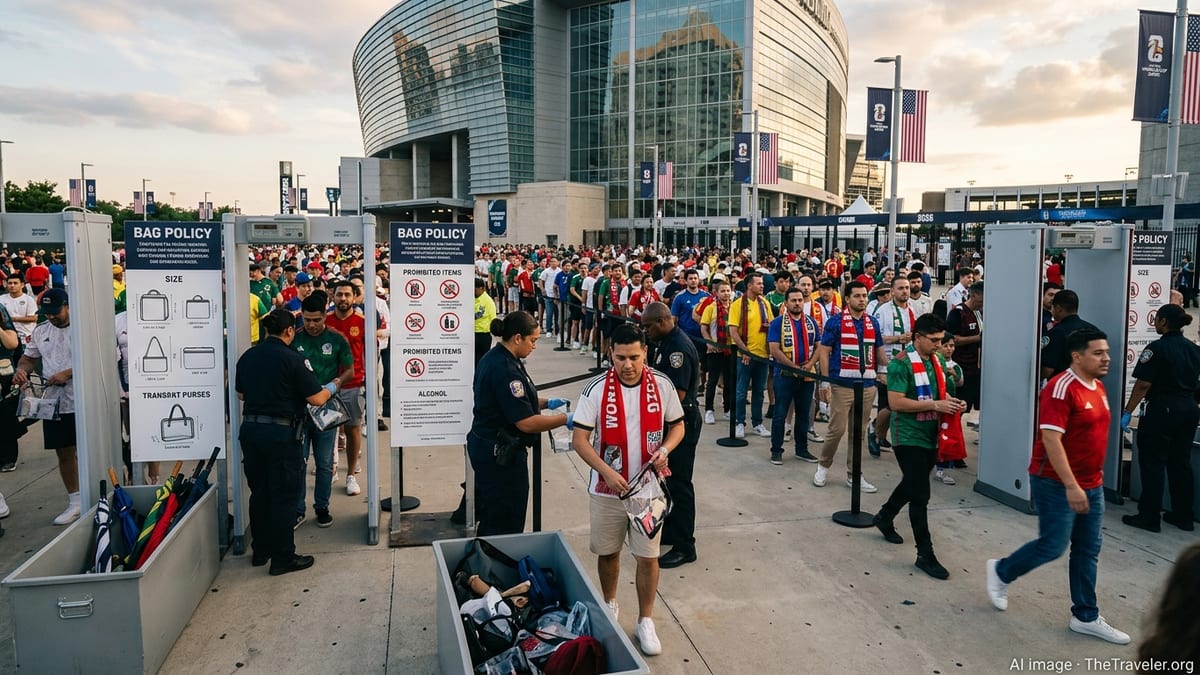
Inside the host cities, some of the strictest American rules will reveal themselves at the stadium gates. Most of the large U.S. venues selected for the 2026 World Cup are multipurpose arenas that currently follow the National Football League’s clear bag model or closely related standards for major events. These policies sharply limit both the size and the type of bags that fans may bring to their seats.
Guidance published by multiple U.S. stadiums shows near-identical language: spectators are typically allowed one clear plastic, vinyl or PVC bag not exceeding around 12 by 6 by 12 inches, or a small clear freezer bag of similar volume. In addition, a tiny opaque clutch or wallet, often limited to roughly 4.5 by 6.5 inches, may be admitted. Backpacks, large purses, camera bags and many drawstring sacks are normally refused, even if they would pass standard security checks in other countries.
Stadium policies also list a wide range of prohibited items, including many that European or South American fans might assume are harmless. Hard-sided containers, metal water bottles, large power banks, professional-grade cameras with long lenses, vuvuzelas and other noisemakers, laser pointers and any form of pyrotechnics are routinely banned. Venues reserve the right to refuse other objects they view as disruptive or unsafe, and bag checks at some arenas are known to be rigorous.
Travel forums and supporter groups warn that enforcement can be unforgiving. Fans who arrive with non-compliant bags are often told to return items to their vehicles or to use paid external lockers, which may not be available at every site. For visitors arriving by public transport without easy access to storage, this can mean missing the start of matches or losing personal belongings at the gate.
Alcohol, Smoking and Behavior: Strict Conduct Codes in the Stands
Beyond bag checks, U.S. stadiums typically enforce detailed codes of conduct that may surprise supporters used to more relaxed match-day cultures. Venue guidelines for American football and other major sports often limit where and when alcohol can be consumed, confining drinking to concourse areas and seating zones and setting clear cutoff times during games. Identification checks can be strict, and anyone who appears to be supplying alcohol to underage fans risks ejection.
Publicly available stadium rules show that smoking and vaping are usually forbidden inside the bowl and in most indoor spaces, with only a few designated outdoor areas, if any, available to ticket holders. Some venues have moved toward completely smoke-free campuses, meaning that fans who exit to smoke may not be allowed back in, even with a valid ticket. Cannabis use remains illegal under federal law despite differing state regimes, and stadium policies generally treat it in the same way as other banned substances.
Behavioral expectations are also tightly defined. Codes of conduct for major U.S. arenas typically prohibit threatening language, targeted harassment, discriminatory chants and entering the playing area. Fans who ignore warnings from staff can be removed from the venue without refund, and serious incidents may be referred to local law enforcement. Supporter groups traveling to 2026 matches are being advised to familiarize themselves with local rules on flags, banners and musical instruments, which may require prior approval.
Event planners note that these restrictions are designed to balance vibrant supporter culture with safety and comfort standards that U.S. venues apply across concerts, league games and international fixtures. For many visiting fans, however, the effect will be a noticeably more regulated environment, where crossing certain behavioral lines can have swift and sometimes costly consequences.
Planning Across 11 U.S. Host Cities With Different Local Rules
The 2026 World Cup will be played in a sprawling set of American host cities that includes New York and New Jersey, Los Angeles, Dallas, Atlanta, Houston, Miami, Kansas City, Seattle, San Francisco Bay Area, Boston and Philadelphia. While FIFA will set broad tournament standards, many of the rules that fans actually encounter will be shaped by local laws, venue operators and state-level regulations.
Public guidance from recent major events in these markets shows that regulations can differ sharply from city to city. Open-container laws affect where supporters can drink alcohol outside stadiums, local transit rules govern what can be carried on trains and buses, and city ordinances influence noise limits for organized fan marches and late-night celebrations. Some jurisdictions have extensive surveillance and crowd-control infrastructure around sports venues, which can lead to controlled access zones and temporary street closures on match days.
Accommodation rules are also evolving. Cities that hosted earlier mega-events have tightened safety and licensing requirements for short-term rentals, including popular home-sharing platforms, leading to more inspections and, in some cases, restrictions on group sizes. Visitors who leave bookings until the last minute may find that low-cost options come with stricter house rules, such as quiet hours and visitor limits that are enforced by neighborhood complaint hotlines.
Travel analysts argue that, taken together, this patchwork of local regulations means World Cup fans cannot rely on a single national standard for their match-day routines in the United States. Instead, they will need to study venue-specific policies, check city and state rules and build extra time into their schedules to navigate security lines, customs inspections and transport bottlenecks that reflect some of the strictest event regulations in modern international sport.