

More news on this day
Americans planning international trips this spring are being urged to reassess their itineraries as the United States sharpens its worldwide guidance in response to an escalating conflict with Iran, with new advisories highlighting heightened security risks, transport disruptions and potential spillover threats far beyond the Middle East.
Get the latest news straight to your inbox!
Worldwide Caution Elevated After Combat Operations Begin
The US Department of State issued an updated Worldwide Caution on February 28, 2026, shortly after US forces joined Israeli strikes on targets inside Iran. Publicly available information shows that the alert calls on US citizens everywhere, and particularly those in the Middle East, to review official country advisories, monitor local security updates and keep contingency plans for rapid departure.
The global notice reflects concern that Iran and aligned groups could seek to respond to the campaign through asymmetric attacks, cyber operations or opportunistic violence in locations frequented by Western travelers. Published coverage notes that US-linked sites, diplomatic facilities and energy infrastructure have already been targeted in a widening theater that includes Iraq, Syria, Bahrain and Oman.
Travel industry analyses indicate that this is the most consequential US warning since the October 2023 Israel–Gaza crisis, but on a broader geographic scale. The guidance does not prohibit Americans from going abroad, yet it emphasizes that risk levels are changing quickly and that individuals are expected to take greater responsibility for their own security decisions.
Middle East Hotspots Face Highest Risk Levels
The sharpest warnings are concentrated in and around the Gulf, where the fighting is most intense. Iran, Iraq, Syria and Yemen were already listed at the US government’s highest advisory tier before the current war; in March 2026, travel-focused outlets report that the State Department reinforced messages urging US citizens in several of these locations to leave while commercial options remain available.
Lebanon has also seen a significant tightening of guidance. According to recent reporting, nonessential US diplomatic staff and family members have been ordered to depart, and Americans in the country are being encouraged to consider exit plans amid fears that Israel–Iran exchanges could draw in Hezbollah and other armed groups along the border.
In Oman and Bahrain, both of which host critical US military facilities, Iranian missile and drone activity has struck near ports and infrastructure. Open sources describe evacuations of some US government personnel and temporary closures or restrictions at selected airports and seaports, amplifying concerns about the reliability of transit through these hubs for civilian travelers.
Beyond the immediate conflict zone, neighboring states such as Jordan, Saudi Arabia, Qatar and the United Arab Emirates are not currently at the highest alert level, but regional risk assessments warn that airspace restrictions, potential demonstrations and cyber incidents could disrupt itineraries with little notice.
Strait of Hormuz Crisis Ripples Across Global Travel
The closure and contestation of the Strait of Hormuz, a narrow waterway that carries a significant share of the world’s seaborne oil, has triggered wider disruption in global mobility. Maritime intelligence summaries and port advisories describe a near halt to commercial shipping through the strait since late February, as Iranian forces challenge vessel movements and the United States mounts an aerial campaign to secure sea lanes.
While cruise tourism in the region was modest even before the conflict, the stoppage has forced the cancellation or rerouting of remaining Gulf itineraries and led shipping companies to divert cargo around Africa or through alternative chokepoints. These changes lengthen voyage times and raise costs, with downstream effects on airfare, fuel surcharges and the broader price of travel.
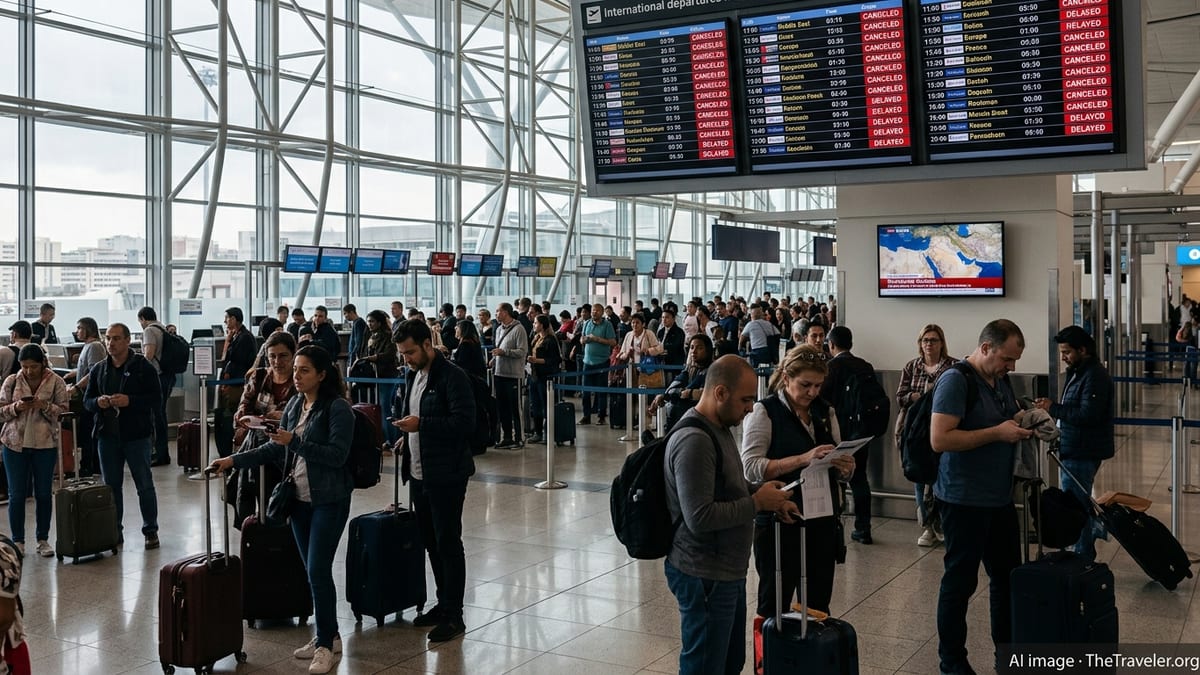
Aviation has been similarly affected. Regional overflight restrictions and security concerns have prompted airlines to suspend or reroute flights across parts of the Middle East, with some long haul services between Europe, North America and Asia adding several hours by tracking south over Africa or north via the Caucasus. Industry trackers indicate that persistent detours, higher insurance premiums and volatile oil prices are feeding into the largest increase in average airfares in more than a year.
For individual travelers, the immediate impact is visible in longer travel times, tighter connection windows and less predictable schedules. Travel risk consultancies are advising companies and leisure passengers alike to build in additional buffer days, avoid nonrefundable bookings in affected regions and monitor airline communications closely up to the day of departure.
US Advisory Map Tightens Beyond the Middle East
The Iran conflict is unfolding against a backdrop of already elevated global risk ratings. Recent roundups of State Department advisories for 2026 highlight a long list of destinations under Level 4 "Do Not Travel" guidance, including Russia, Ukraine, Haiti, Sudan, Libya, North Korea and parts of the Sahel, alongside Iran, Iraq and Yemen.
Travel publications that track these changes note that several countries have recently been upgraded or reconfirmed at higher alert tiers due to overlapping concerns such as armed conflict, terrorism, civil unrest, kidnapping and limited consular access. While these advisories predate the latest Iran crisis in many cases, analysts warn that the new war could aggravate instability in fragile states or inspire opportunistic attacks far from the main front.
This has practical implications for travelers whose journeys cross multiple high risk jurisdictions. Flights and cruise itineraries that previously used regional hubs in the eastern Mediterranean, Red Sea or Gulf may now pass through alternate airports, shifting layovers to cities with different security considerations. Insurance companies are revisiting war risk exclusions and, in some cases, restricting coverage for trips to certain countries or within defined maritime zones.
At the same time, popular destinations in Europe, East Asia and the Americas remain open and are not directly targeted in current travel advisories related to the Iran conflict. However, tourism boards and airlines in those regions are preparing for second order effects, including higher operating costs and possible shifts in demand if US travelers opt to substitute long planned journeys to the Middle East with trips closer to home.
What US Travelers Should Watch in the Weeks Ahead
Security specialists emphasize that the current alerts describe a fluid situation rather than a static map of danger. The most significant variables in the near term include the trajectory of the US and Israeli military campaign, Iran’s response through direct strikes and proxy groups, and any attempts to further disrupt global chokepoints such as the Strait of Hormuz or key Red Sea routes.
For US citizens abroad, publicly available guidance stresses a few consistent themes. Travelers are urged to enroll in official notification programs when available, maintain a low profile in areas where anti American sentiment may flare and avoid crowds, demonstrations and locations associated with government and military activity, including bases, ports and energy facilities.
Prospective travelers are being encouraged by travel industry advisories to scrutinize the latest country specific notices shortly before departure rather than relying on older information from the time of booking. Given rapid shifts seen since late February, experts suggest that even itineraries outside the Middle East be checked for indirect exposure, such as aircraft that rely on contested air corridors or cruises that might transit high risk maritime zones.
While there is no blanket prohibition on international trips for Americans, the tone of recent updates marks a clear shift toward heightened vigilance. As the US Iran confrontation continues to evolve, individuals and travel providers alike are adjusting to a landscape in which geopolitical shocks can reshape routes, timetables and risk calculations in a matter of days.