

More news on this day
Xcel Energy has traced last month’s sweeping power outage at Denver International Airport to a single malfunctioning piece of new equipment, clarifying what caused a blackout that stranded passengers, stalled trains and elevators, and disrupted nearly 500 flights at one of the nation’s busiest hubs.
Get the latest news straight to your inbox!
Utility identifies failed component at airport substation
According to recent coverage of the incident, Xcel Energy’s review found that the March 18 outage began as crews were energizing a new transformer at a substation that serves Denver International Airport. When the new equipment malfunctioned during that process, it triggered a cascading power failure that darkened large portions of the airport and halted normal operations.
Publicly available information indicates that the substation fault cut electricity to key systems across the terminal complex, including concourses, baggage operations, retail areas and critical circulation links. Backup systems maintained limited lighting and safety functions, but the loss of primary power left large sections of the airport effectively unusable for regular passenger processing.
Reports describe the failed component as part of a broader infrastructure upgrade intended to support the airport’s long term growth. Instead, the malfunction exposed how a single point of failure at a critical node in the electrical network can ripple through an entire facility, especially when that facility depends on a tightly choreographed flow of aircraft, passengers and ground services.
Xcel Energy has not publicly identified the specific make or model of the equipment involved, but coverage of the outage notes that the failure occurred during commissioning, a phase when assets are being tested and integrated into the live grid. That timing has drawn attention to how new infrastructure is phased in at high stakes transportation hubs.
Travelers trapped and nearly 500 flights disrupted
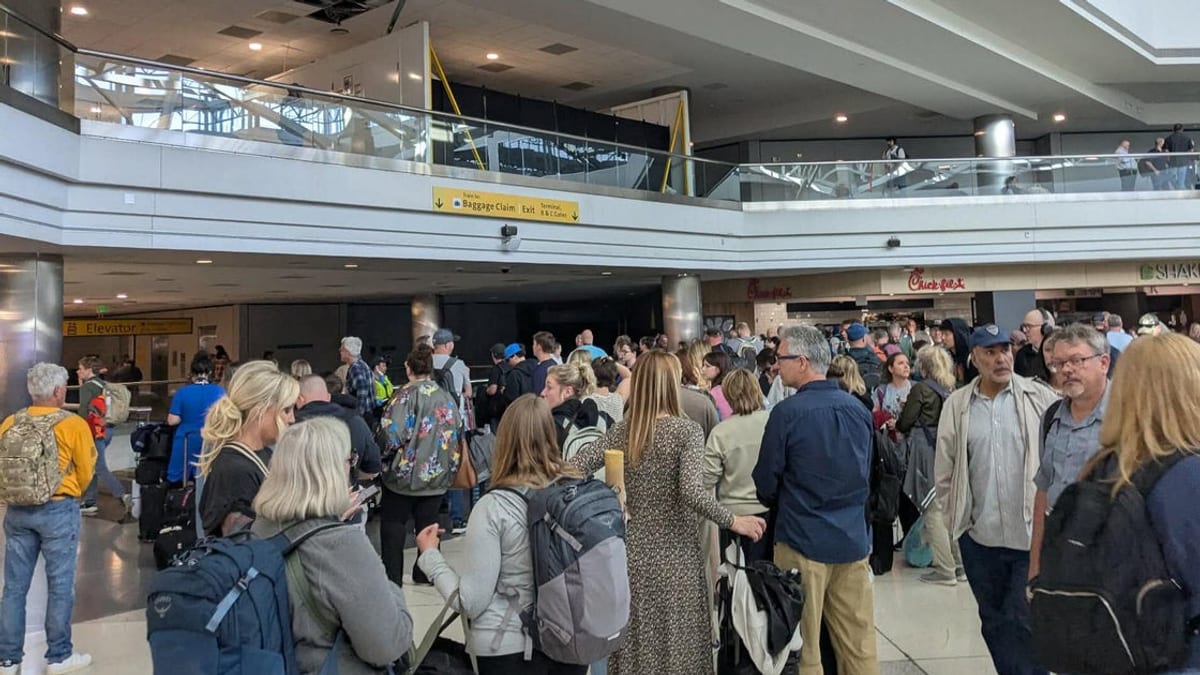
The blackout struck on a busy Tuesday morning, immediately transforming routine travel into a day of uncertainty for thousands of passengers. News reports describe travelers temporarily trapped in elevators, concourse trains stalled in tunnels and long lines forming as check in counters, security lanes and boarding gates lost power or shifted into reduced service.
By the time power was restored across the airport and operations began to recover, nearly 500 flights had been delayed and a smaller number canceled, according to tallies cited in local coverage. The Federal Aviation Administration instituted a ground stop while the extent of the disruption became clear, adding to the backlog of aircraft and crews waiting for clearance to move.
Travelers connecting through Denver faced missed onward flights and hastily rearranged itineraries, while those starting or ending their journeys at the airport encountered crowded terminals as airlines rebooked passengers and repositioned aircraft. In the tightly scheduled world of commercial aviation, the effects extended well beyond Colorado, with knock on delays reported throughout domestic networks.
Online accounts from affected passengers detailed dimmed concourses, manually processed boarding and long waits for updated information. Although safety systems remained in place, the incident highlighted how quickly a modern hub airport can slow to a crawl when its primary power supply falters.
Scrutiny on grid resilience at major air travel gateway
The outage has focused attention on the resilience of Denver International Airport’s electrical supply and the balance between efficiency and redundancy. Planning documents show that the airport receives the bulk of its electricity from Xcel Energy, with power delivered at high voltage to on site distribution systems before being stepped down and routed to terminals, concourses and support facilities.
Industry observers note that airports typically rely on multiple feeds, on site switching yards and layers of backup generation designed to keep essential safety systems running in an emergency. The Denver incident, however, illustrates that even with these measures, failures at key substations can still interrupt normal operations if redundancy is limited while new infrastructure is being installed.
Aviation and energy analysts have pointed to this event as part of a wider conversation about critical infrastructure dependencies. Large airports function as regional economic engines, and even short disruptions can lead to missed business connections, delayed cargo shipments and added costs for airlines and travelers. The Denver blackout, coming on the heels of severe weather and wildfire related power concerns elsewhere in Colorado, has sharpened local debate over how aggressively utilities should invest in grid hardening.
Commentary in regional outlets suggests that regulators, airport planners and utilities are likely to review the incident in detail, looking at how commissioning protocols, protection settings and backup systems performed and where additional safeguards might be warranted as passenger numbers and electrical loads continue to grow.
Xcel Energy response and infrastructure plans
In public statements following the outage, Xcel Energy has acknowledged the equipment failure and indicated that engineers are examining the malfunction to prevent similar incidents. Reports referencing the company’s planning documents note that Xcel has proposed significant investment in substations and transmission infrastructure to keep pace with rapidly expanding demand from Denver International Airport and other large customers in the region.
Coverage of the utility’s broader filings with state regulators describes a focus on modernizing grid components, refining protection schemes and adding new technologies intended to isolate faults more quickly. While many of those efforts have been linked to wildfire risk and extreme weather, the Denver airport outage is now being cited as an example of how grid reliability directly intersects with transportation reliability.
For travelers, the immediate concern is avoiding a repeat scenario in which a single malfunction brings one of the country’s major connecting hubs to a standstill. For Xcel Energy, the incident has become a high profile test of its ability to diagnose a problem, implement fixes and demonstrate that lessons learned are being applied across its system.
Airport stakeholders, from airlines and concessionaires to ground transportation providers, are watching closely as discussions progress between the utility, local officials and regulators. Any resulting upgrades or new operating procedures could shape how Denver International Airport manages electrical risk for years to come, with implications for the reliability of both regional power infrastructure and one of North America’s key air travel gateways.
Ongoing questions for travelers and the industry
While the immediate cause of the outage has now been identified, questions remain about how quickly information reached passengers, how airlines coordinated their responses and what additional communication tools might help during future disruptions. Observers have noted that in a sprawling facility with multiple terminals and diverse passenger flows, clear and consistent messaging can be as critical as restoring physical systems.
Aviation analysts also point to the incident as part of a pattern in which infrastructure issues, from air traffic control glitches to localized grid failures, increasingly shape the travel experience alongside more familiar weather and demand related delays. As airports add electrified ground equipment, expand terminals and integrate new technology, the underlying power supply becomes even more central to smooth operations.
For now, Denver’s March blackout stands as a case study for other major hubs assessing whether their electrical architecture, backup capacity and commissioning processes can withstand similar faults. The answer will influence not only engineering choices but also traveler confidence, as passengers weigh the reliability of different connecting points when planning complex itineraries.
With the immediate crisis over and investigations moving into a more technical phase, the Denver outage continues to reverberate through both the energy and aviation sectors, illustrating how a single failed component can reverberate far beyond the substation fence line.