

More news on this day
The ancient Kizil Caves in Xinjiang, one of China’s earliest Buddhist cave complexes and part of a UNESCO World Heritage corridor, are entering a new phase of visitor-focused development that combines upgraded on-site facilities with expanding digital interpretation.
Get the latest news straight to your inbox!
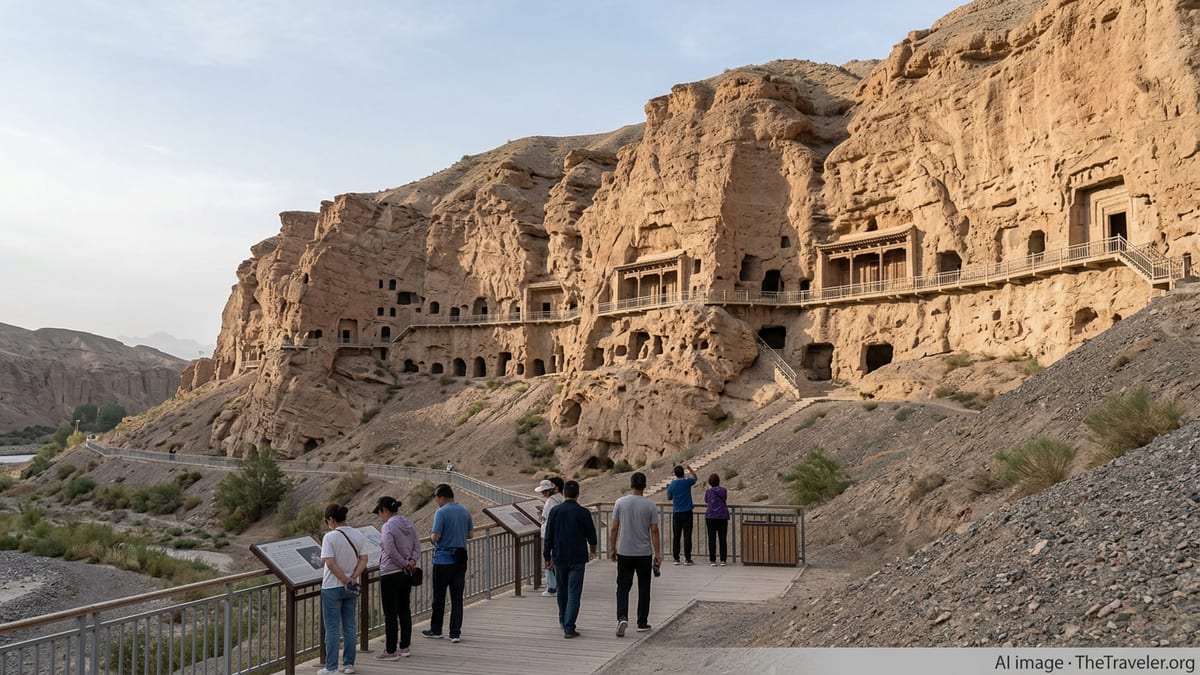
World Heritage Site Adapts to Growing Cultural Tourism
Carved into cliffs along the Muzat River in Baicheng County, Aksu Prefecture, the Kizil Caves form one of the most significant Buddhist grotto complexes on the northern Silk Road. Archaeological research indicates that the site flourished between the 3rd and 8th centuries, with elaborate murals and sculptures documenting centuries of cultural exchange across Central Asia and beyond.
The caves were inscribed in 2014 on the UNESCO World Heritage List as part of the Silk Roads: the Routes Network of Chang’an Tianshan Corridor, a vast serial property linking sites from Xi’an across the Tianshan region. Publicly available information shows that regional authorities have positioned the Kizil Cave Temple Complex as a flagship attraction within broader efforts to build “world-class” cultural tourism destinations in Xinjiang, alongside sites such as the Subashi Buddhist Ruins and Kizilgaha Beacon Tower.
Recent policy documents and regional briefings indicate that Xinjiang’s tourism sector has expanded rapidly, with hundreds of millions of domestic trips recorded in 2024. Within this context, Kizil’s managers are pursuing an approach that seeks to welcome more visitors while placing conservation requirements at the center of site planning.
Museum and Interpretation Upgrades Highlight Qiuci Culture
One of the most visible changes for visitors is the strengthening of museum and interpretation facilities associated with the Kizil Caves and the wider Kucha cultural landscape. Academic research published in 2025 describes an upgrade of the Kizil Kucha Cave Temple Museum and a shift toward more comprehensive interpretive storytelling about the ancient Buddhist kingdom of Qiuci, of which Kucha was the political and cultural heart.
New exhibition strategies place the Kizil Caves within a network of related sites, including nearby grottoes, beacon towers and temple ruins. Displays foreground motifs from the famous murals, from narrative jataka scenes to depictions of merchants, musicians and donors, positioning them as evidence of the cosmopolitan character of Silk Road society.
Reports on regional cultural heritage investment note that Aksu Prefecture has directed significant funding in recent years toward archaeological work, emergency reinforcement and visitor infrastructure at major heritage sites. The Kizil Cave Temple Complex is highlighted within a three-year action plan covering 2024 to 2026 that aims to better integrate Kucha’s World Heritage assets into cultural tourism routes while enhancing on-site interpretation and presentation.
Digital Technologies Deepen Access to Fragile Murals
Because many of the Kizil caves contain fragile murals, access is strictly limited to protect the paintings from humidity, light and visitor impact. Research and media coverage indicate that managers are increasingly relying on digital tools to expand the visitor experience without increasing physical pressure on the original artworks.
A series of recent initiatives has focused on high-resolution documentation, three-dimensional modeling and digital reconstruction of key caves, including monumental image chambers. Scholarly work on the site describes a holistic digital framework that supports not only conservation and research, but also virtual exhibition concepts for visitors who may never enter the most sensitive spaces.
Regional outlets have also highlighted the use of artificial intelligence and advanced imaging to aid mural restoration and visualization at the Kizil caves. These tools allow specialists to clarify faded scenes and test restoration hypotheses virtually, while at the same time generating material that can be presented through projection, interactive screens or immersive installations in nearby visitor centers and museums.
For travelers, the growing use of digital interpretation means that more of Kizil’s narrative can be accessed through replicas, projections and multimedia displays, reducing the need to open large numbers of caves to public footfall. This model mirrors evolving practice at other major grotto sites in China, where virtual access complements carefully controlled in situ viewing.
Balancing Conservation Needs With Visitor Experience
Balancing expanded tourism with strict conservation requirements remains a central challenge at Kizil. Studies released by heritage and conservation specialists emphasize that the caves face multiple stresses, from geological instability in the cliff face to temperature fluctuations caused by human presence. These factors inform the visitor management framework that shapes how guests experience the site.
Available planning documents and technical reports indicate that annual visitor numbers are managed through controls on group sizes, time limits inside certain caves and seasonal adjustments to access. Site staff undertake regular monitoring rounds, checking individual cave doors and ensuring that environmental conditions stay within safe ranges for the murals.
Information made public by heritage organizations notes that physical interventions at the site have focused on consolidation of cave structures, drainage improvements and discreet safety infrastructure along cliff paths. At the same time, new interpretive boards and multilingual explanations help visitors understand both the artistic significance of the murals and the reasons why photography and prolonged stays are often restricted.
This policy mix seeks to position the Kizil Caves as an accessible cultural highlight on regional itineraries while reinforcing the message that the site’s long-term survival depends on careful control of visitor impact.
Part of a Wider Silk Road Heritage Corridor in Xinjiang
The expansion of visitor experience at the Kizil Caves is closely tied to Xinjiang’s broader strategy of building a connected Silk Road heritage corridor. Government briefings and tourism promotion materials describe plans to upgrade roads, scenic routes and archaeological parks so that travelers can move more easily between key Buddhist sites, ancient cities and frontier installations.
In Aksu Prefecture, Kizil is promoted alongside the Subashi Buddhist Ruins, the Kizilgaha Beacon Tower and other grotto complexes as part of an integrated narrative of Kucha’s role on the overland Silk Road. Investments in museums, signage and cultural programming are intended to encourage longer stays and repeat visits, particularly from domestic travelers interested in history and religious art.
Across Xinjiang more widely, other cave and grotto sites in places such as Turpan have recently opened additional chambers or launched new visitor programs, contributing to what regional coverage describes as a “cultural corridor” of Buddhist heritage. The Kizil Caves occupy a central place in this network as one of the earliest and most extensive cave temple groups in China, and ongoing upgrades suggest that their profile within national and international tourism is likely to grow.
For travelers planning itineraries through western China, these developments mean more structured access, richer interpretation and a greater emphasis on understanding how the Kizil Caves fit into the wider story of trans-Eurasian exchange along the historic Silk Road.