

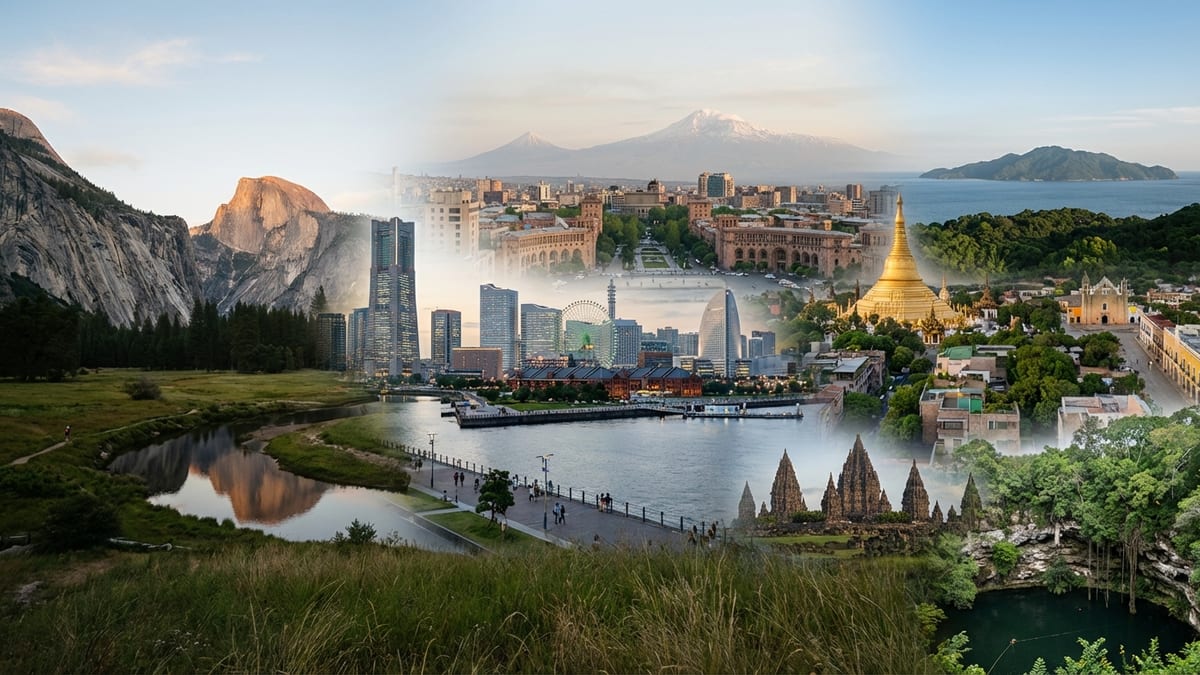
Some letters dominate the travel imagination. P is for Paris, B is for Bali, T is for Tokyo. Yet some of the most rewarding journeys begin with a less obvious letter. From volcanic coasts in Japan to ancient cities in the Caucasus, destinations starting with Y provide a surprisingly rich alphabet of experiences for travelers who want their itineraries to feel just a little different.
What follows is a curated tour through some of the world’s most compelling Y places, stretching from North America to Southeast Asia and the Middle East, with practical context and sensory detail to help you imagine your own route.
Yosemite, United States: Granite Cathedrals and Giant Sequoias
Yosemite National Park in California remains one of the most powerful landscapes in North America, a valley of sheer granite walls, thunderous waterfalls and vast high-country plateaus. Protected as a national park since 1890, Yosemite has long been a proving ground for climbers and a sanctuary for anyone who responds to scale and silence. In peak spring, snowmelt feeds waterfalls that plunge from cliffs more than 2,400 feet high, while in autumn the valley floor glows with golden meadows framed by granite and evergreens.
For first-time visitors, the drama of Yosemite Valley is the essential introduction. El Capitan rises directly from the valley floor, a monolith of pale granite that has become emblematic of modern climbing. Half Dome, with its distinctive carved profile, dominates views from meadows and viewpoints alike. Yet beyond the icons there are quieter rewards. Early mornings often begin in a hush broken only by the Merced River and the rustle of mule deer in the trees, while dusk can bring streaks of alpenglow across the high peaks.
Summer brings crowds and competition for campsites, but it also opens access to the park’s higher elevations. Along Tioga Road and in Tuolumne Meadows, hikers find cooler air, alpine lakes and long-distance trails that feel worlds away from the bustle of the main valley. In winter, a different Yosemite emerges. Snow dusts the cliffs, some roads close, and photographers chase the rare lunar rainbows sometimes visible in waterfall mist under a bright moon. Regardless of season, advance planning for accommodation, park entry reservations and wildfire conditions is essential.
Yokohama, Japan: Port City With a Cosmopolitan Heart
Just south of Tokyo, Yokohama offers a more relaxed, maritime counterpoint to the country’s capital while still feeling unmistakably urban. As one of the first Japanese ports opened to foreign trade in the 19th century, it developed a cosmopolitan identity that lingers in its architecture, food and neighborhoods. Traces of this history remain in waterfront districts where Western-style brick warehouses stand near sleek modern towers and promenades.
Yokohama’s harbor is the city’s living room. Wide pedestrian paths run along the water, with lawns and public art inviting both residents and visitors to linger. Here, the skyline mixes observation wheels, high-rise hotels and cruise terminals. At night the harbor reflects a mosaic of neon and moving ship lights, giving the city a distinctly cinematic atmosphere. On weekends, the waterfront fills with street performers, families and couples strolling with takeaway snacks from vendors and cafes.
Inland, the city’s character shifts from international port to compact neighborhoods of narrow streets and local shops. Japan’s largest Chinatown district, with its ornate gates and lantern-strung lanes, sits within walking distance of more subdued residential pockets where tiny bars and family-run restaurants offer counter seats and short menus. Public transportation connects Yokohama seamlessly with Tokyo and other cities in the region, making it an easy addition to a broader Japan itinerary. For travelers who enjoy urban exploration but want a softer pace than the capital, Yokohama provides a compelling balance.
Yerevan, Armenia: Pink-Stone Capital at the Crossroads
Armenia’s capital, Yerevan, surprises many first-time visitors with its mixture of Soviet-era grand avenues, cafe culture and deep historical resonance. One of the world’s oldest continuously inhabited cities, it sits in a wide valley with views, on clear days, toward the snow-capped silhouette of Mount Ararat across the border. The city’s nickname, the “pink city,” comes from the rose-hued tuff stone used in much of its architecture, which takes on a gentle glow in early morning and late afternoon light.
Republic Square is the city’s formal heart, framed by arcaded government buildings and a history museum. From there, streets radiate outward into districts with distinct personalities. Northern Avenue hosts more contemporary shops and apartments, while tree-lined Tumanyan Street and its side streets anchor a thriving cafe and wine-bar scene. Outdoor seating is the norm from spring through early autumn, giving Yerevan a pleasantly social, Mediterranean feel in the evenings.
Beyond its surface charm, Yerevan carries the weight of Armenian history. Memorials and museums commemorate the Armenian Genocide, while centuries-old churches stand within modern neighborhoods. Markets keep local food traditions visible, from herbs and dried fruits to lavash bread and regional cheeses. Many visitors also use Yerevan as a base for day trips to monasteries, lakes and wine regions, returning in the evening to a city that feels both intimate and increasingly modern in its outlook.
Yangon, Myanmar: Golden Pagodas and Fading Colonial Grandeur
Yangon, the largest city in Myanmar, presents a vivid first impression: dense traffic, ramshackle markets, crumbling colonial-era buildings and, above it all, the gleaming stupa of Shwedagon Pagoda catching the tropical sun. Although the country has undergone waves of political and social change in recent years, Yangon’s spiritual and architectural landmarks remain some of the most striking in Southeast Asia, making the city an important destination for travelers who approach it with respect and awareness.
Shwedagon Pagoda dominates both the skyline and the spiritual landscape. Clad in gold plates and crowned with a gem-studded spire, the complex draws worshippers from across the country. Visitors ascend barefoot up covered stairways to reach terraces lined with shrines, bells and candles. Sunset is a particularly evocative time to visit, when the stupa shifts through shades of gold as the sky darkens and the city’s sounds soften into murmurs and distant horns.
At street level, Yangon tells other stories. In neighborhoods around the city center, colonial-era buildings line gridded streets, their facades weathered by heat and monsoon rains. Inside, you might find everything from family apartments to offices and small workshops. Teahouses remain social hubs, where conversations swirl over cups of milky tea and plates of snacks. Night markets spring up along busy roads, offering fresh fruit, noodles, skewers and sweets. Political developments and travel advisories can affect when and how visitors choose to go, so it is essential to check the latest guidance and consider using reputable local operators who prioritize community well-being.
Yogyakarta, Indonesia: Cultural Capital of Java
On the island of Java, Yogyakarta stands out as a center of Javanese arts, education and tradition. Locals often call it “Jogja,” and the nickname reflects the city’s approachable, creative energy. This is a place where batik workshops operate between contemporary galleries, and where royal heritage still shapes parts of daily life. Unlike some Indonesian destinations almost entirely oriented toward tourism, Yogyakarta balances its role as a visitor hub with its identity as a university town and cultural heartland.
The Kraton, or Sultan’s Palace, anchors the historical core. Within its walls, pavilions open onto courtyards where cultural performances, from gamelan orchestras to classical dance, are regularly staged. Surrounding neighborhoods host artisans who produce batik textiles, leather shadow puppets and silverwork, often in small home-based studios. For many travelers, the chance to see these crafts practiced in context is as compelling as the more famous temples nearby.
Yogyakarta also serves as the gateway to two of Southeast Asia’s most important archaeological sites. To the east, the Hindu temple complex of Prambanan rises in a cluster of stone spires, while to the northwest, Borobudur’s massive Buddhist stupa emerges from a ring of volcanic hills. Sunrise and sunset visits are popular, though increasingly regulated to protect the structures. Within the city, an evolving food scene adds another layer: street stalls serving gudeg, a local jackfruit stew, stand alongside cafes catering to students and artists. As with many Indonesian destinations, the dry season generally offers more predictable weather, but cultural events and festivals can be found year-round.
Yucatán, Mexico: Cenotes, Ruins and Coastal Color
The Yucatán region of Mexico, particularly the state of the same name and its neighbors on the peninsula, invites exploration far beyond its well-known resort strips. Inland, a lattice of secondary roads connects colonial towns, Mayan archaeological sites and freshwater cenotes that puncture the limestone bedrock. Along the coasts, smaller communities complement the larger resort hubs, offering quieter beaches and a closer connection to local life.
For many visitors, the first introduction to Yucatán’s interior is a colonial-era city with pastel-colored facades and shaded plazas, where evenings bring families and vendors into the streets. Nearby, cenotes provide a chance to swim in cool, clear water beneath hanging roots and stalactites. Some lie open to the sky, surrounded by jungle, while others require descending stairways into cave-like chambers lit by shafts of sunlight. Respecting local customs and environmental guidelines is important, as these sinkholes form part of a fragile aquifer and hold cultural significance.
Archaeological sites across the peninsula demonstrate the architectural and astronomical sophistication of the ancient Maya. Well-known complexes attract the largest crowds, but smaller sites in the state of Yucatán and beyond give a more contemplative experience, with temples rising above forest canopies and iguanas sunning themselves on carved stones. On the coasts, wind and tide shape long arcs of sand where pelicans dive and fishing skiffs rest at anchor. The region’s modern tourism infrastructure continues to grow, making both independent travel and guided experiences feasible, yet it remains possible to find stretches of relative quiet with a bit of planning and willingness to explore beyond main highways.
Yakushima, Japan: Island of Ancient Forests
Off the southern tip of Kyushu, the small Japanese island of Yakushima offers a concentrated dose of wilderness. Its interior is dominated by rugged mountains cloaked in temperate rainforest, where some cedar trees, known as yakusugi, are counted among the oldest in Japan. The combination of heavy rainfall, thick mosses and mist gives parts of the forest a dreamlike quality that has inspired artists and filmmakers and drawn hikers from around the world.
Trail networks of varying difficulty lead into this landscape. Some routes can be completed in a few hours, passing rivers and waterfalls, while others demand full-day or overnight efforts to reach ancient trees or mountain summits. Boardwalks and stone paths help minimize erosion in heavily visited sections, but trails can still be slippery, and the weather shifts quickly. Local guides are available for those who prefer additional safety and interpretation of the island’s ecology.
Outside the forest, Yakushima’s coastline presents yet another personality. Small ports, hot springs and narrow roads trace the shore, revealing sea turtles nesting on certain beaches in season and waves punching into basalt cliffs in others. Accommodation ranges from simple guesthouses to more polished lodges, with many emphasizing local seafood and seasonal produce. Due to the island’s popularity among domestic tourists and its limited capacity, advance reservations are strongly recommended, especially during Japanese holiday periods and peak hiking months.
The Takeaway
Destinations starting with Y share no single geography, language or climate, yet they reveal how a simple organizing idea can open unexpected doors on the map. Yosemite’s granite walls and sequoia groves contrast sharply with the dense alleyways of Yangon or the volcanic forests of Yakushima, while Yerevan’s pink-stone boulevards feel far removed from Yucatán’s cenotes or Yokohama’s waterfront skyline. What connects them is the sense of discovery they offer travelers willing to step slightly aside from the most obvious headline cities and resorts.
For trip planners, using Y as a lens can be both playful and practical. It encourages weaving together disparate regions into one itinerary, such as combining urban Japan with a side trip to Yakushima, or pairing a cultural stay in Yogyakarta with time on nearby coasts and highlands. It also highlights how lesser-known capitals and regional centers, from Yerevan to smaller towns in Yucatán, often reward unhurried exploration as much as their more famous neighbors. In an age of increasingly crowded hot spots, these Y destinations demonstrate that there is still immense richness to be found slightly off the alphabet’s main stage.
FAQ
Q1. Which Y destination is best for first-time international travelers?
Yokohama is often the most approachable for first-time international travelers, thanks to Japan’s efficient transportation, high safety standards and clear visitor infrastructure, while still offering a softer, more relaxed atmosphere than Tokyo.
Q2. Is Yosemite suitable for travelers who are not avid hikers?
Yes. Yosemite offers scenic drives, short flat walks to viewpoints, ranger-led programs and accessible lookouts, so visitors who prefer gentler activity can still experience the valley’s major sights without undertaking strenuous hikes.
Q3. How many days should I plan for Yucatán beyond a beach resort stay?
Allow at least three to four full days to explore Yucatán’s inland towns, cenotes and archaeological sites at a comfortable pace, with more time if you plan to visit multiple regions across the peninsula.
Q4. Is Yerevan a good base for exploring Armenia?
Yerevan works very well as a base, as most organized day trips and private drivers operate from the capital, allowing you to visit monasteries, lakes and wine regions by day while returning to the city’s restaurants and cafes each evening.
Q5. What is the best season to visit Yakushima?
Late spring through early autumn generally offers the most reliable hiking conditions on Yakushima, though rainfall is common year-round; winter can be beautiful at higher elevations but requires more preparation for cold and potentially icy trails.
Q6. Is Yogyakarta safe and comfortable for solo travelers?
Yogyakarta is widely regarded as friendly and manageable for solo travelers, with plentiful guesthouses, cafes and cultural venues, though standard precautions around personal belongings and late-night transport still apply.
Q7. Can I combine Yangon and Yogyakarta in one trip?
It is possible to combine Yangon and Yogyakarta in a single Southeast Asia itinerary, but you should factor in regional flight connections, visa requirements and the need to stay informed about political and safety conditions in Myanmar before finalizing plans.
Q8. Do I need guided tours in these Y destinations, or can I explore independently?
Most of these destinations can be explored independently using public transport or rental vehicles, but guided tours are valuable for complex sites such as major temples around Yogyakarta, remote trails on Yakushima and certain cultural or historical excursions around Yerevan and Yangon.
Q9. How can I minimize environmental impact when visiting Yosemite and Yakushima?
Stick to marked trails, respect park or local guidelines, carry out all trash, use refillable water bottles, choose eco-conscious accommodation where possible and avoid disturbing wildlife, particularly in sensitive alpine and rainforest ecosystems.
Q10. Are there lesser-known Y destinations worth considering beyond these?
Yes. Places such as Yellowknife in Canada’s Northwest Territories, Yuma in the United States or smaller towns in the broader Yucatán region can add northern lights, desert landscapes or quieter cultural experiences to an itinerary built around the letter Y.