

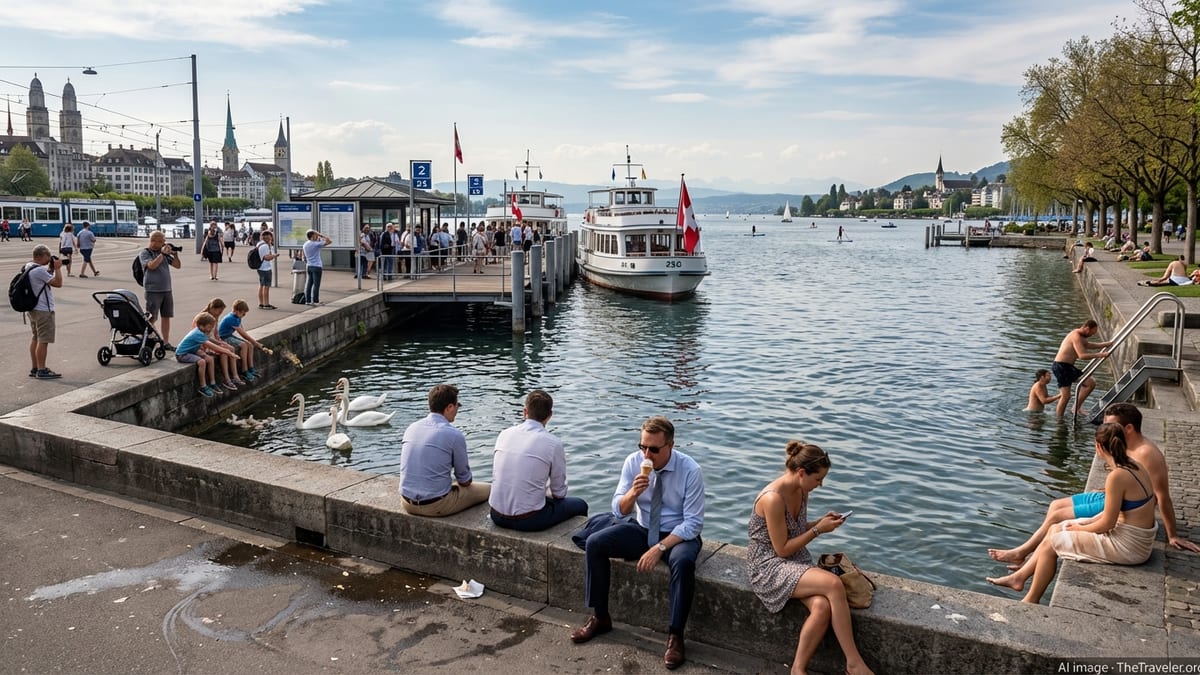
Before I went to Zurich, I imagined Lake Zurich as a sort of polished Alpine postcard: mirror‑flat water, mountains at every angle, and gentle little boats drifting past medieval spires. The reality was more complex. I found a busy, lived‑in urban lake that locals treat as their summer living room, complete with commuter boats, office workers in suits eating ice cream on the promenade, and packed public baths.
Some moments felt genuinely magical. Others were crowded, pricey, or oddly underwhelming. If you are trying to make sense of cruises, swimming spots, and viewpoints around Lake Zurich, this is what it actually felt like on the ground.
First Impressions: A Working Lake Masquerading as a Holiday Spot
My first real encounter with Lake Zurich was walking from the main station down to Bürkliplatz, the central square on the lakeshore where the main boat pier is. It is only about fifteen minutes on foot, and the transition is striking. One moment I was dodging trams and shoppers, the next I stepped into an almost Mediterranean scene with people licking gelato, kids feeding swans, and the white ZSG boats lined up at the dock. The lake sits right at the edge of the city, and that immediacy is one of its biggest strengths. There was no elaborate journey out of town. I simply walked until the road stopped and the water began.
What surprised me immediately was how much the lake doubles as public transport. The boats are fully integrated into the Zurich transport network, run by ZSG in cooperation with ZVV, so the same zone tickets and passes you use for trams also work on most scheduled lake routes. At first I found the network map a bit intimidating, with place names like Thalwil, Küsnacht, and Rapperswil floating along the blue shape of the lake. Once I understood that these boats are just another tram line, but wetter and slower, it became less romantic but more useful. The lake is not just a pretty surface. It is part of how people get around.
Visually, Lake Zurich is attractive rather than jaw‑dropping. From the city you see gentle hills, church steeples, and on a perfectly clear day a teasing hint of the Alps at the far end. It is lovely, but not the dramatic, wall‑of‑mountains experience you might expect from Swiss marketing photos. If you go in expecting those cinematic snow‑capped peaks right on the shore, you may feel a slight disconnect. If you treat it as a very pleasant urban waterfront that happens to be extremely clean and swimmable, reality lines up better with expectation.
Understanding the Cruises: Mini, Short, Long and Everything in Between
The cruise options on Lake Zurich are where I felt the gap between brochure and reality most sharply, so I will break them down in terms of how they actually felt, not just how they are named. The standard tourist offerings from Zurich Bürkliplatz are the Mini Lake Cruise (about 1 hour), the Short Lake Cruise (about 1.5 hours), and the Long Lake Cruise (around 4.5 hours). There are also river cruises on the Limmat and additional routes from Rapperswil further down the lake. Tickets are sold via ZSG and fall under the ZVV zone system, with specific zone combinations for each route. Information boards at Bürkliplatz explain it reasonably clearly, but on a busy afternoon, queuing with dozens of others and trying to decode zone numbers on the fly was more stressful than I expected.
I started with the Mini Lake Cruise, which is often recommended as an introduction. In practice, it felt more like a gentle detour than a full experience. The route heads out from Zurich, passes along the Gold Coast side of the lake, and then loops back. The commentary is available via the ZSG audio guide app if you download it, which I only discovered properly after boarding. Without the app, there is minimal explanation, so the experience can feel a bit anonymous. The upside is that it is easy and short; the downside is that it felt like sitting on a slow‑moving tram with better scenery and a lot of people angling for selfies near the railings.
The Short Lake Cruise added an extra half hour and, crucially, onboard catering. On my trip, this meant a small bar and a limited but decent menu of snacks and drinks. Prices were what I have come to think of as standard Zurich pricing, which is to say objectively high, but not shocking once you have paid for a coffee in the city. It was pleasant to sit with something to drink, but again the ambiance swung depending heavily on crowds. On a sunny afternoon in peak season, the upper deck filled quickly, and families with strollers and groups of tourists competed for space. I found myself spending more time guarding my seat and less time sinking into the scenery.
The Long Lake Cruise was the one that forced me to rethink how I use boat trips on a city lake. At around 4.5 hours, you need to commit a substantial chunk of the day. The route reaches much further down the lake, towards Rapperswil, and you see a broader slice of lakeside villages and countryside. For me, this was the first time the lake started to feel expansive rather than just like an elongated city park. Yet the duration comes with trade‑offs. The pace is relaxed to the point of occasional boredom, especially if you are not deeply interested in every landing stage. I noticed more than one passenger nodding off or scrolling their phone instead of looking at the view. The long route does offer first class seating and more substantial catering options, but the difference in comfort did not entirely justify the higher price in my case.
Booking, Timing and the Realities of Getting on a Boat
On paper, using the boats is straightforward. ZSG publishes a 2026 timetable with the main season running from mid‑December 2025 to mid‑December 2026, and the website allows you to check departures and plan connections. In reality, what mattered far more to me was how it worked day‑to‑day at Bürkliplatz. The ticket counter has seasonal opening hours, with longer hours in summer (in July and August it is open daily roughly from mid‑morning until around 8 pm). I turned up on a sunny Saturday afternoon, joining an already long queue that snaked across the square.
The first frustration came with the combination of ZVV zoning and cruise tickets. If you already hold a Zurich Card or a valid day pass covering the right zones, some of the shorter cruises are either included or discounted, but you still need to queue to clarify what you need. The staff were patient, but the line moved slowly, and there was zero shade while I waited. By the time I got my ticket, boarding had begun and I ended up among the last people on the upper deck, which meant a compromised view and a lot of bobbing heads in my photos.
On another day I tried to be clever and buy via the ZVV app, which is technically possible for standard zone tickets. That did save time, but the app is not very explicit about which cruises require supplementary payments or reservations. I spent a few anxious minutes at the pier wondering whether my digital ticket would be accepted without question. In the end it was, but the process felt less seamless than I would expect in a famously efficient city. If you dislike last‑minute ambiguity, I would either visit the Bürkliplatz ticket counter earlier in the day or commit to a specific departure and arrive well ahead of time.
Seasonality also matters more than it first appears. In high summer, boats are frequent and the lakefront feels festive, but you are sharing the experience with a lot of people. Outside of peak season, service frequency drops, and some special cruises are suspended, which can limit spontaneity. On a chilly early‑spring evening, I boarded a mini cruise with only a handful of other passengers. The quiet was pleasant, but the open upper deck was too cold to enjoy for long, and the lower saloon felt a bit like a commuter ferry, complete with damp jackets and steamed‑up windows. I left that trip feeling that while Lake Zurich cruises are technically year‑round, they are emotionally a summer product. If you come in the off‑season, set your expectations accordingly.
Swimming the Lake: Badis, Beaches and Cold‑Water Reality
For all the effort that goes into marketing cruises, the real soul of Lake Zurich reveals itself at the Badis, the public swimming areas that dot the lakeshore. These are a deeply Swiss institution, and experiencing them shifted my opinion of the lake from “slightly bland cruise destination” to “genuinely impressive urban playground.” I spent time at Strandbad Mythenquai on the western shore and at other lakeside facilities such as the ones in Enge and Zurichhorn, each with its own character.
Strandbad Mythenquai is a family‑oriented lido with a sandy beach, floating platforms, a non‑swimmer zone and a diving tower. In the 2025 season, the park area is even open over winter as a free park between early October and early April, though without full swimming operation. During the main summer season, paid entry gets you access to the lake area, changing rooms, and amenities. The posted opening times run roughly from early morning until early evening, with last entry half an hour before closing and a clear rule that everyone must be out of the water by closing time. I appreciated the clarity but found the strictness a little jarring on long, golden evenings when the light was still beautiful and I would have gladly stayed another hour.
The water itself was cleaner and more inviting than almost any urban lake I have swum in. On a warm July afternoon, the temperature hovered in the mid‑20s Celsius, and the combination of clear water, distant hills, and the skyline of Zurich behind me felt quietly luxurious. At the same time, this is not a remote Alpine tarn. You share the water with distant motorboats and sailboats, and you are always aware of the city around you. If your idea of wild swimming involves solitude and total silence, Lake Zurich’s Badis will not fully satisfy that itch. What they offer instead is a highly organized, social kind of swimming, with designated lanes, roped‑off areas, and lifeguards keeping a close eye on everything.
Facilities were a mixed bag. At Mythenquai, the presence of a vegetarian Hiltl restaurant on site meant that food quality was well above what I expect from a public pool, but prices matched the broader Zurich landscape, so a casual lakeside meal for one quickly added up. There were grassy areas to spread out a towel, plus grills and a children’s splash area, which made it obvious why locals spend entire days there. However, on peak weekends it was extremely busy. I had to weave between groups, dodge stray footballs, and I often felt like I was intruding on private picnics by simply looking for a reasonably flat patch of grass. It was sociable, but not especially peaceful.
Free Dips, Quiet Corners and the Art of Dodging Crowds
One of my priorities was to see how much of Lake Zurich you can enjoy without paying entry fees for lidos every time you want a swim. The answer is: more than I expected, but with some caveats. Along the promenade between Bürkliplatz and Zurichhorn, there are several spots where people simply climb down ladders and jump in. On a hot day, office workers in rolled‑up shirts, students, and tourists all shared these spots, turning the edge of the promenade into a casual, open‑air pool. It felt wonderfully democratic. There are often small changing cabins or at least places to stash your bag, but nothing like the infrastructure of the official Badis.
These informal swimming spots are technically free and always accessible, but comfort levels vary. There is limited shade, the stone steps can be slippery, and you are more directly exposed to boat wakes and the occasional trash floating by. The water quality still felt high, but psychologically it was different from the fenced‑off calm of the lidos. I enjoyed the spontaneity of being able to strip down to a swimsuit and plunge in after an afternoon of touring museums, but I would not rely on these spots for a full‑day lakeside experience. They are best treated as an opportunistic cool‑down rather than a destination.
Searching for quieter corners, I took boats to smaller lakeside towns and walked along sections of the shore further out. In places like Thalwil or Küsnacht, short stretches of public shoreline offer benches, small piers, and patches of grass that felt much calmer than the central city. Here I could sit with my feet in the water, watch swans glide past, and feel like I had a little piece of the lake to myself. The trade‑off is time and planning. Reaching those spots involved coordinating boat or train times and checking return options, and I was always slightly conscious of the clock. Lake Zurich outside the city is more tranquil but also more structured; you are rarely more than a timetable away from having to move on.
Overall, if you want serene, contemplative time by the water, you either need to go early in the morning, aim for shoulder season, or leave the most obvious sections of the promenade. If you are happy with a lively, people‑watching atmosphere, the central lakefront delivers exactly that, especially on warm evenings when half the city seems to be sitting along the wall with drinks in hand.
Views From the Water vs Views Of the Water
One thing I had not fully appreciated before coming to Zurich was how different it feels to see the city from the water versus seeing the lake from above. The classic cruise perspective gives you long, flat panoramas of the shoreline. You glide past the old town, grand hotels, and villa‑lined slopes, and on a clear day the distant Alps sit faintly on the horizon. It is pretty and relaxing, but the view is relatively static. The main variation is in how close or far you are from shore and how often you stop.
In contrast, going up to Uetliberg, Zurich’s local mountain, reframed the lake for me. Standing at the top, the S‑shaped body of water made sense in a way it never quite did at ground level. From that height, I could see how the lake nestles into the broader landscape, how towns string along its shore, and how the city hugs its northern tip. The lake suddenly looked smaller, less like an endless expanse, and more like the centerpiece of a carefully arranged stage set. That vantage point also made me realize that many of the cruise routes cover only a fraction of what you instinctively imagine when you hear “Lake Zurich.”
Back down at water level, some of my favorite perspectives came not from boats but from simple benches at Zurichhorn or the grassy lawns near Tiefenbrunnen. Watching the interplay of paddleboarders, sailboats, and swimmers against the steady background of mountains was surprisingly absorbing. In these moments, the lake felt less like a tourist product and more like a living, evolving canvas. At dusk the light softened, the mountains became silhouettes, and the city lights flickered on in the distance. Those were the times when I was glad I had not treated Lake Zurich as just a quick photo stop between more famous Swiss regions.
I did occasionally feel a touch of disappointment when comparing the reality to the famous Swiss lakes of postcards and screen savers. Places like Lake Lucerne or the smaller mountain lakes offer more immediate drama, with steep slopes and closer‑in peaks. Lake Zurich is gentler, and if you only have one lake day in Switzerland and want the full Alpine punch, you might choose somewhere else. But if you are already in Zurich, the combination of urban comfort and easy lake access becomes a strong argument in its favor, as long as you align your expectations with the more subdued, everyday beauty it actually offers.
Costs, Comfort and Small Irritations That Add Up
I will be blunt: enjoying Lake Zurich in a carefree way can get expensive quickly. None of the individual costs are shocking taken alone, but they accumulate. A standard mini cruise ticket for adults, bought as a regular ZVV single ticket covering the relevant zones, feels reasonable at first glance. Add a snack and a drink onboard, a lido entrance fee, a couple of espresso stops along the promenade, and perhaps a paddleboard rental, and you are suddenly deep into a day that costs more than many coastal beach days elsewhere in Europe.
What made this more noticeable for me was the contrast between how accessible the lake is physically and how curated many of the experiences around it are. You can walk the promenade for free, sit on the wall, and watch the boats glide past, but the moment you want structured comfort, you start paying for it. Sun loungers in some Badis, food that cannot be described as budget‑friendly, and premium prices for sunset cruises all reminded me that Zurich is not shy about monetizing its best asset. I never felt blatantly gouged, but I did find myself calculating whether each extra hour on the water was worth it.
Comfort is generally high. Boats are clean, punctual, and well maintained. Public swimming areas have well kept changing rooms and showers. What irked me were smaller, practical things. Shade is in short supply on some boat decks, so on hot days you either roast in the sun or retreat indoors and lose the fresh‑air feeling you came for. On busy journeys, announcements about stops are sometimes hard to hear over general chatter, and if you are not paying close attention it is possible to miss where you are. Signage at smaller landings can be minimal, and I saw more than one visitor hesitate, unsure whether the boat would actually stop for them or just sail past.
I also encountered the limitations of accessibility. At Strandbad Mythenquai, for example, the city’s own information notes the lack of disabled parking and disabled toilets. Seeing that in Switzerland, a country often held up as a leader in public infrastructure, was disappointing. On the boats, getting from the pier onto the deck sometimes involves steps and gaps that are not ideal if you have mobility issues. None of this makes the lake unusable, but it does mean that for some visitors the picture‑perfect experience portrayed in photos will require more planning and possibly compromises.
The Takeaway
My days around Lake Zurich did not deliver the kind of singular, once‑in‑a‑lifetime moment I might attach to certain mountain peaks or remote valleys. Instead, they layered up into a quieter appreciation of how a city can genuinely live with its lake rather than just look at it from afar. I had swims that felt blissful, especially early in the morning before crowds arrived. I had cruises that were pleasant but verged on forgettable, saved mostly by the novelty of being on water instead of in a tram. I had evenings on the promenade that cost me almost nothing and were among my favorite experiences, simply watching the play of light on the water as the city relaxed around me.
If I went back, I would do a few things differently. I would skip the long cruise unless I had a very specific reason to spend half a day on the boat and would instead combine a short cruise with a trip up Uetliberg to get that contrasting perspective. I would plan one full day centered around a Badi such as Strandbad Mythenquai or Enge, arriving early with my own picnic to reduce costs and claim a good spot before the rush. I would also consciously seek out quieter stretches of shoreline in smaller towns, even if that meant studying the timetable more closely.
Lake Zurich is worth your time if you are already in the city and want to see how locals unwind. It is particularly rewarding in summer, for travelers who value clean, swimmable water and a laid‑back atmosphere more than postcard‑perfect mountain drama. If your trip to Switzerland is short and you are chasing maximal scenery per day, you may find more visual impact at other lakes. But if you give Lake Zurich space to be what it really is, an urban lake woven into daily life, it can offer something subtler but ultimately satisfying: the feeling of borrowing, for a while, the easy lakeside rituals of a city that genuinely uses and cherishes its waterfront.
FAQ
Q1. Is a Lake Zurich cruise really worth it, or should I just walk the promenade?
For a first visit, I found a short cruise worthwhile mainly to understand the shape of the lake and see Zurich’s skyline from the water. That said, the promenade walk between Bürkliplatz and Zurichhorn is almost as scenic, costs nothing, and often felt more relaxed than crowded decks, so I would not build my entire day around cruising.
Q2. Which Lake Zurich cruise length did I like best?
The one hour mini cruise struck the best balance between time, cost, and experience. It gave me the sense of being out on the lake without the mid‑journey boredom I felt on the 4.5 hour long cruise. If you are short on time or easily restless, the shorter options are the safer bet.
Q3. How crowded do the public swimming areas get, and is it still enjoyable?
On hot weekend afternoons places like Strandbad Mythenquai were very busy, with families, groups of friends, and tourists all competing for space. It was still enjoyable if I leaned into the social vibe, but for calm swimming or reading I had much better luck arriving early in the morning or going on weekdays.
Q4. Can I swim in Lake Zurich for free, or do I always have to pay for a Badi?
You can absolutely swim for free at informal spots along the promenade, using ladders and steps into the lake, and many locals do exactly that. The trade‑off is less comfort, less shade, and fewer facilities. For a full‑day experience with showers, toilets, and food, I still preferred paying the modest entry fee for a Badi.
Q5. How cold is the water, and is it comfortable for swimming?
In summer the lake was pleasantly warm by Swiss standards, with temperatures in the mid‑20s Celsius making it easy to stay in for long stretches. In shoulder seasons the water felt bracing but manageable for short dips. Outside of summer it becomes a cold‑water experience that only enthusiasts will truly enjoy.
Q6. Is the Zurich Card actually useful for exploring the lake?
For me, the Zurich Card made sense because it covered trams, buses, some boat routes, and museums in one package. It simplified decisions and reduced the friction of buying separate tickets, especially when I was hopping between city sights and the lake. However, if you plan to spend most of your time just walking and sitting by the water, the card is less essential.
Q7. Are Lake Zurich boats suitable for people with limited mobility?
Some boats and piers are manageable, but I noticed steps, gaps, and uneven surfaces that could be challenging if you have serious mobility issues. Certain lakeside facilities, including at least one major Badi, also lack dedicated disabled parking or toilets. It is possible, but I would recommend checking specific routes and facilities in advance rather than assuming full accessibility.
Q8. What would I skip around Lake Zurich if I were short on time?
If I had only a day or two in Zurich, I would probably skip the long lake cruise and any elaborate paid sunset cruises. I would focus instead on a single short cruise, one good Badi session, a walk along the promenade, and a trip up Uetliberg for an overview of the lake and city.
Q9. Is Lake Zurich a good destination for families with kids?
Yes, with some planning. Family‑oriented Badis like Mythenquai have shallow areas, play spaces, and plenty of grass for picnics, and kids seemed to love the floating platforms and diving towers. The main challenges are cost and crowds in peak season, so arriving early, bringing your own snacks, and picking calmer times of day make a big difference.
Q10. When is the best time of year to enjoy Lake Zurich?
In my experience, late spring to early autumn offered the best balance of warmth, frequent boat services, and open swimming facilities. High summer brought the liveliest atmosphere but also the biggest crowds. If you prefer quieter walks and are less focused on swimming, sunny days in May, early June, or September can be ideal for appreciating the lake without feeling overwhelmed.