

More news on this day
Thousands of travelers across the United Arab Emirates are facing days of disruption as Dubai, Abu Dhabi and Sharjah airports battle the fallout from the Middle East conflict, with 462 flights canceled and 321 delayed across key carriers including Emirates, flydubai, Etihad and Qatar Airways.
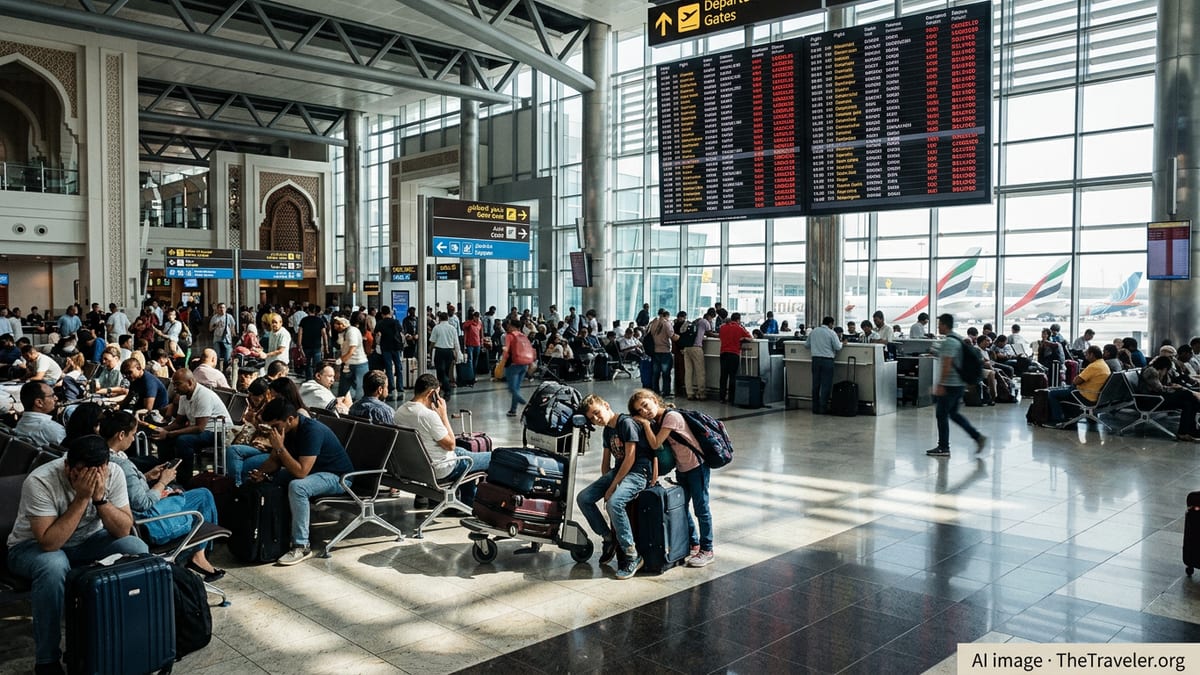
UAE’s Major Hubs Grapple With Prolonged Disruption
Dubai International, Abu Dhabi’s Zayed International and Sharjah International remain in partial operation, functioning well below normal capacity as regional airspace closures and military overflights continue to constrain movements. Authorities have authorized only limited commercial services while prioritizing safety checks and restricted flight corridors.
Operational data compiled from airline and airport updates indicates that, since the latest escalation, 462 scheduled flights serving the three hubs have been canceled, with a further 321 suffering significant delays. The disruption spans both outbound and inbound services, affecting not only point-to-point traffic to the UAE but also the dense web of connecting itineraries that rely on these airports as global transit hubs.
Dubai International, normally one of the busiest airports in the world by international passenger numbers, has seen its daily schedule slashed as carriers rework routings to avoid conflict zones and comply with rapidly shifting safety directives. Abu Dhabi and Sharjah, though smaller in scale, are reporting similar patterns of rolling cancellations and delayed departures as they reintroduce flights in tightly controlled phases.
Airport authorities have repeatedly urged passengers not to travel to terminals without confirmed, operating bookings, warning that walk-in travelers will likely be turned away or left waiting for days without certainty of departure. Terminal congestion has eased compared with the first days of the shutdown, but long queues and crowded waiting areas remain common, especially around airline customer-service desks.
Flagship Carriers Slash Schedules and Reroute
Emirates and flydubai, based in Dubai, along with Abu Dhabi’s Etihad Airways and Doha-based Qatar Airways, have all sharply reduced their schedules to and through the UAE while the conflict continues. Many flights have been outright canceled, while others are departing on extended routings that skirt closed or high-risk airspace, adding hours to journeys and compressing aircraft and crew availability.
Emirates has announced a reduced schedule with dozens of daily flights still grounded as it works through a backlog of stranded passengers. Etihad has adopted a similar posture from Abu Dhabi, focusing first on repatriation and essential routes before adding broader network frequencies. Flydubai, which serves a large portfolio of regional destinations, has been particularly affected by the closure of nearby skies, forcing mass cancellations on short-haul services.
Qatar Airways and other regional carriers that rely on the UAE for feeder traffic are also feeling the strain. With Dubai, Abu Dhabi and Sharjah operating under constrained conditions, multi-leg journeys that once depended on smooth Gulf connections have turned unpredictable. Many travelers report being rebooked multiple times or shifted onto ad hoc services operating via more southerly corridors.
The tight capacity is compounded by aircraft and crews being out of position after days of abrupt shutdowns. Airlines are juggling complex rescheduling, maintenance checks and crew duty limits as they try to rebuild coherent timetables. Industry analysts say it could take weeks after a full airspace reopening before operations resemble anything close to normal.
Passengers Face Long Waits, Uncertainty and Rising Costs
For travelers, the impact is immediate and deeply personal. Families on holiday, migrant workers returning to jobs and business travelers caught mid-itinerary are all struggling to navigate fragmented options. With more than 780 flights either canceled or heavily delayed across the three main UAE hubs, seats on the limited remaining services are scarce, and fares on alternative routes have surged.
Reports from terminals in Dubai and Abu Dhabi describe lines snaking through departure halls as passengers attempt to rebook or secure refunds. Many have spent nights sleeping in airport seating or nearby hotels, checking airline apps and departure boards that change by the hour. Others have opted to travel overland to neighboring states such as Oman or Saudi Arabia to connect with flights operating outside the most restricted airspace.
Travel agents say they are overwhelmed by requests to reroute journeys via secondary hubs in Europe, South Asia or East Africa, but warn that onward capacity is limited and schedules remain volatile. Even travelers whose flights are not officially canceled are experiencing missed connections and forced stopovers when delays cascade through multi-leg itineraries.
Some passengers attempting last-minute solutions have turned to charter or private jet operators, where demand and prices have soared since the conflict tightened regional airspace. For most travelers, however, the only realistic option is to wait for their carrier to confirm a revised departure and to remain flexible about routing and timing.
Airlines Offer Waivers as Regulators Prioritize Safety
In response to the turmoil, major carriers serving the UAE have rolled out temporary waivers on change fees, rebooking penalties and, in some cases, full refunds for affected flights. Emirates, Etihad, flydubai, Air Arabia, Qatar Airways and several international airlines have updated travel advisories, emphasizing that passengers with canceled or heavily delayed flights can modify itineraries without the usual financial penalties.
However, the fine print of these waivers varies by airline, fare class and route, and customer-service channels remain heavily congested. Travelers are being urged to use digital tools such as official apps and booking portals rather than visiting airports or calling hotlines, which are frequently overwhelmed. Many airlines are prioritizing passengers who were already in transit or stranded in the UAE over those whose trips have not yet begun.
Aviation regulators in the UAE continue to stress that safety considerations override all commercial imperatives. They are coordinating with international bodies and neighboring states to manage limited flight corridors that avoid active conflict zones, which has led to complex rerouting and spacing requirements between aircraft. Authorities have also stepped up security protocols on the ground at airports, contributing to longer processing times but aiming to reassure anxious travelers.
Industry experts note that while airlines may be under pressure to restore more flights swiftly, any premature resumption through unstable airspace could carry unacceptable risks. The result is a carefully calibrated restart, in which a small number of flights are added each day while officials monitor military developments and air-traffic patterns across the region.
Global Ripple Effects on Tourism and Trade
The disruption at Dubai, Abu Dhabi and Sharjah is reverberating far beyond the Gulf. Because these airports act as pivotal long-haul connectors between Europe, Africa, Asia and Australasia, cancellations and delays in the UAE are rippling through schedules worldwide. Tour groups have had to abandon carefully planned itineraries, while cruise passengers and corporate travelers face fragmented or canceled onward journeys.
Tourism boards and hotel operators across the Middle East and in popular onward destinations from the UAE report a wave of short-notice cancellations and date changes. Many leisure travelers are choosing to postpone trips entirely rather than risk becoming stranded, particularly those with limited travel insurance or fixed work commitments at home.
Cargo flows are also being hit, as many passenger aircraft that carry freight in their holds remain grounded or operate on longer, less direct routes. Logistics specialists warn that this could temporarily raise costs and extend delivery times for high-value goods that usually transit through Emirati hubs, from electronics to pharmaceuticals.
Despite the immediate shock, analysts say the UAE’s aviation and tourism sectors remain structurally strong and are likely to rebound once airspace restrictions ease and confidence returns. For now, however, thousands of travelers caught in the middle of the crisis are left juggling rebookings, refunds and uncertainty as they wait for clearer skies over the region.