

More news on this day
Hundreds of passengers across Europe woke on Thursday to find their travel plans in disarray, as 526 flights were cancelled at major hubs including Helsinki-Vantaa, Rome’s Leonardo da Vinci, Amsterdam Schiphol, Zurich, Luxembourg and Stockholm-Arlanda, triggering a fresh wave of queues, missed connections and overnight airport stays.
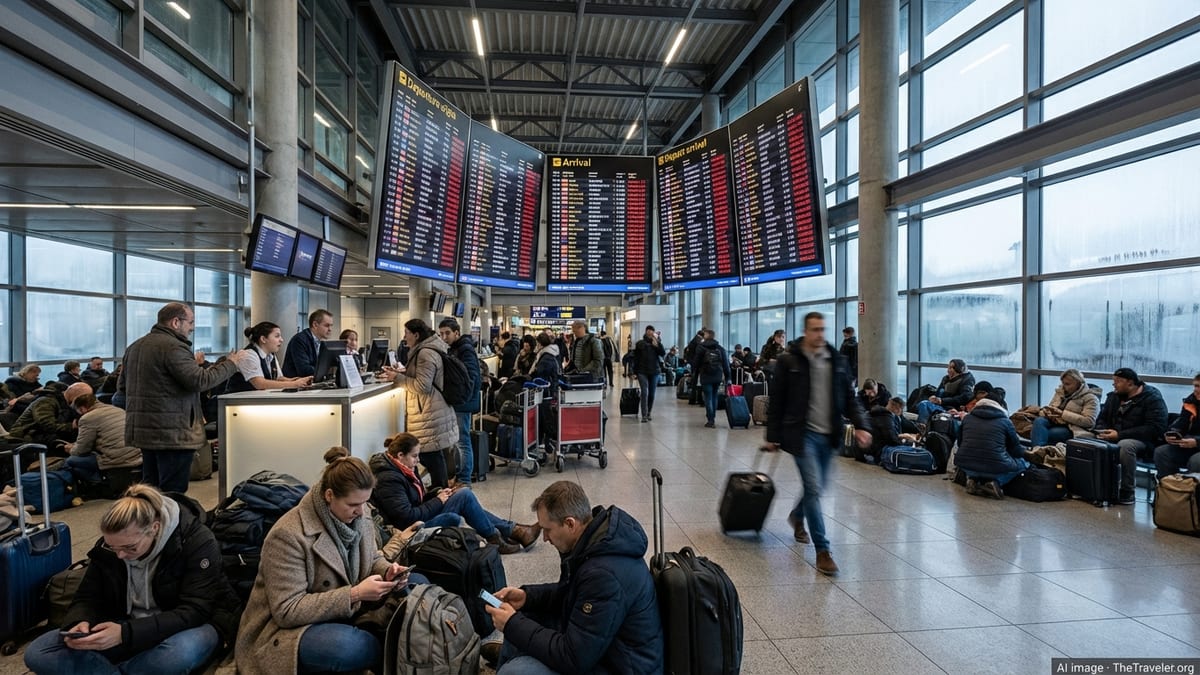
Major European Hubs Hit by Fresh Wave of Cancellations
The latest disruption, collated from live operational data across European airports, underscores how fragile the continent’s air travel network remains in late February 2026. While cancellations and delays have become a recurring theme this winter, today’s combined tally of 526 cancellations at a cluster of key hubs stands out for its geographic spread, affecting both northern and southern Europe.
Helsinki-Vantaa and Stockholm-Arlanda, two of the Nordic region’s main gateways, reported dozens of scrubbed flights as carriers grappled with knock-on effects from earlier disruptions and tight aircraft rotations. Amsterdam Schiphol and Zurich, both critical transfer hubs for connecting traffic across Europe and beyond, also saw schedules trimmed, amplifying the impact for long-haul and intra-European travellers connecting through these airports.
In southern Europe, Rome’s Leonardo da Vinci airport struggled to keep operations on track amid the broader regional turbulence. Luxembourg Airport, a smaller but strategically important node for business and EU institutional traffic, was also hit, with cancellations there radiating out across short-haul routes into larger hubs.
Industry observers note that, although today’s operational picture differs in detail from earlier episodes this month, the scale of cancellations and delays is consistent with a pattern seen across European skies throughout February, when multiple data snapshots have shown hundreds of cancellations and well over a thousand delays on particularly bad days.
Ripple Effects From Nordic Gateways to Southern Europe
For passengers, the chaos was felt most acutely at the transfer points. At Helsinki-Vantaa, one of Finnair’s key hubs, cancellations affecting both domestic and international routes left travellers bound for regional cities such as Oulu and for onward long-haul destinations scrambling for alternatives. Similar pressure built at Stockholm-Arlanda and Amsterdam Schiphol, where even limited numbers of scrapped flights can quickly cascade into missed connections on already busy winter schedules.
The disruption did not occur in isolation. Recent operational data from earlier in February had already highlighted how combined cancellations and delays at airports in Berlin, Copenhagen, Paris, Amsterdam, London, Helsinki, Zurich and Stockholm could strand thousands of passengers in a single day, even when each airport only contributed a slice of the total. Today’s figures, concentrating 526 cancellations across a smaller set of hubs, show how quickly the system can seize up when several key nodes are hit at once.
Travel analysts say the interdependence of European hubs is once again on display. A cancelled feeder flight from Helsinki or Stockholm can mean an empty seat on a long-haul departure from Amsterdam or Zurich, prompting rebooking chains that ripple outward for hours. Conversely, long-haul cancellations into Rome or Amsterdam can maroon travellers who expected to connect north into the Nordic region by late evening.
The result on Thursday was a patchwork of overcrowded departure halls, long queues at transfer desks and airline call centres, and weary passengers trying to piece together new itineraries on their phones. Many faced overnight stays when rebooked flights were scheduled for the following morning.
Airlines Under Strain as Winter Disruptions Persist
Airlines operating at the affected airports found themselves once again juggling aircraft, crew and customer obligations. Recent days have already seen carriers such as KLM, Finnair, SAS, British Airways and others contend with hundreds of cancellations and delays across the region, particularly at hubs in Amsterdam, Helsinki, Stockholm, London and Zurich, according to industry data and aviation monitoring services.
Low-cost and leisure carriers including Wizz Air and Ryanair have also been prominent in earlier disruption tallies this month, especially at airports in Sweden, the Netherlands and across Western Europe. While today’s list of 526 cancellations spans multiple airlines and alliances, it reinforces concerns that tight winter schedules leave little room to absorb unexpected operational shocks.
Operational planners point out that even when weather is not the primary culprit, a combination of persistent staffing constraints, air traffic control restrictions, de-icing requirements and aircraft maintenance rotations can converge to push marginal operations over the edge. In previous February snapshots, this has translated into more than 300 cancellations and more than 1,500 delays on a single day across Germany, Denmark, Switzerland, France, Ireland, the Netherlands, Sweden, the UK and Finland, underscoring the fragility of the system.
For airlines, every cancelled rotation not only represents lost revenue but also additional costs for passenger care, compensation where applicable, and repositioning aircraft and crews. This, in turn, complicates planning for upcoming peak periods such as the Easter holidays and the summer season.
Passengers Face Queues, Confusion and Limited Alternatives
On the terminal floors in Helsinki, Rome, Amsterdam, Zurich, Luxembourg and Stockholm, the most visible effects of the cancellations were long, slow-moving queues at check-in, transfer and ticketing counters. With many flights scrubbed within hours of departure, some passengers reported struggling to obtain timely information about their options as airline staff worked through backlogs of rebooking requests.
At Amsterdam Schiphol and Zurich, two of Europe’s most important connecting hubs, travellers arriving from unaffected routes often discovered that onward sectors had been cancelled while they were already in the air. That meant sudden changes of plan in crowded arrivals halls, particularly for those without automatic rebooking or those travelling on separate tickets.
For Nordic travellers, domestic alternatives were sometimes limited. When flights between Helsinki and regional Finnish airports or between Stockholm and smaller Swedish destinations were cancelled, surface transport options involved long train or bus journeys in winter conditions. For international travellers caught mid-journey, shortages of available seats on remaining flights meant many had to accept itineraries with extended layovers or detours via secondary hubs.
In smaller markets such as Luxembourg, where flight frequencies are lower than at giant hubs, a single cancellation can effectively wipe out travel options for that route on a given day. Business travellers and officials shuttling between EU institutions and national capitals were among those facing difficult choices between postponing trips or cobbling together complex multi-stop journeys.
What Travellers Should Do If Their Flight Is on the New List
With a new and frequently updated list of cancellations circulating among aviation trackers and travel media on Thursday, consumer advocates urged passengers to act quickly if their flight appears affected. Priority steps include confirming the latest status directly with the airline or airport, using official apps where possible, and securing a rebooking option before available seats disappear.
Passengers are also advised to familiarise themselves with compensation and care rules applicable in their situation, particularly on flights falling under European passenger rights regulations. These can entitle travellers to assistance such as meals, hotel accommodation and, in some cases, financial compensation, depending on the cause of the disruption and the length of delay.
Travel planners recommend that anyone with a connection through Helsinki-Vantaa, Rome’s Leonardo da Vinci, Amsterdam Schiphol, Zurich, Luxembourg or Stockholm-Arlanda build in extra time, monitor their flight status closely in the hours before departure and consider flexible ticket options where feasible. Given the pattern of repeated disruption snapshots across Europe this month, further schedule volatility cannot be ruled out in the days ahead.
For now, Europe’s aviation network continues to operate under strain, with today’s 526 cancellations serving as another reminder that even routine winter days can turn into a travel ordeal when multiple hubs come under simultaneous pressure.