

More news on this day
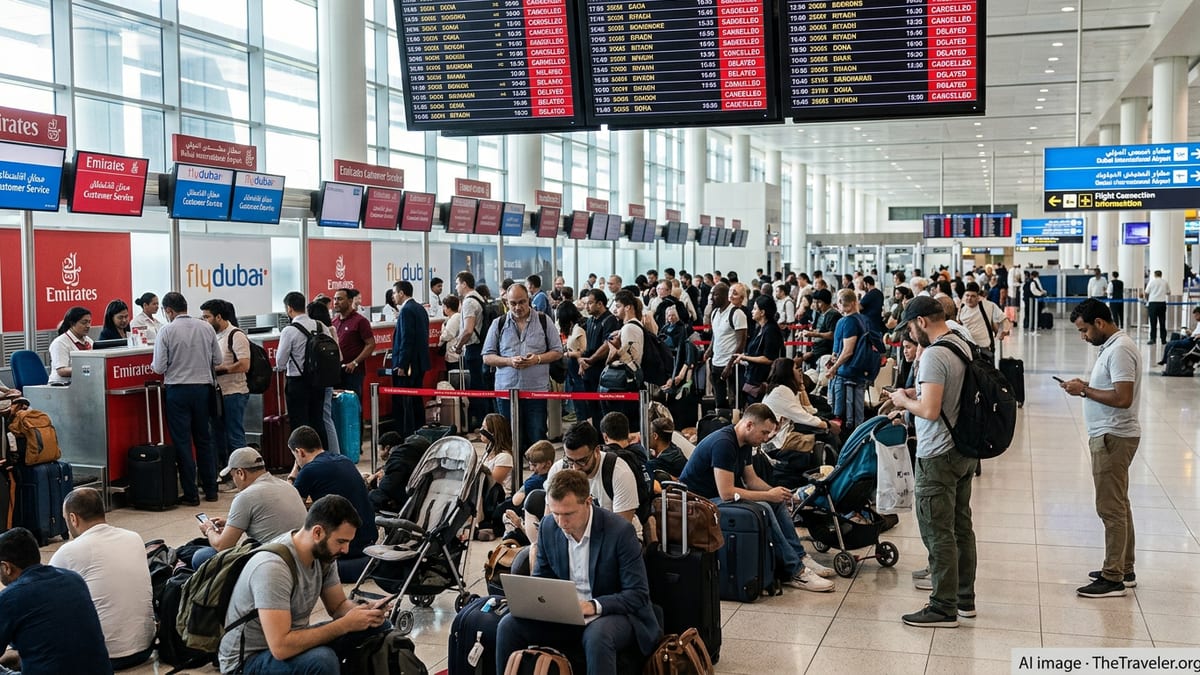
Middle Eastern hubs in the United Arab Emirates, Qatar, Jordan and Saudi Arabia are facing a fresh wave of aviation turmoil, with 673 flight cancellations and 118 delays recorded across major carriers including Qatar Airways, FlyDubai and Emirates, leaving tens of thousands of passengers stranded and forcing last minute changes to some of the world’s busiest long haul routes.
Airspace Closures Trigger New Wave of Cancellations
The latest disruption follows a cascading series of airspace closures across the region that began after a sharp escalation in the security situation at the end of February. Authorities in Iran, Iraq, Kuwait, Qatar, the United Arab Emirates, Bahrain and Jordan sharply restricted overflights, forcing airlines either to divert around affected zones or suspend services altogether.
Data from regional aviation authorities and airport operations shows that in the current 24 hour window alone, 673 flights have been cancelled and 118 delayed across the Middle East, with Qatar Airways, FlyDubai and Emirates among the hardest hit. Those figures come on top of several days of rolling disruption that have already seen thousands of flights cut from schedules at the key hubs of Doha, Dubai and Abu Dhabi.
While some Gulf carriers have restarted limited operations, schedules remain highly unstable. Airlines are releasing updates in short bursts as airspace permissions are granted and revoked, leading to abrupt last minute cancellations that have caught many travellers already en route to the airport or in transit.
Industry analysts say that even if airspace begins to reopen more fully, the backlog of displaced passengers and aircraft will likely keep schedules unsettled across the region for several more days.
Key Hubs and Routes Most Affected
The heaviest concentration of cancellations is centred on the region’s main connecting hubs. Hamad International Airport in Doha has seen hundreds of Qatar Airways flights scrubbed from the board as the carrier keeps much of its network on pause pending clearer airspace guidance. The disruption is rippling across Qatar Airways’ long haul links to Europe, North America, Africa and Asia, routes that normally rely on smooth one stop transits through Doha.
In the United Arab Emirates, Dubai International Airport is again under pressure as Emirates and FlyDubai pare back departures. Cancellations have clustered around flights to and from Europe, South and Southeast Asia, and Australasia, where aircraft would usually cross multiple restricted airspace zones on their way to or from the Gulf. Abu Dhabi has also reported significant disruption on overlapping corridors as carriers attempt to reconfigure routings.
Further west, Saudi Arabia and Jordan are experiencing knock on effects. Riyadh and Jeddah have seen services to Dubai and Doha thinned out or temporarily pulled, cutting capacity on crucial business and religious travel corridors. In Jordan, delays and cancellations on routes linking Amman to Gulf hubs are complicating onward journeys for passengers connecting to North America and Europe.
Long haul itineraries that typically depend on the Gulf as a midway stop are among the worst hit. Travellers headed between Europe and India, Southeast Asia, Australia or New Zealand on Qatar Airways or Emirates are bearing the brunt of the 673 cancellations, with many reporting multi day delays while they wait for scarce seats on alternative routings.
How Qatar Airways, FlyDubai and Emirates Are Responding
Qatar Airways has maintained a particularly cautious stance, keeping large portions of its network grounded while Qatari airspace remains constrained. The airline is operating limited essential services but has cancelled or heavily delayed many of its regular departures in and out of Doha, contributing a substantial share of the 673 cancellations now logged across the region.
Emirates, based in Dubai, has announced a reduced schedule that prioritises key trunk routes and repatriation flights. While some long haul services have resumed on extended routings that skirt closed airspace, others continue to be cancelled with only a few hours’ notice. This has led to clusters of stranded travellers at Dubai International, many of whom had been mid journey on complex multi leg itineraries.
FlyDubai, which operates a dense network of regional routes, has been forced to trim or suspend services to several neighbouring states as airspace restrictions shift. With a fleet optimised for short and medium haul sectors, the low cost carrier has less flexibility to add lengthy detours, leading to point to point cancellations on popular routes that connect secondary cities to Dubai and Doha.
All three airlines are offering some combination of free rebooking, travel vouchers or refunds for disrupted passengers, but processing times are slow. Contact centres and airport help desks are handling unprecedented call volumes, and many travellers report waiting hours for confirmation of new travel dates.
What Stranded Passengers Can Do Now
For passengers currently stuck in the Middle East, the most important step is to secure written confirmation from the airline that a flight has been cancelled or significantly delayed. That documentation underpins eligibility for rebooking, refunds and, on some routes, compensation under local or international passenger rights regulations.
Travellers are being urged not to go to the airport unless they have a confirmed new booking number and departure time. With 673 cancellations and 118 delays already recorded, terminals in Dubai, Doha and Riyadh are working to reduce overcrowding by encouraging customers to manage their journeys through airline apps, online portals or local travel agents instead of queuing at counters.
Those with urgent travel needs, such as onward connections or time sensitive business or medical journeys, should proactively ask airlines about rerouting via alternative hubs that remain less affected. Carriers are increasingly using secondary gateways in Europe, South Asia and East Africa as temporary workarounds, though seats on these options are limited and can sell out quickly.
Travel insurance policies may cover some out of pocket expenses such as additional hotel nights or meals, but coverage varies widely. Policyholders are advised to review their terms carefully and keep receipts for all extra costs incurred while stranded.
Planning Travel Through the Region in the Coming Days
With regional airspace still in flux, travellers planning to transit the Middle East in the next several days should prepare for a period of heightened uncertainty. Schedules published on airline websites and booking platforms are changing frequently and may not reflect last minute cancellations driven by security or regulatory decisions.
Experts recommend building additional buffer time into any itinerary that relies on a Gulf hub, particularly for those travelling to major events, cruises or tours that have fixed departure times. Where possible, travellers may wish to opt for routes that bypass the most heavily affected airspace altogether, even if that means longer detours or overnight stops in alternative cities.
Airlines and airports across the UAE, Qatar, Jordan and Saudi Arabia insist they are working to restore normal operations as quickly as conditions allow. However, the combination of airspace closures, aircraft misalignment and crew scheduling complications means that the impact of the 673 cancellations and 118 delays logged so far will likely be felt well beyond the current news cycle.
For now, the clearest advice is to stay flexible. Passengers should monitor their booking closely, keep contact details updated with their airline and be prepared for changes even after check in. In a region where the major carriers function as a global bridge between continents, any shock to the system can quickly ripple worldwide, and this latest round of cancellations is already reshaping how and where people are able to travel.