


More news on this day
Air travel across the Middle East remains severely disrupted as Kuwait, Bahrain, Iraq, the United Arab Emirates and other countries maintain sweeping airspace closures or highly restricted airport operations in response to the escalating war involving Iran, the United States and Israel, leaving hundreds of thousands of travelers facing cancellations, diversions and uncertain paths home.
Which Airports Are Affected and How the Situation Is Evolving
Since February 28, when U.S. and Israeli strikes on Iran triggered a wave of retaliatory attacks across the region, a patchwork of airspace closures and airport shutdowns has emerged from the Gulf to the Eastern Mediterranean. Kuwait has kept its airspace largely closed to regular commercial traffic, with Kuwait International Airport reduced to emergency and limited movements only. Most scheduled passenger flights remain suspended or diverted, and local carriers have frozen ticket sales on many routes.
In the Gulf, Bahrain, Iraq and the United Arab Emirates have also imposed extensive restrictions. Several key hubs, including Dubai and Abu Dhabi, temporarily halted most commercial services after nearby airspace and, in some cases, airport infrastructure came under threat or direct attack. Operators have since begun cautiously resuming a small number of flights, but capacity is still far below normal and subject to abrupt changes as security assessments are updated.
Saudi Arabia’s role is more mixed. While parts of its airspace near conflict zones are restricted and certain routes have been suspended, major airports such as Riyadh and Dammam have continued to function as pressured lifelines for travelers trying to exit the region. Airlines serving the kingdom have repeatedly adjusted schedules, canceling or consolidating flights at short notice as risk calculations and insurance constraints shift.
Beyond the Gulf, Lebanon and segments of Cyprus’s airspace have also been affected by the conflict, especially on routes transiting Iranian and Iraqi skies. Several European and Asian carriers have paused services to Beirut or rerouted flights to avoid high-risk corridors, adding further strain to already stretched regional capacity and complicating onward connections for travelers heading to or from Europe, Africa and Asia.
What Travelers Can Expect: Cancellations, Diversions and Long Delays
For travelers with tickets into or through Kuwait, Bahrain, Iraq, the UAE or neighboring states, widespread cancellations are likely to remain the norm in the short term. Airlines have scrubbed thousands of flights since the crisis began, often with only a few hours’ notice, as new missile and drone alerts prompted authorities to extend or tighten airspace closures. Even where airports have technically reopened, schedules are skeletal and heavily oversold due to the backlog of stranded passengers.
Flights that do operate are frequently diverted around closed airspace, adding one to three hours to flight times and putting extra pressure on refueling and crew duty limits. This has created a domino effect of missed connections at hubs in Europe and Asia, particularly for passengers who would normally connect through Dubai, Doha or Abu Dhabi on their way between continents.
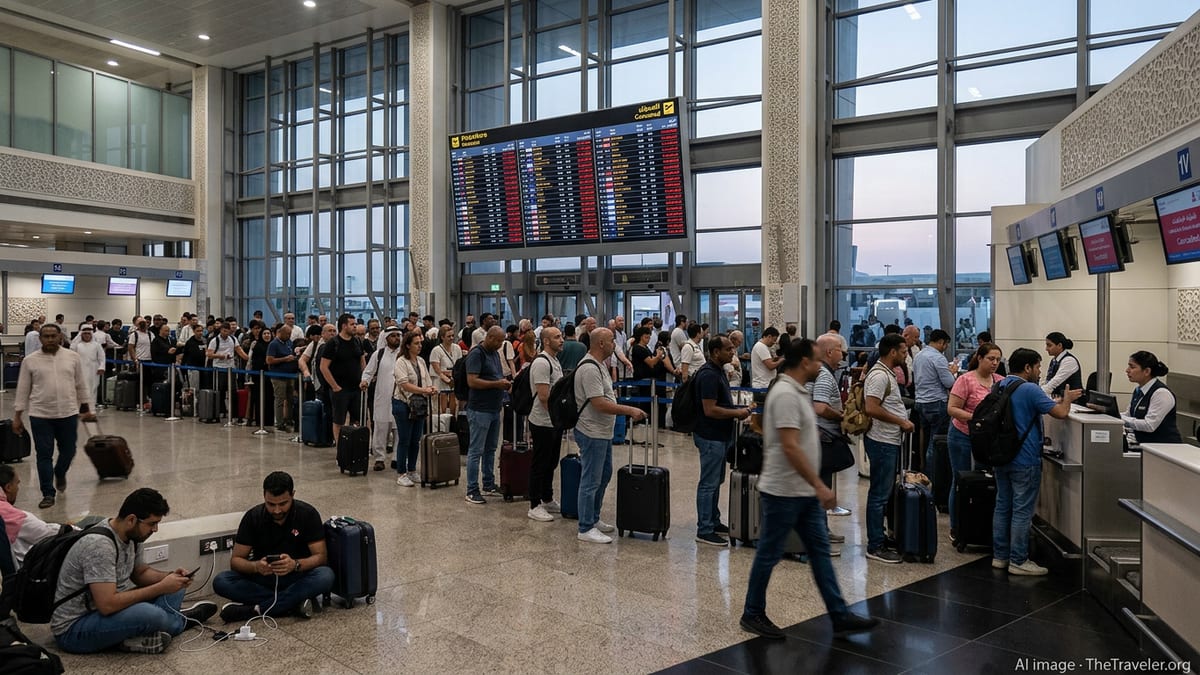
At many airports, terminal scenes remain crowded and tense. With limited onward options, travelers report sleeping on terminal floors, queuing for hours at airline desks and struggling to secure new tickets at reasonable prices. Some governments have begun organizing charter or military evacuation flights for their citizens, but access to these seats is often restricted and subject to fast-changing eligibility rules.
Airlines and airport operators are urging passengers not to go to the airport unless they have written confirmation that their flight is operating and they have a rebooked seat. Information screens can lag behind reality, and some flights shown as scheduled are being canceled late if airspace restrictions tighten or if safety insurers withdraw coverage for a particular route or time window.
Your Rights on Cancellations and How Rebooking Is Working
The legal and commercial framework for cancellations in this crisis is complex, because the disruptions stem from armed conflict and airspace closures rather than routine operational issues. Many airlines are invoking force majeure clauses, which can limit strict compensation owed to passengers, especially on non-European carriers not bound by EU-style compensation rules. Nonetheless, almost all major airlines are offering free date changes, route changes where feasible, or travel credits for unused tickets.
Rebooking, however, is constrained by the reality that there are far fewer seats than stranded travelers. Priority is generally being given to passengers who were already in transit when the closures began, followed by those with imminent departures. In practice, this means that some travelers may wait several days, or even longer, to secure a confirmed seat out of the region, particularly from Kuwait, Bahrain, and temporarily shuttered UAE hubs.
Travelers originating outside the Middle East who have tickets transiting affected hubs are often being rerouted via alternative gateways. Carriers are shifting passengers onto itineraries through Istanbul, Cairo, Muscat, or European hubs such as Athens and Rome, which currently offer safer air corridors. These alternatives may involve overnight layovers, changed arrival airports, or mixed itineraries on partner airlines.
Passengers should keep all documentation, including cancellation notices, boarding passes, and receipts for unexpected expenses such as hotels and meals. While immediate cash compensation may not be guaranteed, especially where war-related exclusions apply, travel insurers and some credit card providers may cover part of the additional costs. Policies differ significantly, and many exclude active conflict zones, so travelers will need to review their terms carefully.
Practical Steps for Stranded and Soon-to-Depart Travelers
For travelers already in Kuwait, Saudi Arabia, the UAE, Bahrain, Iraq, Lebanon or nearby countries, the most urgent task is to establish a verified line of communication with your airline and, where relevant, your embassy or consulate. Airline apps and SMS alerts tend to update more quickly than airport displays, and some carriers have created crisis-specific information pages and dedicated hotlines to manage the surge in inquiries.
Officials are advising passengers not to attempt to cross closed borders or drive long distances to alternative airports without confirming that both the route and destination are safe and operational. Overland travel to a functioning airport in a neighboring country may be possible in some cases, but security conditions can deteriorate quickly, and insurance coverage may not extend to self-organized evacuations through active conflict areas.
Those with upcoming departures into the region are being encouraged to postpone or reroute travel wherever possible. Many airlines are allowing free changes for tickets to affected destinations for travel dates over the coming weeks. Tour operators and meeting organizers across the Gulf and Levant are canceling or moving events, and hotel chains are loosening cancellation policies on stays linked to disrupted flights.
Travelers should also prepare for basic contingencies: ensuring adequate supplies of essential medications, keeping digital and printed copies of travel documents, and maintaining access to funds in case of extended stays. Power banks, unlocked phones with regional SIM cards and the contact details of local ground handlers or travel agents can make a significant difference if you find yourself stranded with limited connectivity.
How Long Might the Disruptions Last and What to Watch
Aviation analysts and regional officials caution that, while some limited services are restarting, the broader Middle East air network will likely remain fragile as long as missile and drone attacks continue and insurers price in elevated risk. Even partial reopening of airspace does not mean a rapid return to normal schedules; airlines must reposition aircraft and crews, clear passenger backlogs and secure overflight permissions on newly approved routes.
Travelers should watch for key indicators, including official notices from civil aviation authorities, statements from major carriers based in the Gulf and Levant, and updated travel advisories from foreign ministries. A sustained reduction in air defense alerts and a shift from full closures to defined, time-limited restrictions would signal a gradual normalization, but these changes are expected to unfold over weeks rather than days.
For now, industry observers expect Saudi Arabia, Oman and select Mediterranean gateways to serve as primary exit points for those able to reach them safely, while Kuwait, Bahrain, parts of Iraq and heavily damaged or threatened hubs in the UAE and elsewhere operate in a restricted or stop-start mode. Airlines are likely to prioritize core long-haul trunk routes and essential repatriation flights before restoring secondary destinations.
Given the volatility of the conflict, experts recommend that anyone planning to travel to, from or through the affected region build flexibility into their plans, avoid nonessential trips and assume that last-minute changes will remain a defining feature of Middle East air travel for the foreseeable future.