

More news on this day
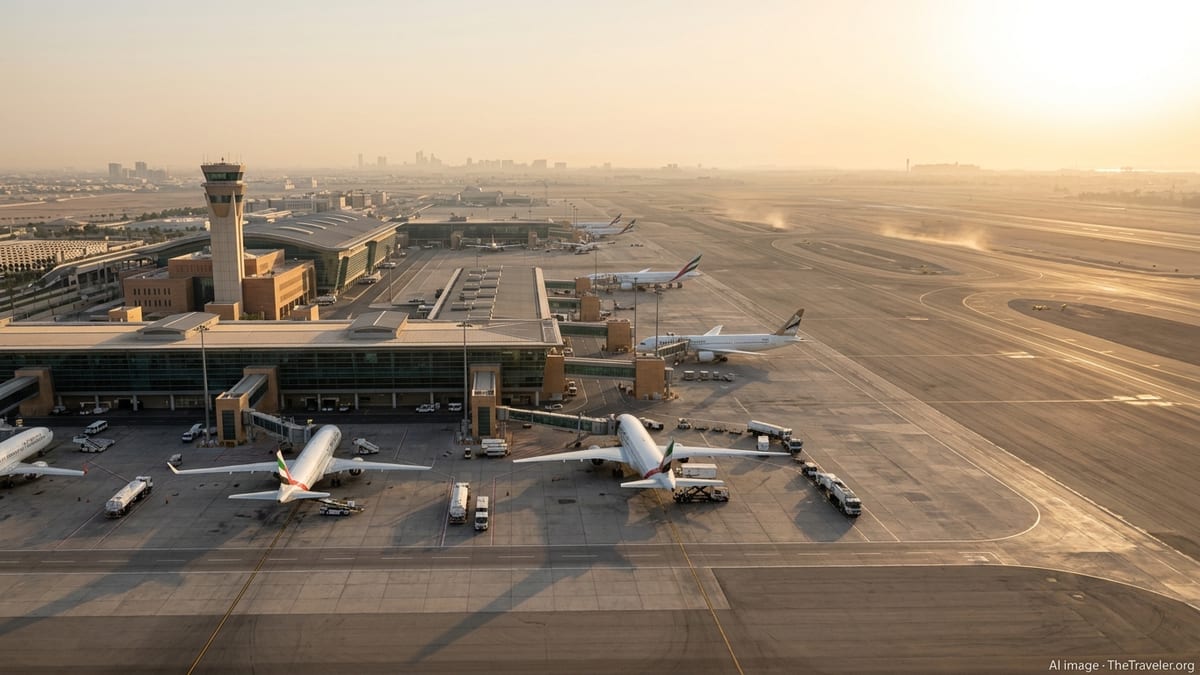
Travelers transiting through the United Arab Emirates are facing renewed disruption as Zayed International Airport in Abu Dhabi operates at reduced capacity amid ongoing regional airspace tensions linked to the 2026 Iran conflict.
Get the latest news straight to your inbox!
Reduced Operations After Regional Strikes and Airspace Closures
Publicly available information shows that flight operations at Zayed International Airport have been significantly curtailed since late February 2026, after Iranian missile and drone attacks targeted locations across the UAE and prompted widespread airspace closures. Initial suspensions of commercial flights from Abu Dhabi were followed by a gradual, tightly managed restart, with only a limited number of services allowed to operate during specific windows.
Travel advisories and industry notices indicate that Abu Dhabi’s main hub remains well short of normal capacity in mid March. Several carriers have adopted conservative schedules or suspended services entirely, citing both the closure or restriction of regional airspace and ongoing security considerations. While some aircraft movements have resumed, the pattern is described as reduced and highly controlled rather than a full return to pre crisis operations.
Reports from aviation and shipping circulars suggest that the UAE has been coordinating closely with regional and international partners on airspace management, prioritizing safety and military requirements over commercial convenience. This has kept throughput at Zayed International Airport markedly below its usual volume, affecting both origin and transit passengers.
Impact on Airlines, Connections, and Transit Passengers
Flag carrier Etihad Airways, which uses Zayed International Airport as its primary hub, has emerged as one of the most affected airlines. According to published coverage and customer communications, Etihad suspended the majority of its Abu Dhabi departures and arrivals in the first days of the crisis, only reopening a narrow band of services as authorities permitted limited airspace access. Even as some flights have restarted, schedules remain fluid and subject to last minute change.
Other regional and international airlines have similarly reduced or rerouted operations involving Abu Dhabi. Travel industry bulletins show that multiple carriers adjusted network plans to avoid UAE airspace or to minimize ground time at airports within the country. This has undermined Abu Dhabi’s role as a dependable transfer point between Europe, Asia, Africa, and North America, with passengers warned to expect longer connections, overnight layovers, or diversions to alternative hubs such as Riyadh, Jeddah, Muscat, or Istanbul.
Travel forums and social media posts over the past two weeks describe passengers stranded in Abu Dhabi as flights were postponed, consolidated, or canceled with limited notice. While airport facilities and local hotels have been accommodating disrupted travelers, the experience has highlighted the vulnerability of hub and spoke networks when a central node such as Zayed International Airport is constrained by geopolitical risk.
Airspace Tensions and Safety Precautions Across the Gulf
The reduced capacity at Zayed International Airport cannot be viewed in isolation from broader airspace tensions across the Gulf region. According to news reporting and specialist aviation advisories, Iran’s missile and drone strikes against the UAE and other Gulf states since late February have prompted defensive responses, heightened military activity, and temporary closure of large swaths of regional airspace.
Several Gulf countries, including the UAE, previously enacted blanket suspensions of civilian overflights before moving to what has been described as exceptional or limited operations. Regulators and aviation safety bodies have issued guidance urging airlines to avoid certain flight information regions or altitude bands, and in some cases have prohibited their carriers from entering UAE airspace altogether. These decisions have directly constrained the number and type of flights that can safely land at or depart from Abu Dhabi.
Although interception systems have reportedly blunted the impact of many incoming projectiles, debris incidents and confirmed strikes near major infrastructure have reinforced a cautious approach. Risk assessments by airlines, insurers, and corporate travel managers continue to influence the pace at which capacity at Zayed International Airport can be restored, even when the physical runway and terminal infrastructure remain serviceable.
What Travelers Using Abu Dhabi Should Expect Now
For travelers with upcoming itineraries routed through Abu Dhabi, the current environment calls for flexibility and careful planning. Publicly available airline updates emphasize that schedules may change at short notice as airspace permissions are adjusted and security assessments evolve. Some carriers continue to operate only skeleton services in and out of Zayed International Airport, often prioritizing repatriation flights, key long haul links, or routes with strong point to point demand.
Prospective passengers are being urged by airlines and travel management companies to monitor their booking status closely, enable notifications, and consider voluntary rebooking where alternative routings exist. Published advisories also note that airport access rules may be tightened, with some terminals restricting entry to ticketed passengers and recommending early arrival times due to potential security checks and congestion at operating counters.
Travelers who must transit Abu Dhabi at this time may find that minimum connection times are effectively unreliable, as onward flights can be delayed or rescheduled in response to evolving airspace controls. Overnight stays in Abu Dhabi remain a possibility for itineraries that previously involved seamless same day connections, and many travel sellers are recommending travel insurance that specifically covers disruption arising from conflict related closures or diversions.
Outlook for Capacity Recovery at Zayed International Airport
Looking ahead, industry analysts quoted in public coverage suggest that the path back to full capacity at Zayed International Airport will depend on both security conditions around the UAE and the broader diplomatic trajectory of the 2026 Iran conflict. Even if the immediate intensity of strikes and interceptions diminishes, airlines are likely to phase their return cautiously, reflecting crew safety considerations, aircraft routing constraints, and passenger demand trends.
Economic assessments of the conflict point to a wider regional impact on trade, tourism, and business travel, with the UAE’s aviation sector, including Abu Dhabi’s hub, facing particular headwinds. Reduced frequencies and thinner route maps could persist for weeks or months, especially on marginal routes that are less profitable or can be more easily shifted to alternative hubs. At the same time, the UAE’s established position as a global connector suggests that carriers will be keen to restore Abu Dhabi once risk premiums and operational uncertainty subside.
For now, Zayed International Airport remains operational but constrained, a symbol of how quickly geopolitical events can reshape global travel patterns. Passengers planning to fly through Abu Dhabi in the coming days should treat schedules as provisional and remain prepared for last minute adjustments as the region’s complex airspace picture continues to evolve.