

More news on this day
Aer Lingus passengers are being warned to brace for tighter identification checks on UK routes and days of transatlantic disruption, as new passport rules take effect just as a powerful blizzard cripples air travel across the northeastern United States.
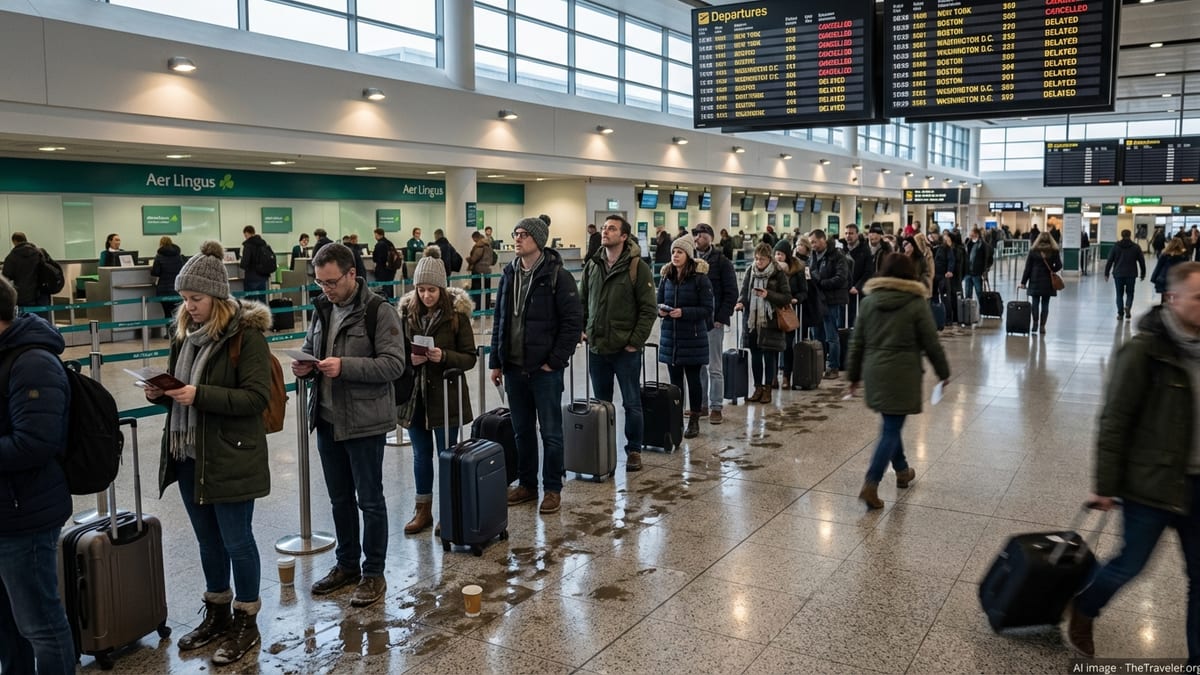
Passport Now Essential on Ireland–UK Aer Lingus Flights
Aer Lingus has confirmed that from 25 February 2026 every passenger travelling between the Republic of Ireland and the United Kingdom on its mainline and Aer Lingus Regional services must present a valid passport or Irish passport card. The move ends a long-standing practice of accepting a wider range of photo identification on routes traditionally treated as relatively informal under the Common Travel Area.
Until now, many Irish and British travellers relied on driving licences, Garda age cards, student cards or workplace ID to board Aer Lingus flights between Irish airports and cities such as London, Manchester and Birmingham. Those documents will no longer be accepted on cross-channel services. The carrier says the updated rules apply regardless of when the ticket was booked, meaning passengers who arranged spring trips months ago must still comply with the new documentation requirements.
The airline has framed the shift as a bid to align Ireland–UK routes with the rest of its network and to streamline airport operations. By insisting on passport-standard documents, Aer Lingus argues it can reduce last‑minute document disputes at boarding gates and minimise knock‑on delays across its schedule at busy hubs including Dublin and London Heathrow.
Domestic flights remain outside the new regime. Services such as Dublin–Donegal, as well as routes operated entirely within the United Kingdom from Belfast to other British cities, keep their existing identification rules. The focus is squarely on flights that cross the border between the Republic of Ireland and Great Britain, where immigration authorities increasingly expect full passport checks as standard.
Confusion for UK Travellers and Families Caught Out
The timing of the policy change has triggered a scramble among some frequent travellers who had grown used to flying without a passport between Ireland and Britain. Families planning half‑term trips, students shuttling between universities and home, and workers on short‑notice business travel are among those now urgently checking the validity of their passports or applying for new ones.
Travel agents report a spike in queries from British and Irish nationals who only hold a driving licence or have let their passports lapse, particularly older travellers who rarely leave the Common Travel Area. Consumer groups warn that anyone arriving at the airport without the correct document risks being denied boarding, even if they have flown the same route many times with alternative ID in the past.
The new Aer Lingus rules also introduce further complexity into an already patchwork landscape of identification requirements around the Irish Sea. British Airways, the Irish flag carrier’s sister airline, continues to permit recognised photographic ID rather than a passport on key links between London and Dublin, and ferry operators on routes between Ireland and Britain still accept a range of documents. Passengers who book through one carrier but end up ticketed on an Aer Lingus-operated flight are being urged to read the small print carefully.
Industry observers say the shift reflects a broader tightening of border procedures around the UK in the wake of Brexit and the rollout of new permission‑to‑travel schemes such as the UK Electronic Travel Authorisation. While Irish and British citizens remain exempt from many of those controls, airlines appear keen to standardise their own checks to avoid fines and operational headaches.
Blizzard Hernando Paralyzes Transatlantic Links
The ID shake‑up comes as Aer Lingus and other European airlines grapple with major transatlantic disruption caused by a record‑breaking winter storm on the US East Coast. Blizzard conditions linked to Storm Hernando have buried parts of New England and the Mid‑Atlantic in deep snow, triggered states of emergency and knocked out power for hundreds of thousands of homes and businesses.
From Sunday 22 February through Tuesday 24 February, more than 11,000 flights in the United States were cancelled, with thousands more delayed as airports from Washington to Boston struggled to clear runways and taxiways. New York’s JFK and LaGuardia, along with Newark and Boston Logan, have ranked among the hardest‑hit hubs, with some airports cancelling the vast majority of scheduled movements at the height of the storm.
Dublin Airport has confirmed that at least a dozen transatlantic services linking Ireland with New York, Newark and Boston were cancelled as a direct result of the blizzard, including multiple Aer Lingus departures and returns. A Shannon flight to Boston was also scrubbed. With many aircraft and crews now out of position on both sides of the Atlantic, timetable knock‑ons are expected to ripple through the week even as skies clear.
In addition to the immediate cancellations, airlines are bracing for a slow recovery as they work through backlogs of displaced passengers. Some US carriers have issued weather waivers allowing travellers to rebook without change fees, while Aer Lingus is advising customers to monitor flight status closely and to allow extra time at the airport when services resume, to accommodate longer queues at check‑in and security.
What Aer Lingus Passengers Should Expect This Week
For Aer Lingus customers, the overlap of a major policy change and a historic storm means this week is shaping up to be particularly challenging. On Ireland–UK routes, the message from the airline and airports is clear: no matter how short the hop or how familiar the journey, passengers should treat it as an international flight and bring a valid passport or Irish passport card.
Travellers heading for the United States face a different set of considerations. Even if their own Aer Lingus flight is showing as operating on time, cascading delays at East Coast gateways can lead to last‑minute schedule changes, missed connections and overnight stays. Passengers connecting onward within the United States are being encouraged to build in generous transfer times or, where possible, to postpone non‑essential trips until the US network stabilises.
Airport authorities in Dublin and Shannon say they are working closely with airlines to manage crowds in departure halls and to keep information displays updated. Nonetheless, they recommend that passengers check their flight status repeatedly in the 24 hours before departure and sign up for airline text or email alerts so they can react quickly to any change.
With many hotels near key US hubs already filling up with stranded travellers, those whose journeys are discretionary may find it less stressful to defer travel by a few days. Where travel is essential, experts advise packing medication and a change of clothes in carry‑on bags, budgeting for potential overnight expenses and keeping digital copies of important documents in case of disruption.
Broader Questions for the Common Travel Area
The Aer Lingus passport decision also reignites debate about the future of the Common Travel Area, the long‑standing arrangement that allows free movement of Irish and British citizens between the two islands. While the legal framework remains intact, travellers are confronting a reality in which documentation expectations differ sharply depending on the carrier, route and mode of transport they choose.
Legal experts point out that the Common Travel Area does not oblige airlines to accept any particular form of identification; it simply governs the rights of entry for eligible citizens. Carriers are free to impose stricter document checks if they believe it is necessary for security, regulatory compliance or operational consistency, and there are signs that more may follow Aer Lingus in moving towards passport‑only policies on cross‑channel flights.
For now, the practical impact falls hardest on occasional travellers and lower‑income passengers who may not have an up‑to‑date passport. Advocacy groups are calling on airlines and governments to better coordinate messaging, simplify rules where possible and explore options such as reduced‑fee passports or alternative trusted travel documents for Common Travel Area journeys.
As the transatlantic network slowly recovers from the latest bout of extreme weather, many in the industry see this week as a stress test not just of airline resilience but of how well travellers are being prepared for a patchier and more paperwork‑heavy era of mobility between Ireland, Britain and North America.