

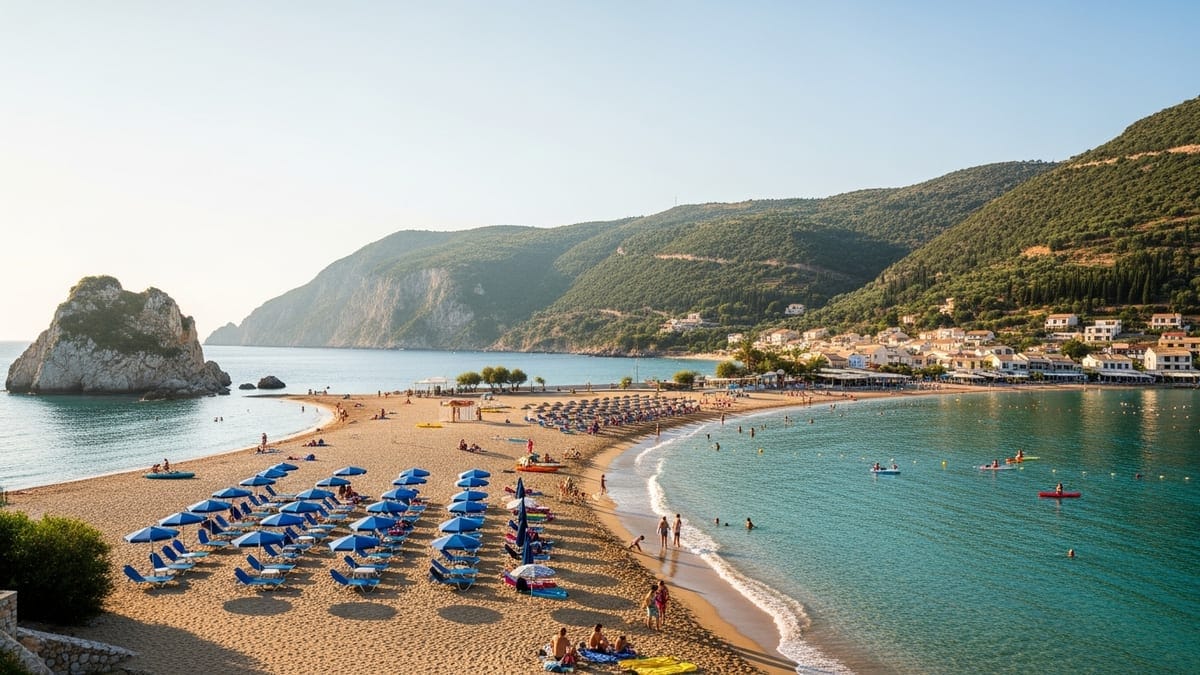
Agios Gordios is one of Corfu’s most photogenic west-coast beaches, a long crescent of golden sand framed by steep green hills and a dramatic rock stack rising from the Ionian Sea. Just 30 to 40 minutes from Corfu Town, it feels like a different world once you descend the winding road into this compact resort village. Whether you come for lazy swims in clear water, leisurely paddles on a stand up paddleboard, or sunset cocktails in the sand, Agios Gordios offers the kind of easygoing beach holiday that Corfu does best.
Getting Oriented: Layout and Atmosphere of Agios Gordios Beach
Agios Gordios sits on Corfu’s central west coast, roughly opposite Corfu Town on the east side of the island. The resort occupies a steep valley that opens out onto a long, gently curving bay. At the back of the valley you will find olive groves and cypress-clad hills; in front, a broad sandy shore with the small island-like rock of Ortholithi standing sentry just off the southern end of the beach. The main village road runs downhill and ends directly on the seafront, which makes navigation simple for first-time visitors.
The beach itself is roughly one and a half kilometers long, predominantly soft sand with occasional shingle or small pebbles where winter storms have shifted the shoreline. The central stretch in front of the tavernas and cafés is the liveliest part, with rows of sunbeds and umbrellas, music drifting from beach bars and a steady flow of people in high season. As you walk away from the village toward either end of the bay, the atmosphere quickly becomes quieter and more natural, with fewer facilities but more space.
Even at the height of summer, Agios Gordios rarely feels as crowded as some of Corfu’s better-known beach resorts. Day trippers arrive from Corfu Town and nearby inland villages, but most visitors stay in local hotels and apartments within walking distance. That gives the area a friendly, lived-in feel rather than the transient mood of purely day-trip destinations. In the evenings the beach road turns into a relaxed promenade, with families strolling, couples lingering over dinner and the sun sinking directly into the sea.
The surrounding landscape is a major part of the appeal. The hills rise steeply on both sides, creating a sense of enclosure and shelter. Olive groves cascade down to the back of the beach, and the Ortholithi rock at the southern side gives the bay a recognisable silhouette that you will see on many postcards and travel posters. Whether you are here just for a day or for a week-long base, it is an easy beach to settle into quickly.
Swimming Conditions: Water Clarity, Temperatures and Safety
Agios Gordios is primarily a sandy beach, which makes entry into the water comfortable underfoot and keeps the sea looking a distinctive turquoise on sunny days. The central and southern sections of the bay tend to shelve gradually, giving a relatively long, shallow zone close to shore where the water comes up to waist or chest height. This is ideal for casual swimmers and families with older children who want room to splash and play.
The Ionian Sea here warms steadily through the season. Average sea temperatures hover around 19 degrees Celsius in May, reach about 22 degrees in June and peak near 25 to 26 degrees in July and August. Even in September the water generally remains around 25 degrees before cooling back to the low 20s in October. These are comfortable swimming temperatures for most people from late spring right through early autumn, with the warmest and most predictable conditions from mid June to mid September.
Because Agios Gordios faces west into the open Ionian, you will often find gentle waves rather than completely flat water. On calm days the sea can be glassy, particularly early in the morning. When onshore winds pick up, usually in the afternoon, the waves become more noticeable but are rarely large enough to deter confident swimmers. Beach flags, where used, follow the standard Greek system, with green indicating low risk, yellow advising caution and red signaling that swimming is prohibited due to high waves or strong currents. Even when there are no lifeguards on duty, it is wise to use these same principles, watching for increasing wave height and strong surges before you go far from shore.
Families and less confident swimmers will be most comfortable in the central section of the bay near the main access road, where the seabed is sandiest and the gradient into deeper water is most forgiving. Conditions can be slightly variable near the rocky northern end, especially on windier days. As with many west-coast Corfu beaches, there can be a small shorebreak where waves meet the sand, so children and anyone with mobility issues should take particular care when entering or exiting the sea. In general, though, Agios Gordios has a reputation as a safe, user-friendly beach with clear water and no significant underwater hazards close to shore.
Best Areas of the Beach for Different Types of Swimmers
The long arc of Agios Gordios means different parts of the beach lend themselves to different kinds of swimming and relaxation. Choosing your spot carefully can make a real difference to your day, especially in the height of summer when shade and space are at a premium. Fortunately, the shoreline is easy to walk, and you can explore the full length of the bay in 20 to 30 minutes at an easy pace.
The central zone, directly in front of the main village and beach access, is the best all-rounder. Here you will find the most sunbed sets, lifeguard coverage if provided that season, quick access to cafés and toilets and the smoothest sandy entry into the water. If you are staying in a seafront hotel or apartment, this is likely to be your default area, and it suits mixed groups who want a balance of swimming, people-watching and convenience.
Walk south, toward the Ortholithi rock, and the beach gradually becomes more spacious and less structured. Some organised sections remain, particularly in front of individual restaurants or small hotels, but you will also find gaps where you can lay your own towel and umbrella. The sea remains suitable for swimming here, and the views back toward the village, hills and rock stack are especially photogenic from this angle. If you like to swim short laps along the shoreline, this southern stretch often feels a little calmer underfoot and in terms of crowds.
The northern end of the beach, closer to the cliffs and large rock formations, is more rugged and can appeal to stronger swimmers seeking a slightly wilder feel. The seabed becomes a bit more mixed, with scattered rocks and patches of shingle among the sand. This can give the water extra clarity on very calm days, but it also demands more attention to where you place your feet. Stronger swimmers sometimes use this area to explore around the rocks or to snorkel when visibility is good. For children and less confident bathers, the central and southern sectors generally remain the better choice.
Water Sports and On-the-Water Adventures
Agios Gordios has a relaxed character, but it still offers a good selection of low-key water sports for those who want to do more than simply float and sunbathe. Along the central part of the beach you will typically find operators renting kayaks and stand up paddleboards, as well as pedal boats. These are ideal for exploring the bay at your own pace, hugging the shoreline or paddling toward the Ortholithi rock when conditions allow. Early morning and late afternoon are usually the calmest times for such excursions, with softer light and fewer boats on the water.
Motorised activities are more limited than at some of Corfu’s busier resorts, which many visitors regard as an advantage. In high summer you may see small boats pulling inflatables or offering short rides, but the mood remains low-key rather than full-blown power-sport hub. If you are specifically interested in jet skiing or paragliding, you may find more options at larger resorts elsewhere on the island, using Agios Gordios as a quieter base for swimming and relaxing between excursions.
For casual paddling and snorkeling, the edges of the bay provide the most interest. Kayakers often head south toward the Ortholithi rock for the views and to get a sense of the open sea beyond the bay. On calm days, the area near the rock can have clear, inviting water, although this zone is better suited to experienced swimmers and paddlers because it is farther from shore and more exposed to swell. Stay clear of any boat routes and avoid venturing out in strong wind or building waves.
If you would like to explore beyond Agios Gordios, local tour operators and agencies in the village can arrange boat trips to other west-coast beaches and coves, sometimes combined with snorkeling stops. These excursions are a good way to see Corfu’s dramatic coastline while keeping Agios Gordios as your home beach. In peak season it is sensible to book a day or two ahead, especially for trips timed around sunset or popular weekend departures.
Facilities, Comfort and Practical Tips for Beach Days
Agios Gordios is a fully equipped beach resort rather than a remote cove, so you will find most day-to-day comforts within a short walk of your sunbed. Several sections of the beach are organised, with rental sets of two loungers and an umbrella managed by nearby cafés or hotels. Prices vary slightly among operators and by season, but they commonly include table service for drinks and snacks, making it easy to settle in for several hours at a time. If you prefer to bring your own gear, look for the unorganised stretches especially toward the southern and far northern ends.
Behind the main beachfront row, a compact grid of streets hosts tavernas, bars, mini-markets and a few beachwear and souvenir shops. This is where you will find most public restrooms and changing facilities, typically linked to restaurants and bars. Showers are often located at the back of organised beach zones, for washing off salt and sand. Many seafront establishments remain open from breakfast until late evening in high season, offering everything from coffee and fresh juice to grilled fish, salads and traditional Corfiot dishes, so you never have to go far for a meal.
Parking is one of the few mild stress points in peak summer. The small seafront parking area at the very bottom of the road only has space for a limited number of cars and tends to fill up by mid morning on busy days. Turning around at the end of the road can be awkward once it is congested with pedestrians. A more reliable solution is to park higher up in the village near the main entrance and walk down, which only takes around ten minutes and saves you from navigating the tightest section of the road. For those staying in local accommodation, many hotels and apartments provide their own small parking areas or are close enough to the beach to make walking the simplest option.
Beach footwear is recommended even though the shore is predominantly sandy. Summer sand can become very hot by midday, and there are occasional pebbly patches or scattered rocks in the shallows, particularly near the edges of the bay. A pair of lightweight water shoes or sandals can make all the difference, especially for children or anyone with sensitive feet. Sun protection is essential, as the west-facing exposure means strong afternoon sun; wide-brimmed hats, reef-safe sunscreen and periodic shade breaks will make your beach days far more comfortable.
When to Visit: Seasons, Crowds and Sunset Magic
The classic beach season in Agios Gordios runs from late May to early October, with July and August as the peak months for both temperatures and visitor numbers. In high summer the village is at its liveliest, with all tavernas and bars open, full water-sports services in place and long, hot days that roll into warm evenings. Sea temperatures reach their maximum during this period, making it particularly appealing for long swims and water-based activities.
For many travelers, however, the shoulder seasons of June and September, and even early October in good years, offer the most balanced experience. In June the hills are still green, the sea is warm enough for comfortable swimming, and crowds are noticeably lighter than in August. September brings reliably warm water and slightly cooler air temperatures, with a more relaxed atmosphere as families with school-aged children return home. Some businesses begin to scale back hours by early October, but a core of restaurants and cafés usually remains open as long as there is demand, and the weather often allows for several hours of beach time each day.
Spring and late autumn can reward more flexible travelers, especially those who enjoy walking and scenery as much as swimming. In April and early May the sea can still feel brisk, but sunny days are common, and the surrounding countryside is at its most lush and fragrant. November sees cooler air and water temperatures, increasingly unsettled weather and very limited resort operations, so it is less attractive for a classic beach stay but can appeal to off-season hikers and photographers.
Regardless of the month, sunsets are a daily highlight in Agios Gordios. Facing due west across the Ionian, the beach offers unbroken views of the sun dropping toward the horizon, silhouetting the Ortholithi rock and painting the sky in shades of gold, pink and crimson. Many visitors plan their day around this moment, returning from inland excursions in late afternoon to claim a table at a beachfront taverna or a towel on the sand. Even on busier days the beach never feels too crowded to enjoy the spectacle, and for many travelers these sunsets become the defining memory of Agios Gordios.
Beyond the Beach: Walking, Viewpoints and Nearby Experiences
While Agios Gordios is very much a beach-focused resort, its setting in a steep valley means there are rewarding walks and viewpoints within easy reach. The road down to the village from the main inland route offers several lay-bys and terrace cafés with panoramic views over the bay. Even if you are staying at sea level, it is worth heading uphill one evening simply to see the full sweep of the beach, the Ortholithi rock and the surrounding hills from above. The change in perspective can be dramatic, especially around sunset or just after a summer storm when the light is particularly clear.
Behind the resort, small lanes wind into the olive groves, connecting Agios Gordios with older hillside villages such as Sinarades. These walks provide a glimpse of traditional Corfiot life away from the waterfront, with stone houses, narrow alleys and small squares shaded by plane trees. The routes vary in difficulty, but even a short stroll into the groves can be refreshing on a hot day, offering dappled shade and the scent of wild herbs. Good footwear and a measure of caution are advised, as surfaces can be uneven and steep in places.
For those willing to explore further, Agios Gordios can serve as a base for visiting other west-coast beaches and attractions. Nearby options include more secluded sandy bays and organized resorts with broader water-sport offerings. Inland, you can visit monasteries, olive presses and viewpoints reached by local roads that twist and climb through the interior. Car hire is popular, but for shorter distances local taxis or pre-arranged transfers to trailheads and viewpoints can be an easier option, especially for visitors not accustomed to Corfu’s narrow, curvy roads.
Back in the village, evenings revolve around the beachfront and the central lane. Tavernas serve fresh seafood, grilled meats and Corfiot specialties, often with sea views and the sound of the waves in the background. Beach bars shift from daytime chill-out venues to relaxed nightspots, with low-key music and cocktails. It is not a late-night party scene on the scale of Corfu’s bigger clubbing centers, which suits visitors looking for a more laid-back atmosphere where a sunset drink or ice cream walk often marks the end of the day.
Staying in Agios Gordios: Beachfront Comfort and Access
One of the advantages of Agios Gordios as a beach destination is the range of accommodation that lies either directly on the sand or within a short walk of the water. Along the seafront you will find small hotels and apartment complexes offering balconies with sea views, pool access and immediate proximity to the beach. Many properties combine straightforward comfort with prime location rather than striving for ultra-luxury, which helps keep the mood relaxed and the village feel intact.
Set slightly back from the front line, family-run guesthouses and studios often sit on terraces rising up the hillside. These can provide even more dramatic views across the bay in exchange for a few extra steps up or down each day. For travelers who value a quiet night’s sleep, being one or two rows back from the busiest bars may be a plus, especially in July and August when the seafront can stay lively into the late evening. Many accommodations include kitchenettes, which suit families and long-stay guests who like to prepare some of their own meals.
Reaching Agios Gordios from Corfu’s airport or main port usually involves a drive of around 30 to 40 minutes, depending on traffic and the exact route. Some hotels arrange airport transfers, while others can help you book a taxi or shared shuttle. Public buses link the resort with Corfu Town on regular schedules during the main season, giving independent travelers an affordable way to combine beach time with visits to the island’s capital. Once you arrive in the village, you can easily do without a car for day-to-day needs, as everything from supermarkets to tavernas and beach access is walkable.
Because the resort is compact, booking early is wise if you have your heart set on a specific kind of stay, such as a top-floor room with uninterrupted sunset views or a ground-floor studio with direct garden access. Families often favor accommodations with pools as an alternative to the sea on breezy days. Couples may prioritize balconies or terraces with privacy. Whatever your preferences, the defining feature of most stays in Agios Gordios is proximity to the beach, ensuring you can slip into the water within minutes of leaving your room.
The Takeaway
Agios Gordios brings together many of the elements that make Corfu’s west coast so appealing: a broad sandy bay, clear Ionian water, dramatic hills, everyday comforts and unforgettable sunsets. It is a place where you can swim before breakfast, linger over a seaside lunch, paddle a kayak in the afternoon light and watch the sky burn orange from the same stretch of sand. The beach has room for both simple pleasures and small adventures, from relaxed floating in the shallows to paddling out for a better view of the Ortholithi rock.
For swimmers, the gentle gradient, largely sandy seabed and seasonally warm water make Agios Gordios a welcoming choice, especially from June through September. For those seeking water sports, it offers enough to stay entertained without turning into a noisy playground of engines and wake. Families, couples and solo travelers alike can find their corner of the beach, whether in the organized central zone with all facilities on hand or at the quieter fringes where the natural scenery takes over.
Ultimately, Agios Gordios feels less like a spectacle and more like a place you ease into over a few days, recognizing familiar faces at the café, choosing a favorite sunset spot and learning the best time to slip into the sea when it is at its calmest. If your idea of a beach holiday balances swimming and sun with a laid-back atmosphere and a strong sense of place, this Corfiot bay deserves a place high on your list.
FAQ
Q1. Is Agios Gordios Beach suitable for non-swimmers and children?
Yes. The central part of the bay in front of the main village has a mostly sandy bottom and a gentle slope, so the water stays relatively shallow close to shore. It is still important to supervise children carefully, especially when waves pick up in the afternoon, but many families find this section of the beach comfortable and user-friendly.
Q2. When is the best time of year to swim at Agios Gordios?
The most comfortable swimming conditions are typically from mid June to late September, when sea temperatures are around the low to mid 20s Celsius and the weather is reliably warm. May and early October can also offer pleasant swimming on sunny days, though the water will feel cooler, and you may encounter more changeable weather.
Q3. Are there lifeguards on duty at Agios Gordios Beach?
Lifeguard presence can vary by year and by section of the beach. In high season, central organized parts of the shore may be covered, but you should always check locally on arrival and treat the sea with respect even when lifeguards are present. When in doubt, follow flag warnings, stay close to shore in wavy conditions and avoid swimming alone.
Q4. What water sports are available at Agios Gordios?
Agios Gordios offers mainly low-impact water sports such as kayak and stand up paddleboard rentals, as well as pedal boats. In peak months, you may also see some boat-towed inflatables. The overall atmosphere is quieter than at large resort hubs, which many visitors appreciate for swimming and relaxing without constant engine noise.
Q5. Is snorkeling worth doing at Agios Gordios?
Snorkeling can be enjoyable around the rocky edges of the bay, particularly toward the northern end and near rock formations on calm days. Visibility depends on recent weather and wave action, but you can often see small fish and interesting rock structures. For more dramatic underwater scenery, you might combine Agios Gordios with boat trips to nearby coves.
Q6. How crowded does the beach get in summer?
In July and August, the central section of the beach can become busy, especially late morning and mid afternoon, but it rarely feels overwhelmed. Walking ten minutes toward either end of the bay usually brings you to quieter stretches with more personal space. Arriving early in the day or later in the afternoon is an easy way to enjoy a more tranquil atmosphere even in peak season.
Q7. Is it easy to find shade on the beach?
Organized zones provide umbrellas with sunbeds for rent, which are the most convenient form of shade. Natural shade along the sand is limited because the hills rise steeply behind the beach, so if you prefer not to rent equipment, bringing a small beach umbrella or sun tent is advisable, particularly for younger children and during the midday hours.
Q8. Can I visit Agios Gordios without a car?
Yes. During the main season, public buses connect Agios Gordios with Corfu Town, and many visitors rely on this service combined with walking around the village. Taxis and pre-booked transfers provide additional flexibility. Once in the resort, everything from supermarkets to tavernas and beach access is within easy walking distance for most travelers.
Q9. What should I pack for a day at Agios Gordios Beach?
Essentials include swimwear, a high-SPF reef-safe sunscreen, a hat, sunglasses and some form of beach footwear. A lightweight cover-up or shirt for sun protection, a refillable water bottle and perhaps a small dry bag for valuables are also useful. If you do not plan to rent an umbrella, packing a compact sunshade will help you enjoy longer hours on the beach in comfort.
Q10. Is Agios Gordios a good base for exploring the rest of Corfu?
Agios Gordios works well as a base if you prioritize beach time on the west coast but still want occasional trips elsewhere. It is within roughly 30 to 40 minutes’ drive of Corfu Town and is reasonably placed for day trips to other central and southern beaches. With a car you can explore widely; without one, you can still combine beach days with bus or taxi excursions to selected attractions.