

More news on this day
Airports across the United Kingdom and Asia are rapidly adopting artificial intelligence to decide where aircraft park, a quiet yet powerful shift that promises fewer delays, faster turnarounds and a smoother experience for millions of global travelers.
Get the latest news straight to your inbox!
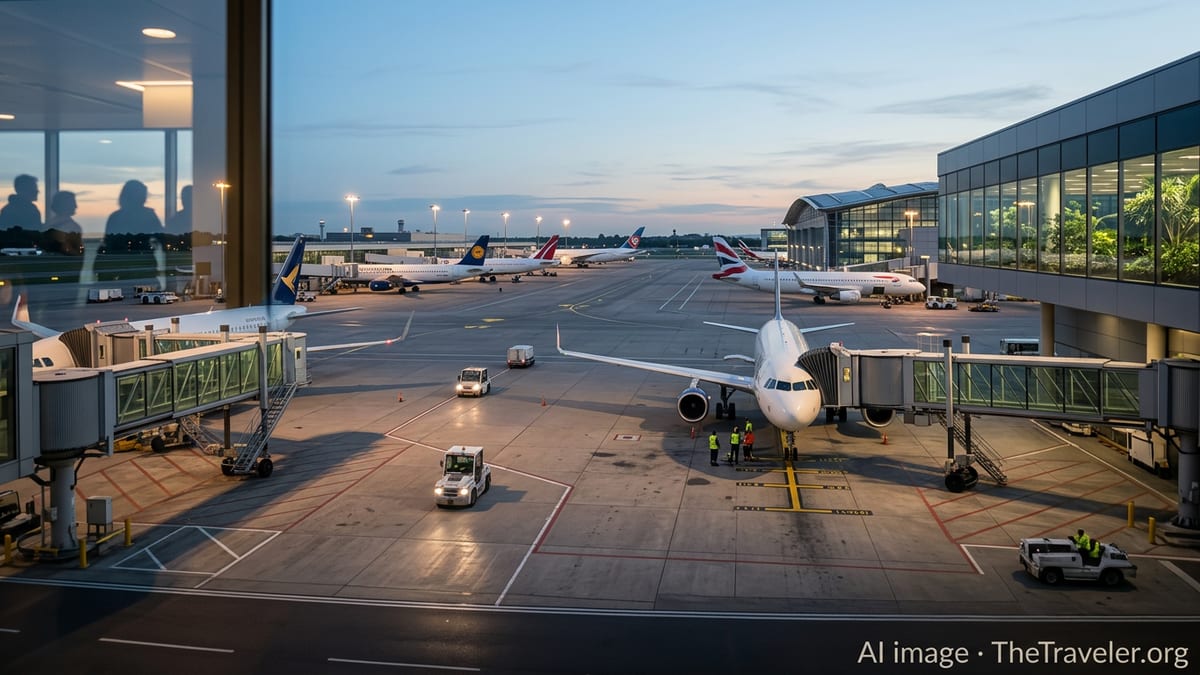
AI Takes Over One of Aviation’s Biggest Bottlenecks
Behind every on-time departure lies a complex puzzle: matching arriving aircraft to the right parking stand or gate, at the right time, with the right ground resources in place. Traditionally, this has been handled by large control teams using a mix of legacy software, radio calls and experience. With growing passenger volumes and constrained airport footprints, that manual juggling act has become a critical bottleneck.
Artificial intelligence is now being brought into that decision chain. New systems ingest live data on arrivals, departures, aircraft size, turnaround status, crew and passenger connections, and even airfield congestion, then recommend or automatically assign aircraft stands. The aim is to reduce conflicts, cut the time jets spend waiting on taxiways, and ensure that scarce contact stands with jet bridges are used as efficiently as possible.
Industry studies suggest more than half of the world’s airports are implementing some form of AI-driven operational tool, with stand and slot allocation among the fastest-growing use cases. For travelers, the benefits are designed to show up in fewer last-minute gate changes, shorter tarmac holds and improved on-time performance, especially at congested hubs.
While the algorithms are complex, airport operators stress that the technology is being introduced as decision support rather than a replacement for human controllers. The systems surface optimal stand plans in seconds, while experienced staff retain the authority to override recommendations in unusual circumstances such as weather disruptions or medical emergencies.
Heathrow Puts AI at the Heart of Punctuality Drive
London Heathrow, one of the world’s busiest and most slot-constrained airports, is among the front-runners in using AI to squeeze more efficiency out of its stands. The airport has outlined a multibillion-pound investment plan that includes expanded use of AI tools to improve punctuality, optimise stand usage and reduce ground-related delays.
A key element is the installation of cameras and sensors around each aircraft stand, feeding real-time data into AI systems that monitor turnaround milestones such as arrival, refuelling, catering, baggage loading and boarding. By tracking these events in detail, the software can predict when a stand will be free, flag potential delays earlier and suggest reassignments that keep the overall schedule flowing.
This data-driven view is particularly important at Heathrow, where stand capacity is a hard constraint and the difference between using a contact stand or a remote parking position can add significant time to the passenger journey. AI stand allocation aims to maximise the use of the most desirable positions, prioritising long-haul and connection-heavy flights while still keeping within safety and regulatory rules.
Airport executives argue that smarter stand allocation is one of the most immediate ways to improve resilience without expanding the airfield. As airlines add capacity and schedules tighten, the hope is that AI will help Heathrow maintain its status as a punctual and well-connected global hub despite limited physical room to grow.
Changi and Asian Hubs Build AI-Ready Airfields
Across Asia, major airports are pairing AI stand allocation with broader airside automation projects. Singapore’s Changi Airport, often cited as a benchmark for smart airports, has rolled out autonomous baggage tractors on live routes between terminals and aircraft stands, backed by an expanding suite of AI systems monitoring the airfield.
Changi has invested in a digital twin of parts of its infrastructure, allowing operators to simulate different stand allocation scenarios and stress-test how disruptions ripple through the system. AI models forecast passenger surges, maintenance needs and baggage flows, giving planners an early warning when stand capacity may become a pinch point and enabling pre-emptive reassignments.
The airport has also implemented a formal AI management framework certified to international standards, positioning it to scale up stand and gate allocation tools in a controlled way. This governance is seen as critical as more operational decisions, from routing ground vehicles to sequencing pushbacks, become data-driven.
Elsewhere in Asia, large hubs in India, Southeast Asia and East Asia are integrating AI allocation engines with existing airport operational databases, biometric check-in programmes and automated border controls. The shared goal is to create a more predictable airport ecosystem in which aircraft, baggage and passengers flow through stands and terminals with fewer bottlenecks.
From Tarmac to Terminal: What Travelers Will Notice
For most passengers, AI stand allocation will never appear on a departure board, but its effects should be increasingly visible on the day of travel. Airports expect fewer late gate swaps that force passengers to dash across terminals, especially at tight-connection hubs. More accurate estimates of when an aircraft will arrive on stand or push back should translate into more reliable boarding times and better information in airline apps.
Ground congestion is another area where travelers may see a difference. When stands are poorly sequenced, arriving aircraft can be left idling on taxiways while tugs and equipment are repositioned, adding to noise and emissions. AI-powered planning is designed to cut those inefficiencies, getting jets into place faster and reducing the time passengers spend buckled in waiting for a gate.
On the airside, the combination of AI stand allocation with autonomous tractors, smarter baggage systems and predictive maintenance aims to bring greater consistency to turnarounds. That should help airports and airlines protect tight schedules during peak periods and recover more quickly from disruptions such as thunderstorms or air traffic control restrictions.
Industry analysts caution that technology alone will not eliminate delays, and early deployments have highlighted the need for strong contingency plans when digital systems encounter glitches. Even so, the direction of travel is clear: for global hubs in the UK and across Asia, the stand where an aircraft parks is becoming a test case for how AI can quietly transform the airport experience.