

More news on this day
AIDA Cruises has cancelled its entire 2026-27 Middle East season, withdrawing planned sailings in the Gulf and wider region as cruise lines reassess exposure to rising geopolitical tension and operational uncertainty.
Get the latest news straight to your inbox!
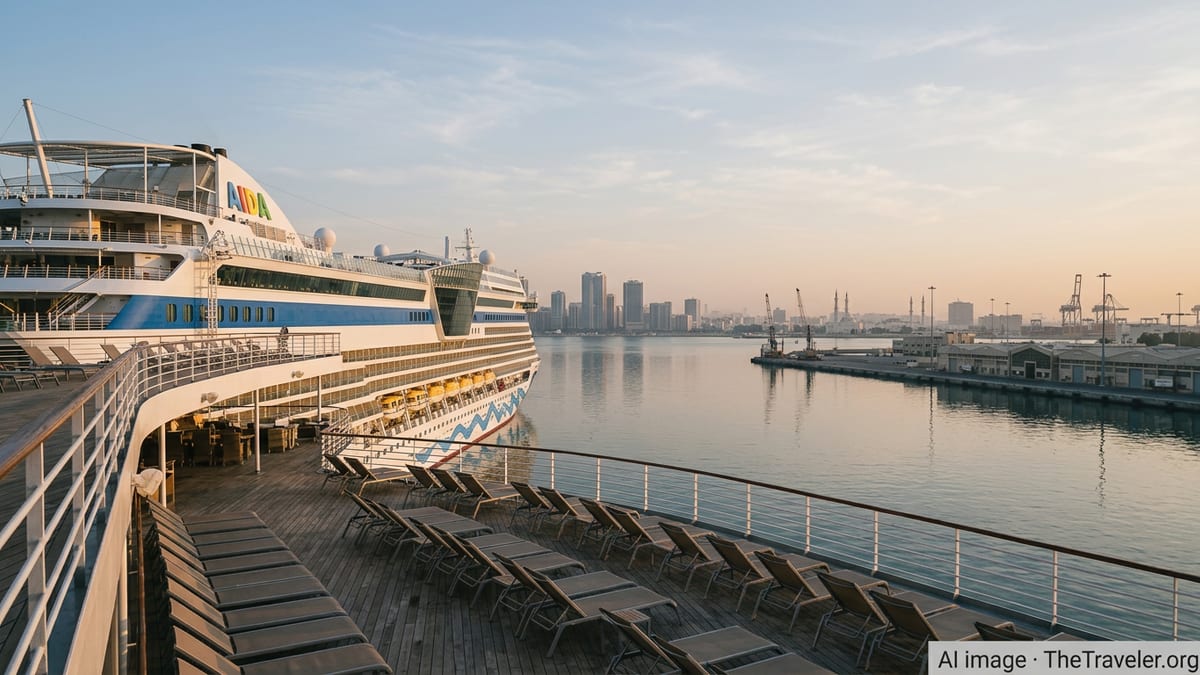
Program Pulled as Security Risks Mount in the Region
The decision removes AIDA’s scheduled deployments across key Middle Eastern ports for the 2026-27 winter, affecting itineraries that would typically include the United Arab Emirates and nearby Gulf destinations. Publicly available information indicates that the cruise line has opted to withdraw rather than maintain a reduced schedule, reflecting a cautious approach to the evolving risk landscape.
The move follows a pattern of itinerary changes across the industry in response to instability around the Strait of Hormuz and adjacent waters, where heightened tensions have periodically disrupted commercial traffic. Reports indicate that several operators have either shortened current seasons or reworked future plans to avoid chokepoints and politically sensitive areas.
While detailed ship-by-ship redeployments have not yet been fully outlined, the removal of Middle East sailings for 2026-27 signals a significant shift for AIDA’s winter program, which in recent years has relied on warm-weather Gulf cruises as a staple offering for European guests.
Impact on Guests With Booked 2026-27 Middle East Sailings
Travelers who had reserved AIDA Middle East departures for late 2026 or early 2027 are now facing itinerary cancellations and the need to rebook. Based on standard cruise industry practice and recent examples from other brands, affected guests can typically expect a combination of options such as alternative sailings, future cruise credits or refunds, depending on fare conditions and booking channels.
Travel forums and social media posts suggest that some customers were already monitoring geopolitical developments closely and weighing whether to change plans even before the formal program withdrawal. The cancellation may therefore come as both a disappointment and a pragmatic resolution for travelers who were uncertain about the safety and reliability of future calls in the Gulf.
Travel advisors are likely to play a central role in helping guests understand their choices and secure comparable alternatives, particularly for those who had coordinated air travel and pre- or post-cruise stays around the now-cancelled itineraries. In similar recent cases elsewhere, rebooking windows and protections have varied by cruise line and by region, making early contact with booking providers especially important.
Operational and Logistical Challenges Behind the Decision
Cancelling an entire seasonal deployment highlights the operational complexity of sailing in a region where access to key straits and ports can change quickly. Cruise planning is typically finalized years in advance, encompassing port reservations, fuel logistics, crew deployment and supply chains. Sudden shifts in navigational risk or insurance conditions can undermine the economic viability of an entire program.
Recent disruptions to cruise traffic in and around the Strait of Hormuz have underlined how rapidly regional conflict can affect passenger shipping routes, prompting both rerouting and full-program withdrawals by multiple operators. For AIDA Cruises, removing the Middle East season for 2026-27 appears aligned with a wider recalibration of deployment to prioritize predictable, lower-risk markets.
Insurance requirements, sailing restrictions, and potential limitations on emergency and port services in conflict-adjacent waters all factor into such decisions. Publicly available coverage of cruise movements in the region shows that lines have become more conservative about relying on itineraries that depend on contested sea lanes for either regular calls or repositioning voyages.
Wider Cruise Industry Shift Away From the Gulf and Red Sea
AIDA’s withdrawal from the Middle East for 2026-27 mirrors a broader retrenchment by major brands that once viewed Gulf winters as a fast-growing segment. Other operators have already trimmed or cancelled upcoming Emirates and Red Sea seasons, citing the fluid security environment and concerns about potential escalation.
Industry analysis points to a noticeable pivot back toward the Caribbean, Canary Islands and Western Mediterranean for winter capacity, where port infrastructure is extensive and contingency options are more readily available. For European-focused cruise brands, these regions provide alternative warm-weather itineraries without reliance on politically sensitive chokepoints.
At the same time, regional tourism stakeholders in the Middle East face the prospect of fewer cruise calls, which in recent years had contributed a growing stream of visitors to key ports and city destinations. The pullback underscores how closely cruise tourism is tied to perceptions of maritime security and how quickly demand can shift when itineraries are viewed as less predictable.
What Prospective Cruisers Should Watch Next
Travelers considering winter 2026-27 cruises are being advised by many commentators to monitor deployment announcements and updates from several lines, not only AIDA. Cruise schedules can continue to evolve as operators balance demand with the latest assessments of regional stability and port accessibility.
Prospective guests are also paying closer attention to cancellation and change policies, including how cruise-only bookings align with separately purchased flights and land stays. Flexible terms, insurance coverage for geopolitical disruption, and the possibility of last-minute rerouting are increasingly relevant factors in choosing both itineraries and brands.
For now, AIDA’s cancelled Middle East 2026-27 season stands as another example of how quickly the global cruise map can be redrawn when regional tensions rise. The redeployment of ships toward more stable waters is likely to reshape winter offerings for European cruisers, even as operators leave the door open to a potential return to the Gulf once conditions allow.