

More news on this day
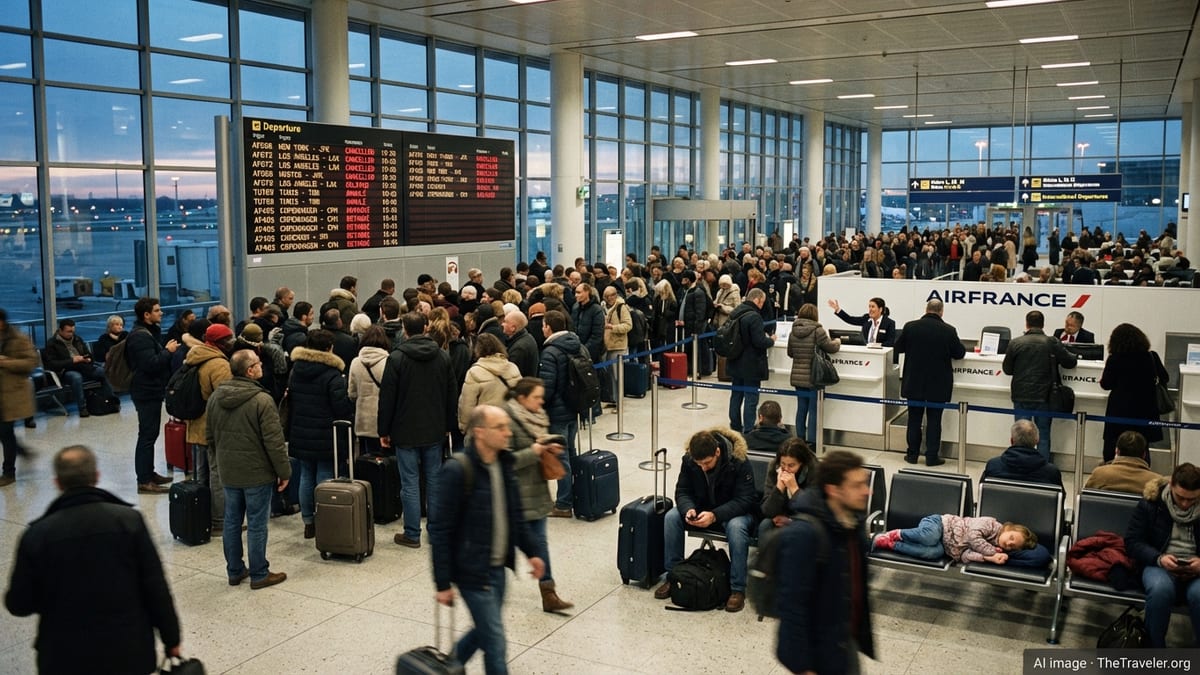
Passengers traveling with Air France faced another day of disruption as the carrier cancelled 14 flights and delayed seven more across its network, leaving travelers stranded from Paris to Tunis, Copenhagen, Los Angeles, New York, and beyond.
Fresh Disruptions Hit Air France Network
The latest figures from European aviation monitoring data show Air France among the hardest-hit legacy carriers in a fresh wave of winter disruption, with 14 cancellations and seven significant delays reported across its schedule. While the overall percentage of its operations affected remains in the low single digits, the impact has been concentrated on long-haul and key European routes, magnifying the fallout for connecting passengers.
The disruption comes as airports across Europe continue to grapple with a mix of winter weather, staffing constraints, and knock-on effects from earlier delays, creating a fragile operating environment where even relatively small operational shocks can cascade through the system. Routes linking France with the United States, the United Kingdom, Scandinavia, and North Africa have been particularly vulnerable, as they rely heavily on tight connection windows at major hubs.
For Air France, whose brand is closely tied to Paris as a global gateway, the cancellations have once again underscored the risks that come with a hub-and-spoke model. When departures banked through Paris Charles de Gaulle or Orly are disrupted, entire chains of onward connections are broken, leaving travelers stranded far from their final destinations.
The latest operational setbacks also follow months of heightened volatility in Europe’s skies, with recent data showing hundreds of daily cancellations and more than a thousand delays affecting carriers across the continent. Air France has not been alone in struggling to maintain schedule integrity, but for many of its passengers, that offers little comfort when they find themselves sleeping at airports or scrambling for last-minute alternatives.
Stranded in Paris: The Human Cost of a Broken Connection
At Paris Charles de Gaulle, where many of the affected Air France services are funneled, departure boards told the story long before official tallies emerged. Rows of flights marked “cancelled” or “delayed” translated into thousands of disrupted journeys, from long-haul travelers en route to North America to regional passengers trying to reach Scandinavia or North Africa.
Some passengers bound for New York and Los Angeles reported being rerouted via other European hubs late in the day, while others were offered departures the following morning after overnight stays in airport hotels. For travelers with fixed commitments in the United States, such as business meetings, medical appointments, or once-in-a-lifetime events, even a delay of several hours carried outsized consequences.
Inside the terminals, Air France ground staff worked to rebook connections and issue accommodation vouchers, but queues at service desks lengthened as the day wore on. Many passengers turned to airline apps and airport self-service kiosks in an effort to secure alternatives more quickly, yet those tools could not fully compensate for limited remaining seat capacity on popular long-haul routes.
With Paris acting as a crucial interchange point, travelers flying from smaller European cities found themselves stranded mid-journey. A missed evening connection could mean 24 hours or more in limbo for a traveler originating in Sweden or the United Kingdom, effectively adding an unplanned stopover to their itinerary.
Northbound and Westbound: Impact on New York, Sweden, and the UK
The network effect of 14 cancellations and seven delays became particularly visible on routes linking France with New York, Sweden, and the United Kingdom. Transatlantic services to New York remain among Air France’s flagship operations, and when one of these flights is cancelled or extensively delayed, the backlog of affected passengers can take days to clear, especially in peak travel periods.
Travelers bound for New York John F. Kennedy Airport found themselves competing for a shrinking pool of available seats on later departures, as well as on partner-airline flights serving similar routes. In some cases, passengers were rebooked via alternate European hubs, adding extra connections and additional hours in transit to what would normally be a relatively straightforward direct flight.
In northern Europe, connections to Sweden were also hit as delays from Paris rippled through the schedule. Passengers who had successfully reached Paris from Stockholm or Gothenburg faced missed onward flights and the prospect of unexpected nights in airport hotels, while those still on the ground in Scandinavia confronted rolling departure-time changes and gate reassignments.
Across the Channel, connections involving British airports were similarly unsettled. Flights between Paris and major UK cities are designed to plug directly into Air France’s long-haul network, but even small shifts in the timing of departures can cause connecting passengers to miss onward legs to North America or North Africa. The cumulative effect has been a day of disjointed itineraries and complicated rebooking chains that often extend beyond Air France’s own metal to alliance and codeshare partners.
North Africa and Scandinavia: Tunis, Copenhagen, and Beyond
Routes linking Paris and Tunis have been a focal point for disruption in recent months, and the latest cancellations reinforced the vulnerability of this busy North African corridor. For Tunis-bound passengers, a cancelled flight does not always translate into quick re-accommodation, particularly on days when demand is heavy and aircraft capacity is already stretched. What might appear as a single line on a cancellation tally often represents hundreds of people whose travel plans are abruptly upended.
For travelers in Tunis trying to reach Europe or connect onward to North America, the cancellation of a Paris-bound service means missed long-haul departures and, in many cases, an overnight wait for the next available option. Long queues at check-in counters and transfer desks have become a familiar sight on such days, with passengers attempting to piece together new routings through other hubs like Amsterdam or Madrid when Paris is no longer viable.
Farther north, Copenhagen has felt the strain as well. Flights between Paris and the Danish capital play a crucial role for both business and leisure travelers, as well as for those using Copenhagen as a secondary hub. When an Air France service is removed from the schedule or substantially delayed, options quickly narrow, especially for same-day connections aimed at reaching the United States or southern Europe.
The resulting pattern is one of scattered bottlenecks: a cancelled flight in Paris leading to overcrowded departures in Tunis, a missed connection in Copenhagen sending extra passengers onto already busy flights bound for London or Frankfurt. For travelers caught in the middle, the experience can feel less like a single disruption and more like a chain reaction with no easy off-ramp.
Transatlantic Turbulence: Los Angeles and Other U.S. Gateways
On the transatlantic front, services touching the United States continue to face pressure, and the latest Air France disruptions have again highlighted how fragile these routes can be when weather and operational delays converge. Flights connecting Paris with Los Angeles are particularly sensitive, given their long duration and the limited number of daily frequencies compared with shorter-haul routes.
When a Los Angeles flight is cancelled, rebooking is rarely as simple as shifting passengers to the next departure. Seats on subsequent services are often close to full, particularly during busy periods, and re-routing via connecting hubs like New York can be complicated by knock-on delays in the wider transatlantic network. Some passengers reported arrival times pushed back by a full day or more, transforming what should have been an overnight journey into a multi-leg odyssey.
Other U.S. gateways, including East Coast cities, have experienced similar strain. The broader context across Europe in recent days has seen carriers cancel and delay large numbers of flights to and from major hubs, with Air France among those forced to recalibrate schedules on short notice. For travelers relying on tight connections into or out of North America, the margin for error has shrunk dramatically.
Travel experts note that while airlines have become more adept at real-time schedule management and dynamic rebooking, the basic physics of limited seat capacity and crew availability still apply. When multiple long-haul flights are disrupted simultaneously, the system offers fewer escape routes for stranded passengers, as many learned this week in Los Angeles and other major U.S. cities.
Why 14 Cancellations Can Paralyze a Much Larger Network
On paper, 14 cancellations and seven delays might appear modest for a carrier operating hundreds of flights daily. In practice, however, the structure of modern airline networks means that a small number of targeted disruptions can reverberate widely, especially when they affect long-haul or high-demand routes.
Most large airlines, including Air France, rely on carefully timed “banks” of arrivals and departures at their hubs, orchestrated so that passengers from multiple origins can transfer efficiently to a broad range of destinations. When a few key flights do not operate, entire connection banks are compromised. Travelers who would have stepped off one aircraft and straight onto another suddenly find themselves misaligned with the schedule.
The effect is especially pronounced when cancellations occur less than 24 hours before departure, leaving minimal time for airlines to reposition aircraft or crews. Aircraft planned to operate subsequent legs may end up out of position, forcing additional schedule changes later in the day. What begins as an issue on one Paris to Tunis or Paris to New York flight can thus lead to residual delays on seemingly unrelated routes.
Compounding the problem is the reality that airlines in Europe have been managing elevated levels of disruption for weeks, amid adverse weather and capacity constraints at key airports. That means contingency buffers that might normally absorb a modest shock are already depleted. Each new set of cancellations places fresh strain on an ecosystem still struggling to regain equilibrium.
What Stranded Passengers Can Expect and How to Respond
For passengers caught in the latest wave of Air France disruptions, the immediate priorities are clarity and options. Travelers are being encouraged to monitor their flight status via airline apps and airport displays, as schedules can evolve rapidly throughout the day. Same-day alternatives may exist, particularly for high-demand corridors like Paris to London or Paris to New York, but availability diminishes quickly once cancellations are announced.
In many cases, Air France is rebooking affected passengers on the next available flight to their destination or via an alternate routing where partner airlines can assist. Where overnight stays become unavoidable, the carrier has been arranging hotel accommodation and meal vouchers, especially for passengers stranded mid-journey at hubs such as Paris Charles de Gaulle. Travelers are advised to retain all receipts for any out-of-pocket expenses, which may be relevant when seeking reimbursement or compensation.
Consumer-rights specialists recommend that passengers familiarize themselves with applicable air passenger protections, particularly on itineraries touching the European Union. Depending on the cause and timing of a cancellation or long delay, travelers may be entitled to refunds, rerouting, or financial compensation. Even when weather is a contributing factor, airlines remain responsible for basic care obligations such as providing food, drinks, and, when necessary, lodging.
For now, the experience of those stranded from Tunis to Copenhagen and Los Angeles serves as a reminder of the volatility still present in global air travel. While schedules may look robust on paper, the lived reality for passengers can change with only a few lines on a departure board, turning a routine journey into an extended test of patience and resilience.