

More news on this day
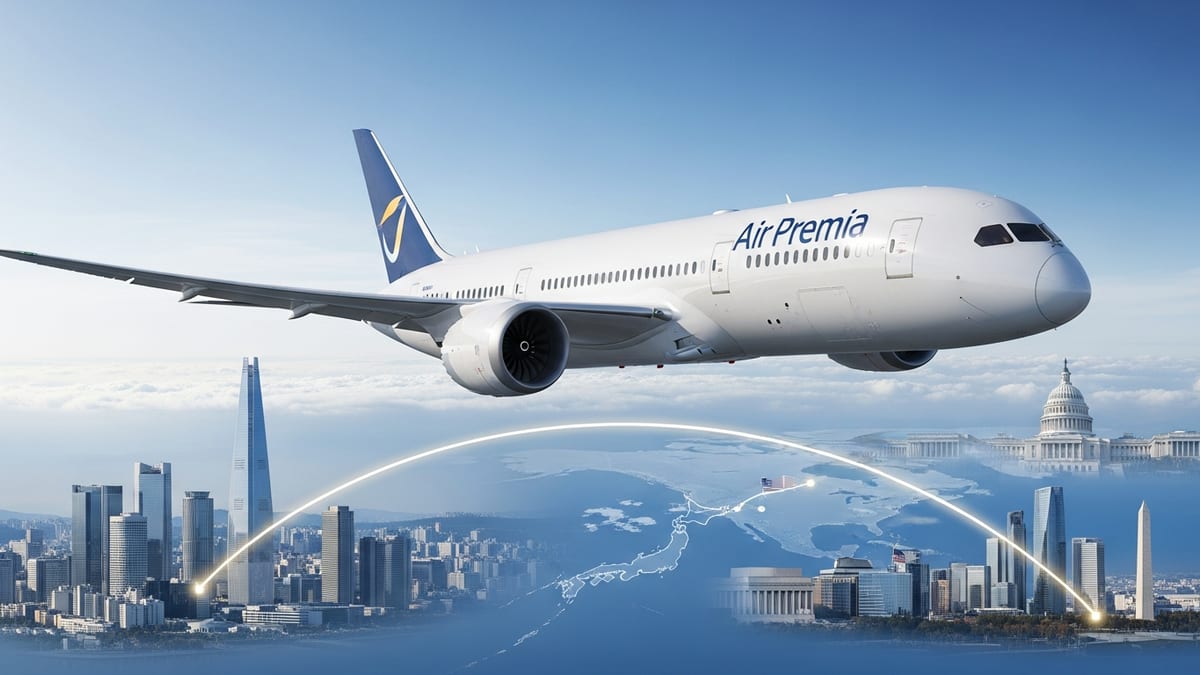
South Korean hybrid airline Air Premia is reshaping transpacific travel for the U.S. capital region with the launch of new nonstop flights between Seoul Incheon and Washington Dulles International Airport in 2026, a move that combines competitive fares with upgraded onboard comfort on one of the most strategically important links between Asia and Washington D.C.
Get the latest news straight to your inbox!
A New Nonstop Bridge Between Seoul and Washington
Publicly available information shows that Air Premia began operating four weekly nonstop flights between Seoul’s Incheon International Airport and Washington Dulles International Airport on April 24, 2026, marking the carrier’s first entry into the Washington D.C. market and adding a fresh option on a long-haul route traditionally dominated by full-service competitors.
The flights operate on a Monday, Wednesday, Friday and Sunday pattern, with daytime departures from Incheon and midday arrivals at Dulles, creating schedules that are designed to appeal to both business and leisure travelers seeking to avoid overnight connections and long layovers in other hubs.
Route data and airport statements indicate that the launch restores and expands nonstop air connectivity between the U.S. capital region and South Korea after a gap in new Korean entrants spanning more than three decades, underscoring the significance of the move for political, commercial and cultural ties between the two countries.
Traffic analyses cited in aviation coverage suggest that the Washington region generates well over one hundred thousand annual passengers traveling between the capital area and Seoul, a market that has historically relied on a limited set of nonstop and one-stop choices; Air Premia’s arrival brings incremental capacity and a different pricing model into that mix.
A Hybrid Model Tailored to Long-Haul Travelers
Air Premia describes itself as Korea’s first long-haul hybrid service carrier, positioning its model between traditional full-service airlines and ultra low-cost carriers by combining lower operating costs with a pared-back but still inclusive onboard product.
According to the airline’s own materials, long-haul economy passengers receive complimentary hot meals, in-flight entertainment and free checked baggage, features that are typically absent on many low-cost competitors but standard on the largest global carriers, helping explain why price-sensitive travelers increasingly view the airline as a value-focused alternative rather than a bare-bones option.
The carrier has aggressively promoted its premium economy cabin, emphasizing wider seats and a seat pitch generally above 38 inches, which places its offering closer to the extra-legroom products of major Asian and transpacific airlines while often undercutting their fares on comparable routes.
Industry observers note that this hybrid approach is particularly well suited to ultra-long sectors like the roughly 15 to 16-hour Seoul–Washington flight, where travelers weigh comfort and space more heavily than on shorter routes, but remain highly price-conscious in a market where business-class fares can run into several thousands of dollars roundtrip.
Why Washington Dulles Is Embracing Air Premia
Washington Dulles International has been steadily building its position as the primary long-haul gateway for the U.S. capital, and publicly available airport data shows that the arrival of Air Premia adds another Asian flag to a line-up that already includes carriers such as Korean Air, ANA, Emirates and Qatar Airways.
Local coverage of the inaugural flights highlighted that Air Premia’s service is the first new Korean airline launch to the Washington region in more than 30 years, an inflection point that underscores how the region’s growing population, technology sector and diplomatic presence are now drawing a broader range of international airlines.
Aviation analysts point out that Air Premia’s entry also coincides with a period of heightened competition in Korea–U.S. travel, as consolidation among large Korean carriers and additional North American routes encourage independent airlines to seek new gateways where demand is strong but capacity has not kept pace.
For Dulles, the service strengthens its portfolio of nonstop links to major Asian capitals while reinforcing the airport’s strategy of positioning itself as the long-haul hub for the wider Washington, Maryland and Virginia catchment area, particularly for travelers who prefer a single flight over connecting via other U.S. or Asian hubs.
Cabin Experience and Fleet on the Seoul–D.C. Route
Fleet information available from public sources indicates that Air Premia operates the Seoul–Washington route with Boeing 787-9 Dreamliner aircraft configured with economy and premium economy cabins, a choice that aligns with the airline’s decision to forgo traditional lie-flat business class in favor of a simplified, high-density layout.
The 787’s lower cabin altitude, larger windows and higher humidity are widely viewed in the industry as features that can reduce fatigue on ultra-long flights, and these characteristics support Air Premia’s marketing focus on comfort at a mid-market price point.
Seat maps and configuration data suggest that standard economy rows provide around 33 inches of pitch, which is more generous than many legacy carriers’ long-haul economy layouts, while premium economy delivers still more personal space and recline, amenities that are particularly noticeable on a 7,000-mile sector.
Traveler reports shared on consumer forums in early 2026 generally describe the onboard experience as closer to a streamlined full-service product than a no-frills low-cost model, with particular praise for legroom, cleanliness and the balance between included services and overall ticket prices.
Growing Appeal Among D.C.-Area Travelers
Within months of the April 2026 launch, early booking trends and comments from regional travel agencies suggest that Air Premia is quickly becoming a favored choice for Washington-area travelers heading to South Korea, particularly among visiting friends and relatives traffic and budget-conscious leisure passengers.
The airline’s pricing structure, which often undercuts traditional full-service competitors on the route while still including checked baggage and meals, appears to resonate with families, students and diplomatic staff who travel frequently and value predictable costs over expansive onboard frills.
Travel industry commentary indicates that the schedule’s midday arrival and early afternoon departure at Dulles also appeal to domestic connecting passengers using United and other carriers, who can link to a broad network of U.S. cities without overnight layovers, further expanding the route’s catchment beyond the immediate Washington metropolitan area.
As Air Premia continues to build brand awareness in North America through new routes to cities including Los Angeles, New York and Honolulu, its Seoul–Washington nonstop is emerging as a showcase for the hybrid model in one of the world’s most diplomatically significant corridors, giving the U.S. capital a new favorite carrier for transpacific travel.