

More news on this day
Luxembourg is rolling out a radically upgraded biometric passport from 11 May 2026, combining cutting-edge security technology with EU-wide digital border systems in a move that positions the Grand Duchy among Europe’s most advanced travel-document issuers.
Get the latest news straight to your inbox!
A New Generation of Luxembourg Passports Arrives
According to official government information, Luxembourg is introducing a redesigned passport from 11 May 2026, replacing the current document with a securely enhanced biometric version that complies with the latest European rules on travel-document standards. Publicly available guidance explains that the launch marks a new phase in how the country authenticates citizens at home and at borders abroad, with updated materials, layouts and embedded technologies intended to make forgery significantly more difficult.
From that date, Luxembourg passports are set to be divided into several categories, with differentiated validity periods depending on the age of the holder. Public information from national portals indicates that shorter validity is foreseen for younger applicants, while adults will retain a longer-term document, aligning Luxembourg more closely with practices already common in other EU states. This structural change is being framed as part of a larger overhaul that balances security objectives with practical considerations for frequent travellers.
Authorities have already been issuing biometric passports for several years, but the 2026 redesign goes further by integrating newer chip technology and updated security printing. Explanatory material from Luxembourg’s foreign affairs administration points to layers of visible and invisible safeguards, such as improved polycarbonate data pages, enhanced machine-readable zones and refined portrait integration, all designed to strengthen the physical link between the document and its holder.
In parallel, the rollout is being synchronised with updated application procedures at consular posts and municipal offices inside Luxembourg. Public service portals detail how residents and expatriates must now follow stricter identity verification steps and provide high-quality biometric enrolment data, including a compliant facial image and fingerprints, before a passport can be issued, renewed or replaced.
Deep Biometric Integration and Security Crackdown
The 2026 passport fits into a wider EU framework that has progressively tightened biometric requirements since Council Regulation 2252/2004 started harmonising security features and biometric identifiers across member-state travel documents. Luxembourg’s latest move is presented as an effort to sit at the forefront of those standards, with a focus on cryptographically protected chips that store biometric data in a way that is resistant to cloning and tampering.
National data-protection bodies in Luxembourg have previously highlighted that biometric passports must reconcile robust security with privacy safeguards. Under the EU’s data-protection regime, holders retain the right to access and, where necessary, correct the personal information encoded on their document. Publicly available guidance emphasises that biometric data captured for passports is used primarily to verify the authenticity of the travel document and the identity of the traveller, rather than to create open-ended tracking capabilities.
At border checkpoints, the stronger Luxembourg document reinforces a broader European security crackdown on fraudulent travel identities and passport abuse. EU-level reporting on the Entry/Exit System describes how more reliable biometric passports help reduce the risk of lookalike fraud, stolen-document recycling and identity theft. For Luxembourg, which already has one of the lowest rates of document fraud in the Schengen Area, the new passport is presented as a further deterrent against increasingly sophisticated forgery networks.
Beyond physical security, the upgraded chip architecture enables stronger digital authentication, including inspection systems that can rapidly verify electronic signatures against European Public Key Infrastructure repositories. This, in turn, allows airport border guards and automated gates to detect altered or counterfeit data pages within seconds, raising the bar for any attempt to tamper with the document or the information it contains.
Harnessing Europe’s New Digital Border Regime
The launch of Luxembourg’s new passport coincides with the full deployment of the European Union’s Entry/Exit System across external Schengen borders in April 2026. European Commission information describes how this digital system replaces manual passport stamping for non-EU nationals, recording biometric identifiers, travel-document data and entry and exit details at land, air and sea checkpoints.
While Luxembourg citizens are EU nationals and therefore not the primary focus of Entry/Exit controls within the Schengen Area, their upgraded passports are designed to interact seamlessly with the ecosystem of e-gates and inspection systems that rely on standardised biometric chips. This matters when Luxembourgers travel to third countries that use similar infrastructure, as more sophisticated chips can speed up identity checks and facilitate integration with future visa or pre-clearance platforms.
European Council and Commission material indicates that the new border systems aim to strengthen Schengen security by automatically detecting overstays and identity inconsistencies among non-EU visitors. In that environment, robust EU passports function as trusted anchors in a complex web of databases and watchlists. Luxembourg’s decision to align its document design and technology with these developments is framed domestically as both a security necessity and a competitive advantage for its citizens.
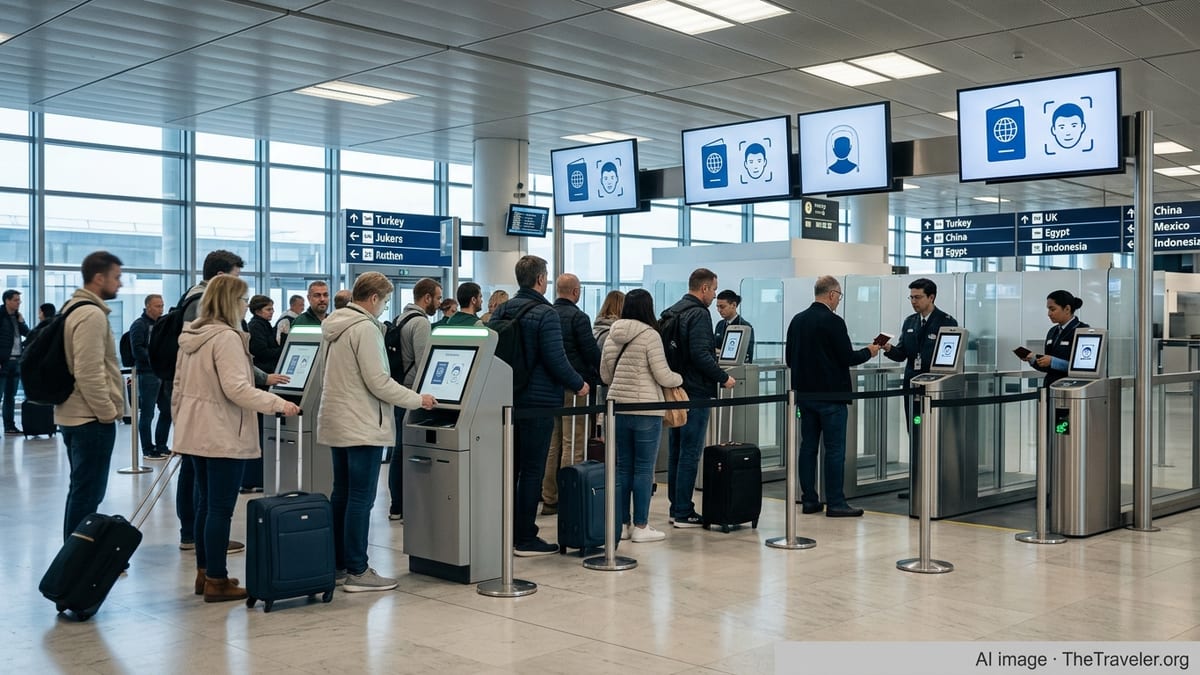
Airport operators across Europe have been steadily expanding the use of automated border-control gates that rely on biometric passports to process travellers more rapidly. With its 2026 redesign, Luxembourg is positioning its passport holders to benefit from these systems, potentially reducing queues at major hubs while still contributing to tighter screening of travellers deemed higher risk by destination countries.
High-Value Visa-Free Access Underpinned by Stronger Documents
Luxembourg’s passport is consistently ranked among the world’s most powerful travel documents by major global indices that measure visa-free and visa-on-arrival access. Recent rankings place it near the top tier of European passports, comparable to other small but globally connected states, reflecting the Grand Duchy’s dense network of bilateral and multilateral travel agreements.
Although the 2026 redesign does not itself create new visa exemptions, analysts note that states with strong document security and low fraud rates tend to negotiate and maintain wider travel freedoms. By enhancing biometric protections and tightening issuance procedures, Luxembourg is reinforcing the reputational capital that underlies its citizens’ easy access to destinations across Europe, the Americas, Asia and parts of Africa.
Publicly available discussions of recent global passport upgrades, including in non-EU countries that have introduced highly complex biometric documents, suggest a pattern whereby security innovation and travel convenience move in tandem. For Luxembourg, the new passport is widely interpreted as part of this trend: a way to preserve and potentially expand high-value travel opportunities, while reassuring partner countries that identity verification remains robust.
In practice, the benefits of such a powerful passport are felt most strongly by frequent business travellers, cross-border commuters and the sizable expatriate community that moves between Luxembourg and other financial or diplomatic hubs. The 2026 changes provide these groups with a document that is better adapted to intensive use in a world of automated gates, digital pre-clearance and data-driven risk analysis.
What Travellers Need to Know for 2026 and Beyond
Guidance for Luxembourg residents highlights several practical implications of the new passport regime. Applicants are advised to check the expiry dates of their existing documents well ahead of planned trips, particularly for travel scheduled after the new design has fully entered circulation. Although older biometric passports remain valid until their printed expiry date, some carriers and border agencies are moving toward preferences for the most recent chip standards, especially for automated processing.
Processing times, fees and required documents are outlined on Luxembourg’s official consular and citizen-service portals, which also emphasise the importance of accurate personal data and compliant photos. Travellers who previously relied on last-minute renewals are being encouraged to build in extra lead time, as the shift to more stringent biometric capture can, at least initially, lengthen appointments and production queues.
Outside Luxembourg, the country’s upgraded passport is expected to interact with a fast-changing landscape of digital travel authorisations, including planned systems in several non-European destinations. Industry commentary indicates that robust biometric passports tend to integrate more smoothly with these platforms, reducing friction when applying for electronic travel permits or registering for trusted traveller programmes.
As 2026 unfolds, Luxembourg’s passport overhaul is emerging as both a technical and symbolic development: a compact European state using high-end travel-document engineering to project reliability at the world’s borders. For citizens and long-term residents, the result is a document that aims to keep pace with an era in which security, mobility and digital identity are increasingly intertwined.