

More news on this day
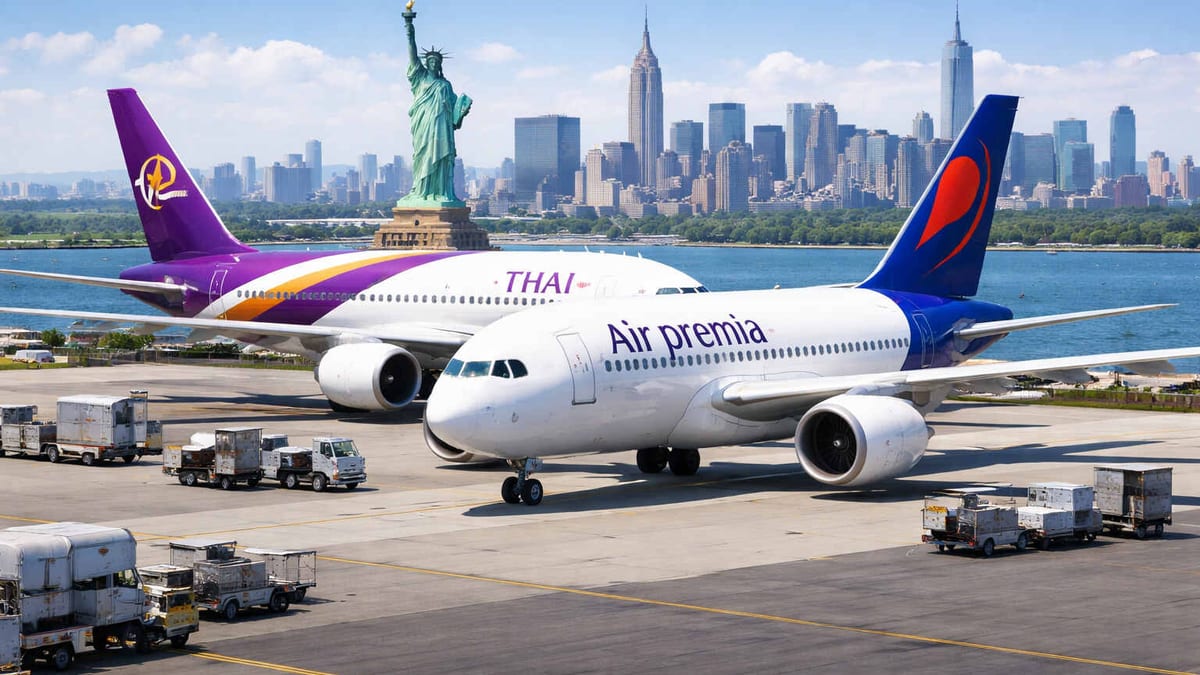
Air Premia’s expanded partnership with Thai Airways, now explicitly incorporating India alongside Japan, Vietnam, Singapore, Indonesia, Malaysia and the United States, is being highlighted as a significant new driver of air connectivity between Southeast Asia and the Americas, according to recent industry coverage.
Get the latest news straight to your inbox!
A Wider Partnership Framing New Asia–Americas Corridors
Recent coverage of the agreement indicates that Air Premia and Thai Airways are positioning their collaboration as a bridge between key cities in Thailand and neighboring markets and Air Premia’s growing long haul network to North America. Reports describe the tie up as a strategic effort to streamline passenger flows between Southeast Asia, India and the United States by combining Thai Airways’ regional strength with Air Premia’s transpacific and transcontinental services.
Information released publicly highlights that the partnership now emphasizes India among a roster of markets that already includes Japan, Vietnam, Singapore, Indonesia, Malaysia and the United States. This framing underlines the scale of the catchment area feeding into joint itineraries, with travelers across Asia gaining additional one stop options to reach American gateways using a mix of Thai Airways-operated regional segments and Air Premia-operated long haul flights.
The arrangement is being presented as a way to unlock seamless journeys rather than isolated point-to-point routes. By coordinating schedules and product offerings, the two carriers aim to reduce total travel times on select routings, expand same-day connections and make it easier for passengers to stitch together complex itineraries that span several countries and continents.
Industry observers note that the move aligns with an ongoing trend in which mid-sized and hybrid airlines seek partnerships to extend their global footprint without waiting for large-scale fleet expansion. The Air Premia–Thai Airways collaboration fits this pattern by using commercial cooperation to create new virtual corridors between Asia and the Americas.
India’s Inclusion Signals a Broader Regional Strategy
The explicit inclusion of India in announcements surrounding the partnership is noteworthy. Publicly available information portrays India not as a marginal add-on but as a key origin and destination market feeding into the broader Southeast Asia and Americas network. Given India’s rapid growth in outbound travel, this emphasis reflects the market’s rising importance for both regional and long haul carriers.
Reports describe how the combined network could funnel Indian travelers through major Southeast Asian hubs into Air Premia’s U.S. routes, while also supporting inbound tourism and business traffic from the Americas into Indian cities. This type of triangulated traffic flow can be especially attractive for passengers seeking flexible schedules, competitive fares and the ability to combine multiple stops on a single ticket.
The move also comes at a time when competition in India’s international market is intensifying. By linking India into a wider regional framework that includes Japan, Vietnam, Singapore, Indonesia and Malaysia, the partnership offers an additional pathway for Indian travelers who may currently route primarily via the Gulf, major East Asian hubs or traditional transatlantic gateways.
For Air Premia and Thai Airways, the strategy expands their addressable market beyond their home bases, enabling them to capture demand from secondary Indian and Southeast Asian cities that may not yet sustain nonstop long haul flights but can be linked via regional feeders and coordinated schedules.
Enhanced Connectivity Across Southeast Asia
Coverage of the agreement underscores that Thailand functions as a central node in the new connectivity map, with Thai Airways’ network reaching into neighboring markets including Vietnam, Singapore, Indonesia and Malaysia. These countries, already significant tourism and business hubs, are being highlighted as key beneficiaries of the strengthened relationship with Air Premia.
By interlacing Thai Airways’ regional strengths with Air Premia’s long haul services, the partnership creates new one-stop options from cities across Southeast Asia to American destinations. This can be particularly valuable for travelers originating in secondary markets that currently rely on multiple stops or fragmented itineraries to reach the United States and other points in the Americas.
Industry analyses often point out that Southeast Asia’s air travel growth is increasingly driven by a mix of leisure, visiting-friends-and-relatives and small-business demand. The flexibility to combine shorter regional sectors with competitively priced long haul flights is likely to appeal to these segments, particularly when baggage handling, minimum connection times and through-check services are aligned between carriers.
The partnership also contributes to competitive dynamics in the region, where airlines based in Singapore, Kuala Lumpur, Jakarta, Ho Chi Minh City and other hubs are expanding their own long haul offerings and codeshare arrangements. By sharpening Thailand’s role as a transit hub, the Air Premia–Thai Airways collaboration adds another option for travelers choosing among several Southeast Asian gateways.
Implications for Travelers Between Asia and the Americas
For passengers traveling between Southeast Asia, India and the Americas, the practical impact of the partnership is increasingly being framed in terms of convenience, choice and potential cost savings. Public reporting suggests that coordinated schedules and reciprocal selling of seats can provide more departure time options, shorter overall connection windows on select routes and simplified ticketing.
Travelers booking itineraries that combine Thai Airways and Air Premia sectors are expected to benefit from streamlined transfers at key hubs, as well as more predictable baggage handling and check in processes compared with assembling separate tickets across unaligned carriers. This can be especially important for long journeys involving multiple segments, where missed connections can carry significant time and financial penalties.
The collaboration also has relevance for premium and value-conscious travelers alike. Hybrid long haul carriers such as Air Premia often promote spacious seating and modern aircraft while maintaining a cost focus, and pairing these long haul products with Thai Airways’ regional network can create attractive propositions for both business and leisure passengers weighing comfort against price.
Travel trade commentary indicates that the enhanced network may also support tour operators and corporate travel planners, who can use the expanded range of routings to design more customized itineraries across Asia and the Americas. This could include multi-city trips that combine, for example, India and Southeast Asia with a U.S. west coast or east coast stay, packaged under a single booking framework.
Positioning in a Competitive Global Aviation Landscape
The Air Premia–Thai Airways initiative arrives amid heightened competition among global airlines to capture long haul demand connecting Asia to North and South America. Major carriers in East Asia, the Gulf, Europe and North America are continually adjusting capacity, partnerships and schedules to secure a share of this traffic, and mid-sized operators are increasingly turning to targeted alliances to remain competitive.
Analysts note that such partnerships allow airlines to extend their virtual networks far beyond their own fleets and slots, often at lower cost and with greater flexibility than launching new standalone routes. For Air Premia, teaming up with Thai Airways amplifies its presence across Southeast Asia and India, while Thai Airways gains added reach into American markets without operating every long haul sector itself.
From a broader industry perspective, the agreement reflects a shift toward more granular, market-specific collaborations that complement traditional global alliances. Rather than relying solely on alliance membership, carriers are layering bespoke partnerships on top, focusing on fast-growing corridors where demand is strong but fragmented among many city pairs.
Observers will be watching how quickly the partnership’s promised benefits translate into concrete schedule options, load factors and customer uptake. As airlines continue to recalibrate networks in response to evolving travel patterns, the Air Premia–Thai Airways collaboration, now prominently featuring India alongside other Asian markets, offers a timely example of how targeted partnerships are reshaping connectivity between Southeast Asia and the Americas.