

More news on this day
South Korean hybrid carrier Air Premia has entered a new partnership with Thai Airways that aims to streamline passenger flows from Thailand, Malaysia, Singapore, Indonesia, Vietnam, and India into key United States gateways, signaling a fresh competitive twist in the transpacific market.
Get the latest news straight to your inbox!
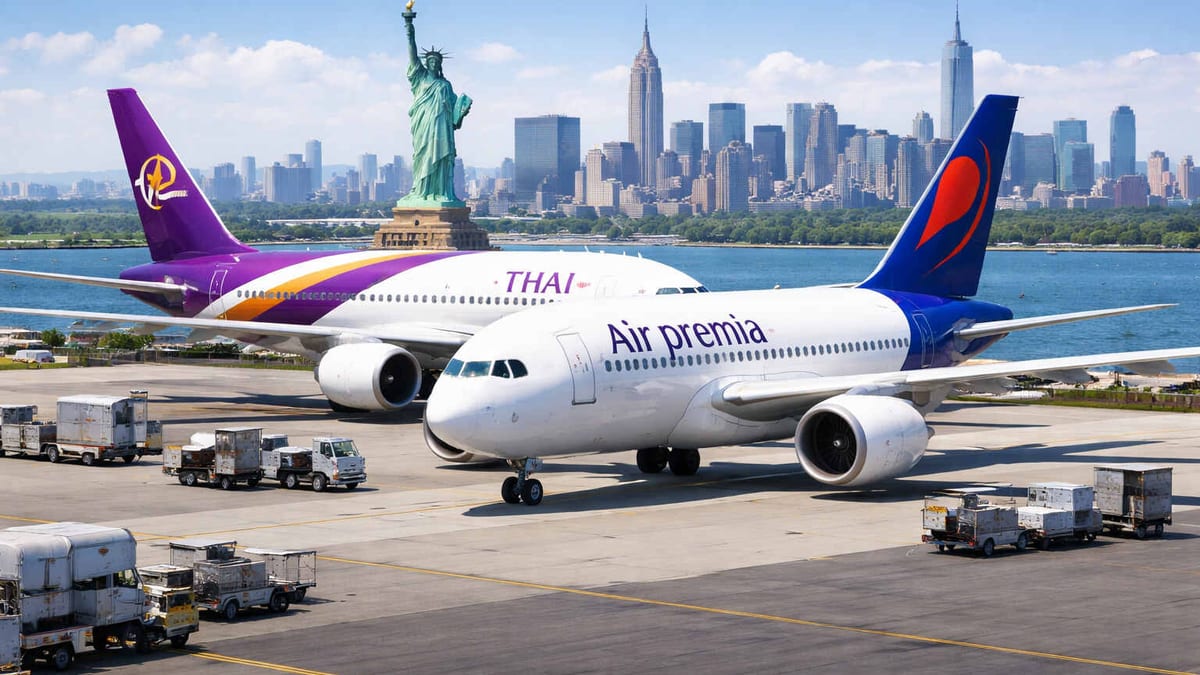
Image by Travel And Tour World
Strategic Tie-Up Centers on Seoul as a Transpacific Gateway
Publicly available information indicates that the agreement positions Air Premia’s growing long haul network and Seoul Incheon hub as the main bridge between South and Southeast Asia and major U.S. cities. While Air Premia already connects Seoul with destinations such as Los Angeles and New York, the partnership with Thai Airways is designed to channel additional regional traffic into those routes through coordinated schedules and streamlined booking.
Reports suggest the carriers intend to build on Thai Airways’ established presence across mainland Southeast Asia and India, while leveraging Air Premia’s widebody capacity on high demand transpacific sectors. The model mirrors a broader industry shift in which mid sized Asian airlines deepen cooperation to compete more effectively against large Gulf and North Asian network carriers.
Analysts note that Seoul Incheon has been steadily consolidating its role as a transfer point for U.S. bound travelers from the Mekong region and the Indian subcontinent. The new tie up is expected to add another layer of connectivity, particularly for secondary cities that lack their own nonstop links to North America.
Enhanced Connectivity From Six Fast-Growing Origin Markets
The partnership focuses on six key origin markets: Thailand, Malaysia, Singapore, Indonesia, Vietnam, and India. These countries have recorded sustained outbound travel growth to the United States in recent years, driven by tourism, business ties, education, and a growing diaspora. Industry data shows that Thailand and Vietnam have both emerged as significant sources of long haul leisure demand, while India remains one of the fastest expanding markets for premium and visiting friends and relatives traffic.
Through Thai Airways’ regional network and partner links, travelers from cities such as Bangkok, Kuala Lumpur, Singapore, Jakarta, Hanoi, Ho Chi Minh City, and multiple Indian metros are expected to gain new one stop options to U.S. gateways via Seoul. Booking on a single itinerary enables through check in of baggage and coordinated protection in case of delays, an important selling point for long haul passengers.
For Thai Airways, which has been reshaping its long haul strategy and relying more heavily on alliances and codeshares for North American access, the cooperation with Air Premia offers a way to expand virtual reach into U.S. cities without immediately deploying its own aircraft. For Air Premia, access to Thai Airways’ regional feed can help smooth seasonality on transpacific routes and raise average load factors.
Competitive Jolt in a Crowded Transpacific Market
The Air Premia Thai Airways link arrives at a time when competition on Asia United States corridors is intensifying. Large incumbents, including U.S. majors and major Northeast Asian carriers, have been rebuilding or expanding their capacity following the pandemic period. At the same time, several Southeast Asian airlines are pursuing partnership led strategies rather than restoring all former nonstop services to North America.
Industry observers point out that the new collaboration adds a fresh challenger in the one stop segment, targeting travelers who prioritize schedule and value over strict loyalty to a single global alliance. Air Premia’s hybrid model, which combines full service amenities with a focus on premium economy and competitively priced long haul fares, may appeal to cost conscious passengers from Southeast Asia and India seeking alternatives to traditional network carriers.
Air service analysts also highlight that the timing aligns with Thailand’s broader efforts to strengthen links with the U.S. market through partnerships following an upgrade of the country’s aviation safety rating. While Thai Airways is not currently operating its own nonstop services to the United States, its strategy of expanding connectivity through partner airlines is viewed as a pragmatic response to fleet constraints and restructuring priorities.
Streamlined Passenger Experience and Network Synergies
According to published coverage of the agreement, travelers will be able to book itineraries that combine Thai Airways operated regional flights with Air Premia’s long haul sectors on a single ticket, allowing baggage to be checked through to final U.S. destinations. This type of arrangement reduces the need for recheck at the transfer point and simplifies disruption handling, as both carriers coordinate rebooking within the same itinerary.
From a network planning perspective, the cooperation enables Thai Airways to optimize schedules into Seoul to meet Air Premia’s bank of U.S. departures, enhancing minimum connection times without requiring extensive additional capacity. Conversely, Air Premia can adjust its transpacific schedules to better align with arrival waves from Bangkok and other Southeast Asian and Indian cities, deepening two way connectivity.
Travel agents and online platforms are expected to highlight the combined offering as a new option for multi city itineraries linking Southeast Asia, India, and the United States. The availability of premium economy and flexible fare products on Air Premia flights may also support corporate travel policies that favor cost efficient, one stop solutions over more expensive nonstop services.
Implications for Travelers Across Southeast Asia and India
For travelers in Thailand, Malaysia, Singapore, Indonesia, Vietnam, and India, the most immediate impact of the Air Premia Thai Airways partnership is likely to be a wider choice of schedules and routings to U.S. cities, alongside potential fare competition. Passengers originating in secondary markets may find it easier to access United States destinations by connecting through Bangkok and Seoul on a harmonized itinerary instead of stitching together separate tickets.
Tourism bodies in the region are expected to watch booking trends closely, as improved air access often correlates with higher visitor numbers in both directions. Easier one stop links can encourage more American visitors to combine multiple countries in a single trip, using regional sectors on Thai Airways and long haul flights on Air Premia to create open jaw or circular itineraries.
On the corporate side, companies with operations spanning South and Southeast Asia and North America may see the partnership as an additional tool to manage travel budgets and route employees efficiently between offices. As both airlines refine their schedules and product offerings in the coming months, observers will be monitoring whether the collaboration spurs further tie ups between mid sized Asian carriers and regional incumbents in the quest to reshape long haul connectivity.