

More news on this day
South Korean hybrid carrier Air Premia is doubling down on its comfort-first strategy, widening seat pitch across its cabins on key South Korea routes and giving every passenger more literal breathing room as competition for long-haul leisure travelers intensifies.
Get the latest news straight to your inbox!
A Hybrid Airline Betting Big on Space
Publicly available information shows that Air Premia has built its business model around a two-cabin layout that prioritizes legroom rather than traditional multi-class segmentation. Instead of operating a separate business class, the carrier focuses on an expansive premium economy section and a roomier-than-average economy cabin marketed as a value alternative on long-haul routes touching South Korea.
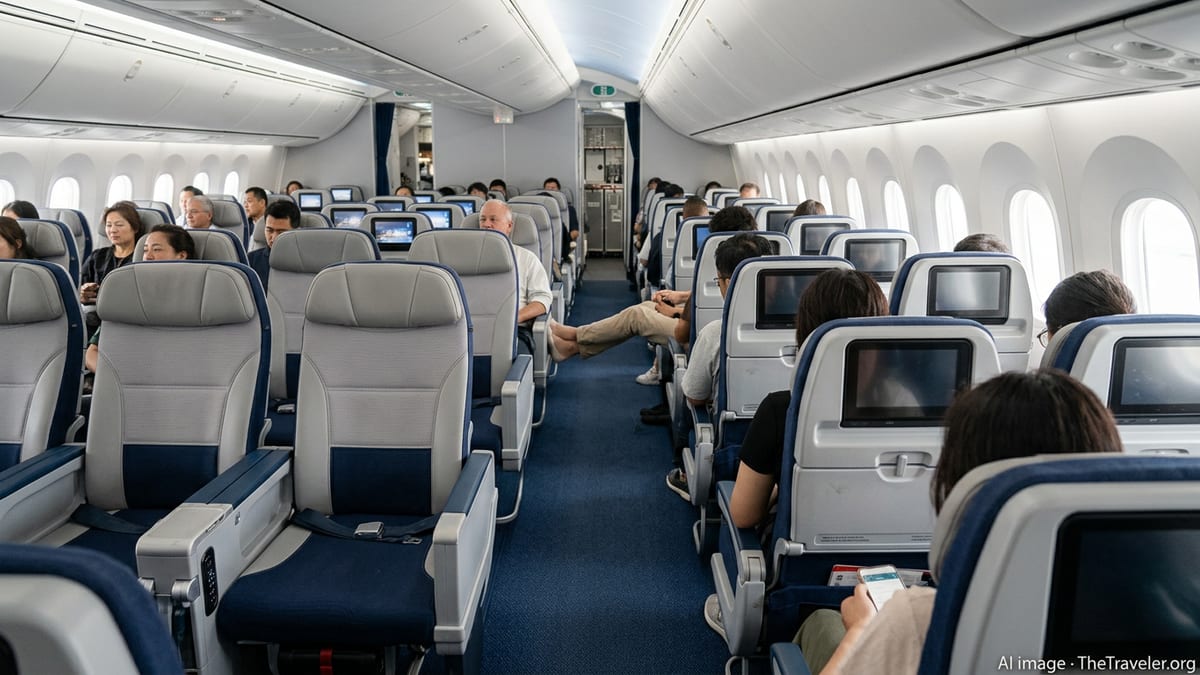
Industry data and fleet filings indicate that Air Premia’s Boeing 787-9 aircraft are configured with a dedicated premium economy product, branded as Premia 42, in a 2-3-2 layout, alongside an economy cabin branded as Economy 35 in a 3-3-3 configuration. The branding reflects seat pitch in inches, signaling a deliberate attempt to make space itself the core selling point on routes linking Seoul with the United States and other long-haul markets.
This emphasis on physical room sets the airline apart in a region where many carriers have densified cabins to manage rising costs and volatile demand. For travelers flying between South Korea and destinations such as Los Angeles, New York and Washington, reports suggest that the additional legroom and wider pitch are becoming central reasons to choose the airline over more established competitors.
The strategy aligns with wider trends in the transpacific market, where premium economy and extra-legroom products have been steadily gaining share as passengers weigh comfort more heavily on 10 to 15 hour sectors. Air Premia is positioning its entire long-haul operation within this comfort-forward band rather than treating extra space as a narrow upsell.
New Configuration, More Room for Every Seat
According to Air Premia’s own cabin descriptions and recent fleet announcements, all passengers on its long-haul South Korea routes now benefit from seat pitches that exceed typical industry baselines in at least one direction. Premia 42 seats are advertised at around 42 inches of pitch, with wider seats and deeper recline, while the Economy 35 section targets a minimum of 33 inches of pitch following a reconfiguration completed in 2024.
In practice, these numbers translate into several additional centimeters of knee and leg space compared with many standard economy cabins on similar Boeing 787 services. Reports from frequent flyer forums and Korean-language business coverage describe the long-haul experience as notably less cramped, with travelers able to stretch their legs more freely on flights approaching 15 hours between Seoul and key North American gateways.
Fleet expansion has reinforced this approach. Recent disclosures on new Boeing 787-9 deliveries show that Air Premia continues to favor configurations with a relatively generous seat count balanced by above-average pitch rather than ultra-dense layouts. The carrier’s latest aircraft, added in late 2024 and early 2025, maintain a clear separation between the premium economy cabin and the main cabin, but both are structured around giving each passenger more usable personal space.
Crucially, the increased pitch in economy is not limited to a handful of exit-row or bulkhead seats. The reconfiguration noted in mid-2024 extended the 33-inch minimum across the cabin, meaning that even travelers on the lowest fares between South Korea and overseas destinations receive more room than is common on many competing long-haul services.
Focus on South Korea–US Links as Competition Heats Up
Air Premia’s move to prioritize space is particularly visible on its growing network connecting Seoul with the United States. Recent route announcements and schedule filings highlight services linking Incheon with Los Angeles, New York and San Francisco, as well as a newly launched route to Washington Dulles that made the carrier one of several South Korean operators competing for transpacific traffic.
Reports in travel industry outlets describe the airline’s 787-9s on these routes as “premium economy heavy,” underlining how much cabin real estate is reserved for the higher-pitch Premia 42 product compared with traditional layouts. At Washington Dulles, for example, recent coverage notes that Air Premia operates a 320-seat 787-9 with 56 premium-class reclining seats in a 2-3-2 configuration and 253 economy seats in 3-3-3, creating a visibly different onboard layout from many legacy competitors.
By effectively making extra space standard across much of the aircraft, Air Premia is attempting to capture a growing segment of leisure and visiting-friends-and-relatives passengers who are price sensitive but unwilling to endure the tightest long-haul configurations. Fares are often described in Korean business media as competitive with or lower than major network airlines, even as the product emphasizes legroom, checked baggage and meals.
The timing is significant. Consolidation among South Korea’s full-service carriers and the steady rollout of premium economy by regional rivals have created a highly contested market. Air Premia is betting that a clear promise of “more space for everyone” on its South Korea routes can stand out amid a wave of new cabin branding and incremental seat upgrades elsewhere.
Passenger Experience and Market Impact
Travel accounts and online reviews suggest that passengers on Air Premia’s South Korea routes notice the difference in space even outside the dedicated premium cabin. Taller travelers in particular point to the ability to stretch legs and shift position without constant contact with the seat in front, a small but meaningful change on overnight transpacific flights.
The broader market impact is beginning to emerge as more carriers in the region refine their own seating strategies. Comparative analyses of airline cabins published in recent months often cite Air Premia as an example of a hybrid model that blends low-cost discipline with a hard product closer to traditional premium economy, especially on flights into and out of South Korea.
Travel analysts note that if Air Premia’s configuration proves financially sustainable, it could pressure other airlines on the same routes to revisit seat density, at least on high-yield or leisure-heavy services. In a marketplace where travelers routinely post seat photos and legroom measurements online, visible differences in space are increasingly difficult for competitors to ignore.
For now, Air Premia’s bold bet on roomier seating across its South Korea network is helping to redefine what passengers can expect from a younger, hybrid airline. As new aircraft join the fleet and additional long-haul routes are added, the question will be whether more breathing space in every cabin can remain the carrier’s calling card while it scales up operations.