

More news on this day
Air Seychelles is set to expand its European footprint with a new twice-weekly service between Mahé and Rome Fiumicino, reinforcing long-haul access to the Indian Ocean archipelago from one of the continent’s most visited capitals.
Get the latest news straight to your inbox!
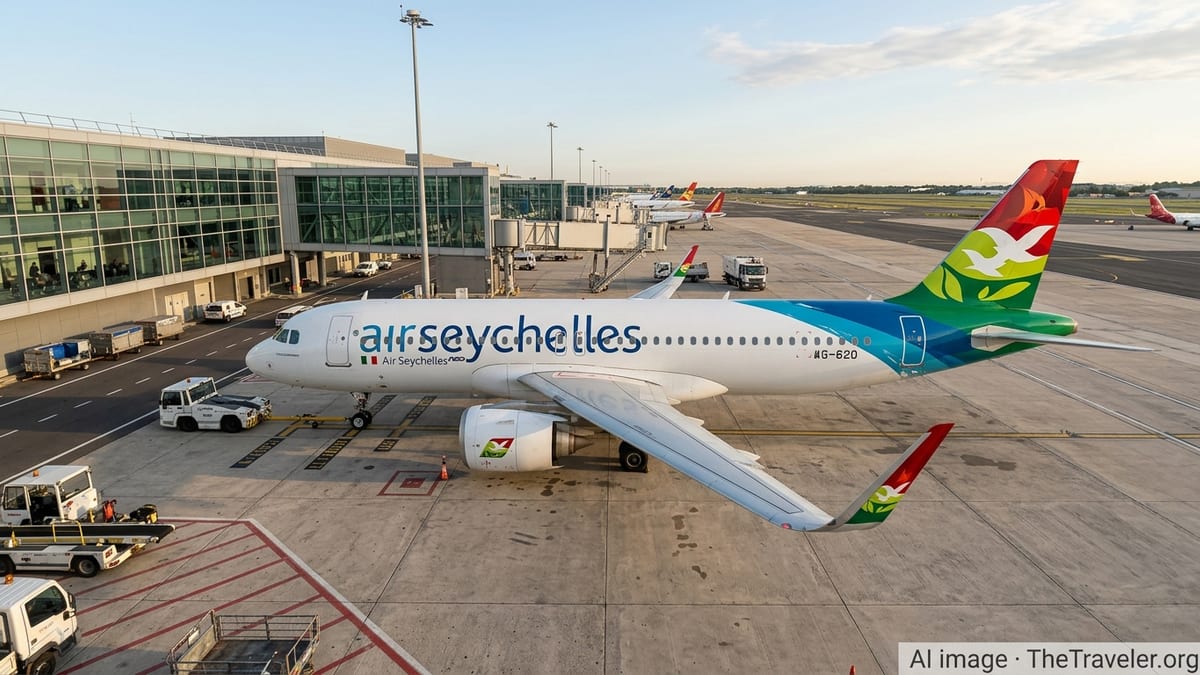
New Nonstop Link Between Mahé and Rome
According to recent aviation route reports and scheduling data, the national carrier of Seychelles is preparing to introduce a nonstop link between Seychelles International Airport on Mahé and Rome’s Leonardo da Vinci–Fiumicino Airport. The service is described as a twice-weekly operation designed to capture both leisure and diaspora traffic between Italy and the Indian Ocean destination.
Publicly available information indicates that the route will be operated with Air Seychelles’ Airbus A320neo fleet, positioning the airline to serve the roughly 6,700 kilometre sector with a narrowbody aircraft configured for medium to long-haul services. Industry commentary notes that the deployment of the fuel-efficient A320neo reflects the carrier’s strategy of operating leaner long-range services on high-demand leisure routes.
The forthcoming Rome connection follows a broader reshaping of Air Seychelles’ network in recent years, in which the airline has focused on high-yield regional and selectively targeted long-haul markets. The new pairing with Rome is viewed within the sector as a logical extension of this strategy, bringing back a direct European city link once served by the carrier in an earlier era of its network development.
Early schedule filings suggest that the flights are expected to operate seasonally in line with peak European travel demand, though the precise start date and season length have not yet been widely detailed in industry databases. Observers note that final timings and frequency may still be refined as the launch window approaches and as the airline monitors booking trends.
Strengthening Seychelles’ Access to the European Market
The Rome service is being interpreted by aviation analysts as part of a wider effort to rebalance Seychelles’ connectivity with Europe. Tourism-focused coverage points out that, while the islands enjoy extensive one-stop access via Gulf and European carriers, nonstop links from the continent remain limited and highly seasonal, constraining growth from key source markets.
Italy has traditionally been one of the important European feeder markets for the Seychelles, alongside France, Germany and the United Kingdom. Travel trade reports highlight that Italian visitors have shown steady interest in Indian Ocean destinations, with Seychelles competing alongside Mauritius, the Maldives and Zanzibar for high-spend holidaymakers seeking beach resorts and island-hopping itineraries.
With Rome Fiumicino serving as Italy’s primary long-haul gateway, the new route is expected to provide a more convenient option for travellers from across the country, many of whom currently reach Seychelles via hub connections in the Middle East or other European cities. Industry observers suggest that a nonstop product from Rome could help reduce total journey times and make the destination more attractive for both short and extended stays.
The move also fits into a broader regional pattern in which Indian Ocean destinations are working to secure or restore direct European services. Recent years have seen other island nations in the area welcoming new or renewed European links, as carriers seek resilient leisure flows that can support year-round or seasonal long-haul operations.
Implications for Tourism and Local Economy
Tourism is a central pillar of Seychelles’ economy, and air connectivity plays a critical role in sustaining visitor arrivals. Travel and hospitality reports consistently emphasize that additional nonstop flights from major source markets can support higher occupancy levels, lengthen average stays and encourage investment in new accommodation and experiences.
The Rome service is expected to appeal to both tour operators and independent travellers. Package holiday providers may gain a new nonstop option to bundle flights and resorts for Italian clientele, while independent travellers are likely to value the simplicity of a direct link that avoids complex multi-stop itineraries. This could support demand across a range of segments, from luxury resorts on Mahé and Praslin to guesthouses and boutique properties on outer islands.
Local businesses involved in excursions, transport and gastronomy may also benefit indirectly from the added capacity and visibility that a Rome route brings. Industry commentary notes that European visitors tend to contribute significantly to on-the-ground spending, from guided nature tours and diving trips to restaurant visits and cultural activities, providing revenue that circulates widely through the local economy.
At the same time, sector analysts caution that route sustainability will depend on maintaining strong load factors throughout the operating season. Airlines serving long-haul leisure markets typically monitor performance closely, adjusting frequencies or schedules where necessary. As such, the long-term impact on tourism will hinge on how effectively Air Seychelles and its partners market the new link in Italy and neighbouring countries.
Competitive Landscape and Network Strategy
In the broader competitive context, the Rome launch is viewed as part of Air Seychelles’ attempt to carve out a distinct niche alongside larger global carriers that already connect Europe and the Seychelles through one-stop itineraries. Foreign airlines, including several based in the Gulf and Europe, offer connecting services between Rome and Mahé via their respective hubs, giving travellers multiple choices on price, schedule and service level.
By introducing a nonstop Rome service, Air Seychelles positions itself as the only airline offering a direct Italy–Seychelles option, differentiating its product on convenience and travel time. Aviation analysts observe that, for leisure travellers in particular, the appeal of avoiding a transfer can be significant, especially for families and honeymooners seeking a seamless start to their holiday.
The use of the A320neo on an extended sector also illustrates the carrier’s ongoing refinement of its fleet strategy. Industry data shows that Air Seychelles has increasingly leaned on narrowbody aircraft to serve longer routes where demand is strong but may not justify widebody capacity. This approach allows more flexible scheduling and can reduce risk when entering or re-entering long-haul markets.
Network planning specialists suggest that, if the Rome route proves successful, it could encourage Air Seychelles to consider additional limited-frequency European points in the future, potentially on a seasonal basis. However, they also note that the airline is likely to move cautiously, prioritising stability and profitability after prior restructurings and adjustments to its long-haul footprint.
What Travellers Can Expect on the New Route
While detailed onboard product announcements specific to the Rome service have not been extensively publicised, Air Seychelles’ existing A320neo operations provide a broad indication of what travellers might experience. Publicly available fleet and cabin information shows a two-class layout with economy and business cabins, reflecting the carrier’s focus on both leisure and premium segments.
Travel reviewers describe the airline’s A320neo interior as featuring modern seating, personal device-based entertainment options on many services, and a cabin environment supported by the aircraft’s quieter engines and improved air filtration systems. On longer sectors, carriers using the A320neo family commonly emphasise enhanced comfort features such as adjustable headrests and USB power points, elements that are expected to be important selling points on the Rome–Mahé route.
From a schedule perspective, the twice-weekly pattern may appeal to travellers planning week-long or longer stays, aligning with typical holiday durations. Industry observers highlight that, for some segments such as honeymoon travel, fixed departure days are less of a barrier than overall journey time and perceived ease of travel, both of which are improved by the availability of nonstop flights.
As booking systems incorporate the new route in the coming months, travellers will be able to compare fares and timings against existing one-stop options through European and Gulf hubs. Travel agents and online platforms are expected to play a key role in surfacing the new service to Italian and wider European audiences who may not yet be aware of the revived direct link between Rome and the Seychelles.