

More news on this day
Air Seychelles is preparing to launch a new nonstop route between Mahé and Rome, a development that strengthens tourism links between the Indian Ocean archipelago and Italy just as widespread airspace disruptions across the Gulf region complicate traditional one-stop connections via Middle Eastern hubs.
Get the latest news straight to your inbox!
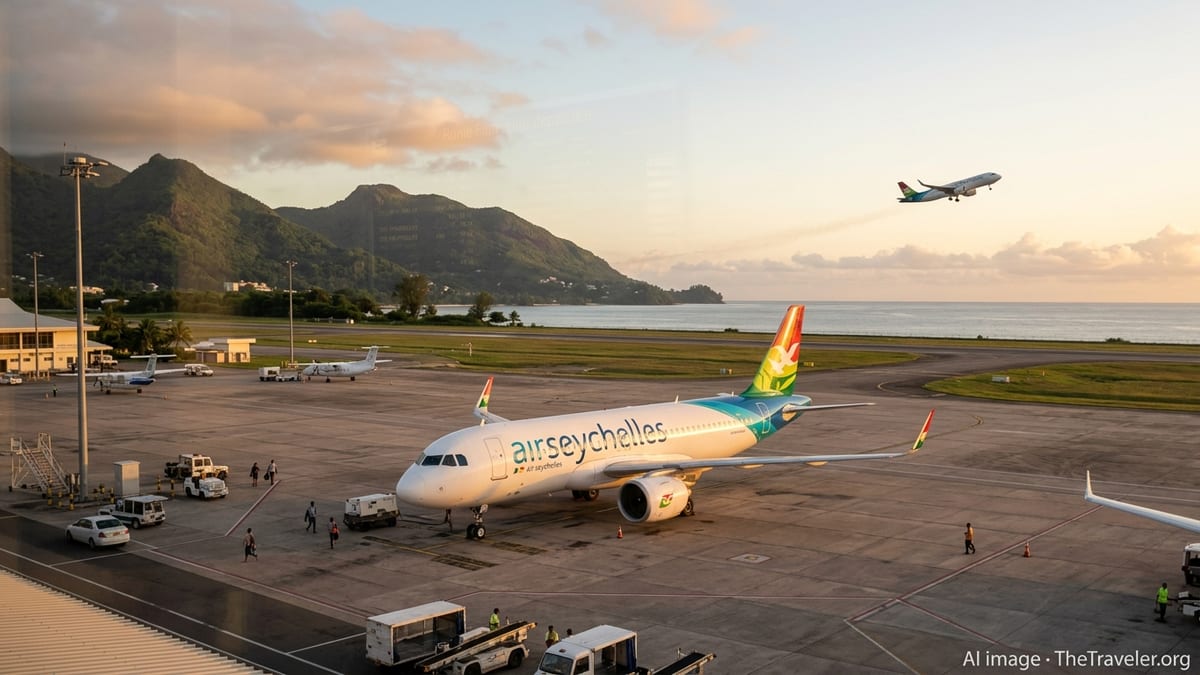
New Rome–Mahé Route Targets Growing Italian Demand
According to recent airline announcements and schedule filings, Air Seychelles plans to introduce a nonstop service linking Rome Fiumicino and Seychelles International Airport on Mahé during the upcoming northern summer season. The route will operate multiple times per week, using the carrier’s widebody aircraft to connect one of Europe’s major leisure gateways directly to the Indian Ocean. Industry data indicates that Italy has been one of Seychelles’ fastest‑growing European source markets, helped by strong tour operator partnerships and sustained demand for long‑haul beach holidays.
Publicly available tourism figures show that Seychelles continues to attract visitors from Europe as it positions itself as a premium, year‑round destination. Italy already ranks among the top European source countries, alongside France, Germany, and the United Kingdom, with travelers typically combining Seychelles with cultural stops in Europe or the Gulf. The new Rome link is expected to capture both point‑to‑point leisure traffic and high‑value package holiday demand arranged through Italian tour operators and travel agencies.
Network planners note that Rome’s position as a major Schengen gateway also broadens the catchment for the new service. Travelers from secondary Italian cities and parts of southern Europe will be able to reach Mahé via a single European connection into Fiumicino instead of relying on longer routings through congested Gulf hubs. This is particularly attractive for families and honeymooners seeking to minimize overnight layovers and reduce total travel time to the islands.
For Seychelles, the route fits a strategy of diversifying away from a heavy reliance on third‑country hubs and reinforcing direct access from key European markets. Aviation analysts suggest that by anchoring more traffic on its own metal, Air Seychelles can capture additional revenue, improve schedule control, and provide more resilient options when external shocks affect partner networks or overflight corridors.
Gulf Airspace Disruptions Reshape Long‑Haul Travel
The launch of a direct Italy–Seychelles link coincides with significant turmoil across Gulf and wider Middle Eastern airspace. Since late February 2026, a series of escalations involving Iran and regional powers has triggered temporary closures or severe restrictions in multiple flight information regions, affecting overflights around Iran, Iraq, Israel, and several Gulf states. Aviation data providers report that thousands of flights have been cancelled or rerouted, with some Gulf hubs suspending regular commercial operations for extended periods.
Travel disruption trackers and airline advisories indicate that major carriers based in Dubai, Doha, Abu Dhabi, and other Gulf cities have faced high cancellation rates and prolonged schedule reductions. Passengers connecting between Europe, Africa, and Asia through these hubs have experienced extended flight times, missed onward connections, and difficulty rebooking during peak travel days. Analysts compare the scale of the current airspace constraints to earlier events such as the closure of Russian airspace in 2022, noting that entire corridors have effectively shifted overnight.
With parts of the Gulf region functioning as a global bridge between Europe and the Indian Ocean, ripple effects have spread far beyond the immediate conflict zone. Long‑haul itineraries that once relied on a single stop in Dubai, Doha, or Abu Dhabi now face diversions that can add several hours to journey times. In some cases, airlines have paused certain routes altogether or temporarily withdrawn capacity, concentrating limited aircraft and crew on a core set of destinations.
In this context, point‑to‑point services that bypass the Gulf altogether have become increasingly valuable. Routes that connect Europe directly to Indian Ocean destinations, East Africa, or southern Africa help insulate travelers from the most acute operational constraints in the Middle East, even as airlines continue to monitor evolving airspace advisories and security assessments.
What the New Route Means for Travelers Between Rome and Seychelles
For leisure travelers planning trips between Italy and Seychelles in the coming months, the forthcoming Rome–Mahé service offers a way to avoid some of the uncertainty surrounding Gulf connections. Nonstop flying eliminates at least one change of aircraft and removes the need to transit hubs that are currently experiencing irregular operations, potential last‑minute cancellations, and longer than usual detours around restricted airspace.
Travel search data and tour operator commentary suggest that demand for Seychelles has remained resilient despite elevated airfares on some long‑haul markets. The new route is likely to appeal strongly to honeymooners, couples, and upscale holidaymakers seeking predictable itineraries and shorter overall journey times. By operating on a scheduled basis rather than as a limited charter, the service can also support dynamic packaging and flexible stays, enabling travelers to combine Seychelles with pre‑ or post‑trip nights in Rome.
At the same time, the new connection may indirectly benefit travelers originating outside Italy. Passengers from other European countries can reach Rome on short‑haul flights operated by a wide range of carriers and then connect to Mahé on a single ticket, potentially reducing exposure to ongoing disruptions in the Gulf. Industry observers note that, in periods of network stress, itineraries that rely on European hubs with multiple alternative carriers often prove more resilient than routings anchored around a single long‑haul operator.
Travelers using the new service will still need to pay close attention to entry requirements and travel advisories for Seychelles and any transit countries used to reach Rome. However, by shifting the critical intercontinental segment to a direct European–Seychelles flight, many will find it easier to adjust plans if conditions in the Middle East change at short notice.
Implications for Seychelles’ Tourism and Airline Strategy
The Rome launch reflects a broader trend in Seychelles’ tourism and aviation planning, as the archipelago seeks to deepen ties with diverse source markets and reduce vulnerability to route disruptions beyond its control. Tourism authorities have spent recent years targeting higher‑spend visitors from Europe, the Middle East, Asia, and Africa, emphasizing sustainability and long‑stay value over pure volume growth. Air connectivity remains central to that effort, given Seychelles’ geography and its reliance on air arrivals.
Publicly accessible industry reports highlight that Seychelles has actively courted new and returning services from European, African, and Asian airlines, including seasonal charter operations and scheduled flights. The development of more direct European links, such as the planned Rome service, complements existing connections to other major gateways and supports hotel investments, cruise calls, and diversified tourism offerings across Mahé, Praslin, and the outer islands.
For Air Seychelles, adding Rome to its network can help balance exposure between regional routes and long‑haul leisure markets. The airline has previously navigated financial challenges and restructuring efforts, and analysts note that carefully chosen, high‑demand seasonal routes can improve aircraft utilization while reinforcing the carrier’s role as a national connector. Success on the Rome route could encourage further experimentation with other European cities where demand for Indian Ocean holidays is strong but currently served only via third‑country hubs.
More broadly, the move underlines how small island carriers are adapting to a more volatile geopolitical environment. As conflicts, airspace closures, and security incidents reshape traditional corridors, airlines with flexible fleets and niche destinations are searching for opportunities to capture displaced demand, restore confidence among travelers, and provide straightforward alternatives to increasingly complex connection patterns via the Gulf.
Practical Tips for Passengers Planning Trips Amid Gulf Disruptions
With conditions in Gulf airspace still fluid, passengers considering travel between Europe and Seychelles in the months ahead may want to compare nonstop and one‑stop options carefully. Routes such as the forthcoming Rome–Mahé service can reduce reliance on corridors subject to sudden operational changes, though fares and availability will vary according to season and demand. Travelers who traditionally route via Middle Eastern hubs may find that point‑to‑point services provide added peace of mind, particularly for special‑occasion trips such as honeymoons.
Industry guidance suggests that travelers should pay close attention to airline schedule updates and advisories, as well as to the fine print on tickets and tour packages. Flexible booking conditions, including the ability to change dates or destinations without heavy penalties, can be especially valuable while airspace restrictions and security assessments remain in flux. Some carriers have introduced more generous rebooking policies on affected routes, but these can change quickly and may differ between fare classes.
Passengers are also encouraged to factor in potential knock‑on effects when planning connections. Even if a specific flight is operating, detours around closed airspace can extend flying times and reduce connection buffers. Building extra time into itineraries, avoiding extremely tight layovers, and choosing through‑tickets with a single airline or alliance can all help minimize the risk of missed onward flights.
Ultimately, the combination of a new direct link between Rome and Mahé and ongoing Gulf disruptions is reshaping how many travelers think about reaching Seychelles. As Air Seychelles moves to deepen its European footprint, the islands are likely to become more accessible to segments of the market that prefer simple, nonstop journeys over complex hub connections at a time of heightened uncertainty in the Middle East.