

More news on this day
Airports around the world are accelerating investment in automated baggage handling and next-generation airport infrastructure, as rising passenger volumes, pressure to cut mishandled bags and an influx of digital tools push the global baggage systems market toward record growth by 2026.
Get the latest news straight to your inbox!
Record Passenger Demand Puts Baggage Systems Under Pressure
After several years of volatile air travel, global passenger numbers have not only recovered but surpassed pre-pandemic levels, putting renewed strain on airport baggage systems. Published industry data indicates that passenger traffic reached around 5.2 billion journeys in 2023, exceeding 2019 figures and intensifying the load on existing conveyor networks, sortation systems and manual baggage halls. At many large hubs, these systems were originally designed for far lower volumes and less complex transfer patterns than they now face.
As airlines add capacity and long-haul connections return, baggage flows have become more challenging to manage, particularly at transfer-heavy hubs in Europe, the Middle East and North America. Earlier disruptions during the rapid recovery highlighted how quickly legacy baggage rooms could become overwhelmed when staffing and equipment were not fully aligned with demand. Those experiences have sharpened the focus on automation and resilience as airports plan their capital spending through 2026.
Recent baggage performance metrics show that while mishandling has improved since the worst of the disruption, the problem remains costly. SITA’s 2024 Baggage IT Insights analysis indicates that mishandled bags fell from 7.6 to 6.9 per 1,000 passengers between 2022 and 2023, even as traffic grew, underscoring how targeted technology investments are starting to pay off. At the same time, industry estimates suggest airlines still face tens of millions of mishandled bags a year, with related costs running to around 5 billion dollars annually, reinforcing the business case for further automation.
For travelers, the renewed attention to baggage reliability is not just about avoiding lost suitcases. Longer queues at check-in, inconsistent self-service options and uneven communication during disruptions have become pain points at many airports. This combination of passenger expectations and operational risk is pushing airport operators and airlines toward comprehensive automation programs that extend from the check-in hall deep into the baggage basement.
Automation and Tracking Drive a New Phase of Investment
Airport infrastructure plans published over the past two years point to a significant wave of spending on baggage systems and automation through the middle of the decade. Market analyses describe multi-billion-dollar programs that include high-speed sorters, cross-belt conveyors, integrated screening, and automated storage and retrieval systems, all supported by sophisticated control software. Many projects are explicitly scheduled to come online or reach peak deployment between 2024 and 2026, aligning with forecasts of strong growth in the baggage handling systems market.
A central theme in this investment cycle is end-to-end baggage tracking. The International Air Transport Association’s baggage strategy emphasizes the use of standardized data exchange and automation to reduce mishandling and fraud. Resolution 753, which requires tracking at key points such as check-in, loading, transfer and arrival, is prompting airlines and airports to upgrade scanners, deploy RFID tags, and ensure their baggage handling equipment can capture and share reliable custody data in real time.
RFID adoption is beginning to move beyond pilot programs. Recent progress reports suggest that around a quarter of surveyed airports now use RFID-based tracking, with significantly higher penetration among mega-hubs. These deployments often coincide with large-scale baggage system replacements, as operators take the opportunity to embed new readers, cameras and sensors directly into conveyors and sorters rather than bolting them on later. Vendors are also promoting computer-vision solutions that can identify and route bags using high-resolution imaging and artificial intelligence, cutting down on no-reads and manual intervention.
The combination of regulatory pressure, operational necessity and improving technology performance is projected to push the baggage handling systems market toward record revenues by 2026. Industry briefings and investor presentations highlight double-digit growth trajectories for providers of sortation hardware, software controls and integrated airport automation, particularly in fast-growing regions in Asia-Pacific and the Middle East where new terminals are being designed around high levels of self-service from the outset.
Self-Service Bag Drop Becomes the New Normal
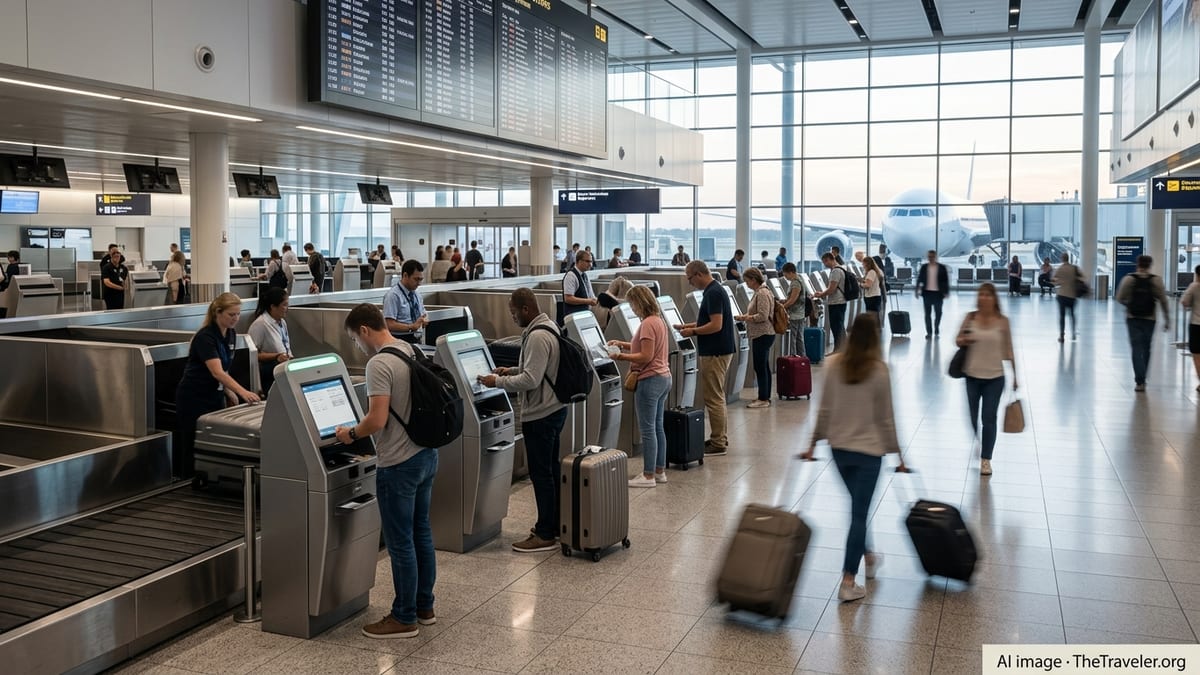
In the public-facing part of the airport, the most visible sign of this shift is the rapid spread of self-service bag drop. Common-use self-service units that allow passengers to tag and dispatch their own luggage, with minimal agent interaction, are now a feature at many large airports in North America, Europe and Asia-Pacific. Industry surveys describe a clear trend toward expanding these units across check-in halls, sometimes replacing traditional staffed counters entirely during off-peak hours.
Manufacturers of bag-drop technology are advertising processing times as low as three seconds per bag, using advanced camera systems, weight sensors and automatic dimensioning to read tags, verify eligibility and route items into the baggage system. Some units are designed to flex between fully self-service and hybrid modes, allowing staff to assist when needed while still relying on the same underlying hardware. The focus is on speed, consistent processing and lower operating costs, especially as labor shortages continue in some ground-handling markets.
Airline and airport IT roadmaps also point to a growing role for biometrics at bag drop. Many new-generation units are described as biometrics-ready, able to integrate with facial recognition platforms so that passengers can check in and drop bags without repeatedly presenting boarding passes or passports. In the United States, for example, several major carriers are rolling out touchless identification at key hubs, linking a traveler’s face to their reservation and baggage record to streamline the journey from curb to gate.
Passenger reaction to self-service remains mixed in some markets, with reports from frequent travelers noting both time savings and frustration when kiosks malfunction or processes are unclear. Nonetheless, industry coverage consistently portrays self-service as a central pillar of airport modernization plans. For travelers planning journeys into 2025 and 2026, it is increasingly realistic to expect that checking a bag will involve interacting with kiosks and automated drops rather than traditional counter agents, particularly at newer terminals.
Behind the Scenes: Smarter Systems in the Baggage Basement
While travelers experience only the first and last steps of the baggage journey, the bulk of current investment is hidden behind walls and beneath the terminal floor. Modern baggage handling systems are evolving into complex, data-rich networks designed to move bags quickly and predictably through a series of security, sortation and loading stages. Control rooms now rely on real-time dashboards that monitor belt speeds, jam points and equipment health across kilometers of conveyors.
According to technical reports and case studies, airports are deploying advanced monitoring platforms that alert technicians within minutes when components malfunction, reducing the risk that a single failure will cascade into widespread delays. Some operators are experimenting with predictive maintenance, using sensor data and machine learning models to identify when motors, rollers or scanners are likely to fail so they can be repaired before causing a disruption. These improvements are particularly critical at transfer-heavy hubs, where a small delay can cause bags to miss tight connections.
Additionally, the integration of baggage systems with airline departure control, airport operations databases and ground-handling tools is becoming more sophisticated. When a flight is delayed, canceled or swapped to a different gate, updated information can automatically ripple through the baggage system, reassigning sortation chutes and reducing the number of bags that must be manually located and re-routed. Some solutions can automatically rebook misrouted bags onto later flights, updating records so that travelers receive more accurate notifications through airline apps.
Security screening is another area of rapid change. As regulators encourage the adoption of more advanced explosives-detection technology, airports are redesigning baggage flows to integrate new scanners and inspection stations without compromising throughput. In some projects, automated storage lanes temporarily hold bags that have passed screening until the right moment for delivery to the aircraft, smoothing peaks and valleys in the loading process. Together, these behind-the-scenes upgrades are central to achieving the market growth and performance gains anticipated by 2026.
What Travelers Should Watch for Before 2026
For travelers, the surge in automation creates both opportunities and adjustments. On the positive side, publicly available information from industry bodies shows a long-term downward trend in baggage mishandling as technology has improved, even as passenger numbers have more than doubled since the mid-2000s. With additional investment flowing into tracking, monitoring and self-service, many airports aim to deliver faster check-in experiences and more reliable reunions between passengers and their bags in the coming years.
At the same time, the transition period can be uneven. Travelers may encounter a mix of old and new processes within the same airport, with some airlines using biometric bag drop and app-based baggage updates while others rely on traditional counters and paper claim tags. Differences between terminals and routes mean that experiences can vary widely, particularly on complex itineraries that involve smaller regional airports or interline connections where systems are less integrated.
Experts and consumer advocates often recommend that passengers familiarize themselves with their airline’s digital tools, including mobile apps that provide baggage status updates where available. As more airports implement real-time tracking tied to standardized tags, these channels are expected to become more informative, offering reassurance during tight connections or irregular operations. Simple traveler habits, such as labeling bags clearly and allowing extra time at unfamiliar hubs, remain useful complements to the high-tech systems now coming online.
With market forecasts pointing to record levels of spending on baggage handling systems and airport automation through 2026, the checked-bag experience is on the verge of significant change. For frequent travelers, the next two to three years are likely to bring more touchscreens, more sensors and more data behind the scenes, all aimed at ensuring that luggage moves as efficiently as the passengers who own it.