

More news on this day
Thousands of travelers across the United States and overseas were stranded on Monday as American Airlines canceled 613 flights and delayed 236 more, with operations severely disrupted at New York, Newark, Boston, Philadelphia, Chicago and a string of international hubs including London, Amsterdam and Tokyo amid a powerful blizzard sweeping the U.S. Northeast.
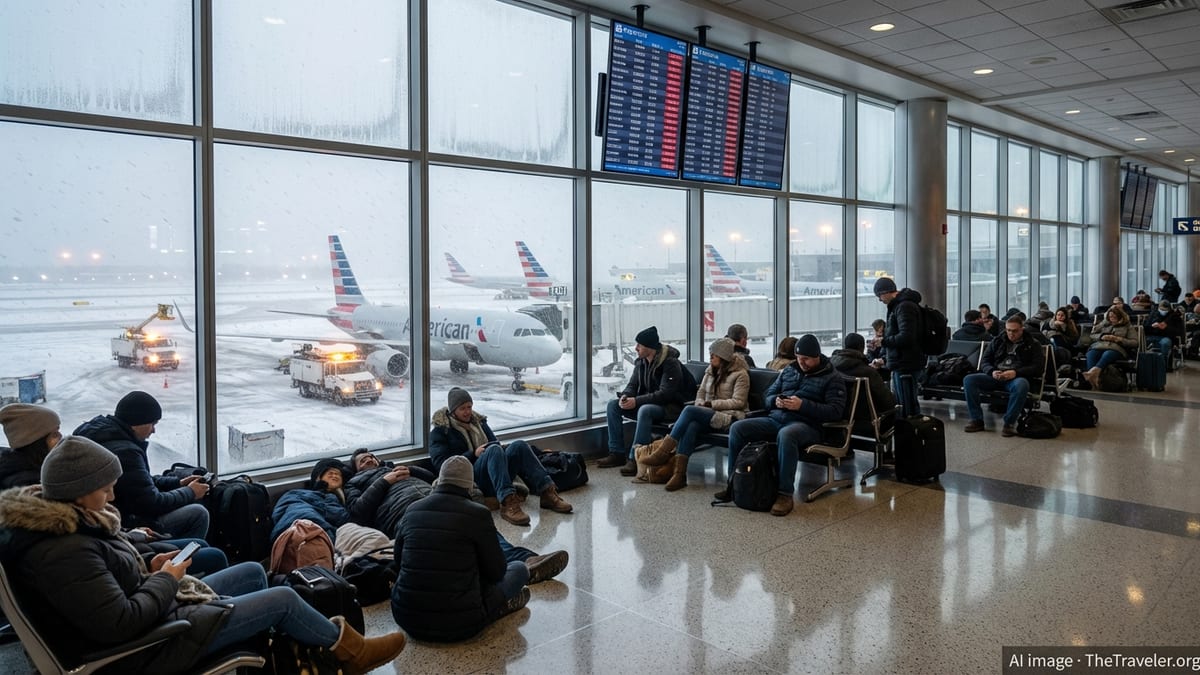
Blizzard-Battered Northeast Brings American’s Operation to a Crawl
American Airlines’ network came under intense strain as a late February nor’easter and blizzard warnings from Maryland to Massachusetts crippled air travel, forcing the carrier to slash nearly one in five of its scheduled flights for the day. Data from flight-tracking services showed American’s cancellations concentrated heavily along the Northeast corridor, where near whiteout conditions, high winds and fast-accumulating snow prompted states of emergency and road travel restrictions in several states.
At the system level, the airline’s 613 cancellations represented about 18 percent of its planned departures, while another 236 flights, or roughly 6 percent, were delayed as crews, aircraft and ground staff struggled to operate safely. The disruption at American unfolded against a wider backdrop of more than 5,000 U.S. flight cancellations across all airlines, making Monday one of the most severe winter-weather travel days since the pandemic era.
Officials and meteorologists warned that the storm’s effects would be felt beyond the day’s schedule, as aircraft and crews remained out of position and fresh rounds of snow and wind complicated recovery efforts. For American and its passengers, that meant even flights still listed as operating were subject to last-minute changes, rolling delays and diversions as the day progressed.
Major Northeast Hubs Hit With Near-Total Ground Stops
Nowhere was the impact more visible than at American’s key Northeast gateways, where operations were pared back to a bare minimum or halted entirely. In New York, John F. Kennedy International Airport operated at a fraction of its normal American schedule, with the carrier scrubbing the overwhelming majority of its departures as runway visibility deteriorated and strong crosswinds pushed conditions beyond safe operating limits.
Across the Hudson River at Newark Liberty International Airport, American’s schedule was essentially wiped out, with data indicating a cancellation rate approaching 100 percent for the day’s departures and only a token number of flights even attempting to operate. Similar scenes played out at Boston Logan International Airport, where an intense burst of snowfall, coastal winds and limited runway capacity combined to force near-total cancellations of American services.
Philadelphia International Airport, another key hub for American along the Northeast corridor, recorded the highest raw number of cancellations among the airline’s listed stations. With more than 200 American flights cut there alone, the carrier’s transcontinental, Midwest and Southern U.S. connections through Philadelphia were all severely affected, rippling delays and cancellations deep into the airline’s domestic network.
Chicago and Other U.S. Gateways See Knock-On Disruptions
While blizzard warnings were concentrated along the Mid-Atlantic and New England, American’s operations in the Midwest and other regions were far from immune. At Chicago O’Hare International Airport, one of the airline’s busiest hubs, flight schedules showed a growing number of cancellations and delays linked not to local weather, but to aircraft and crews stranded in the Northeast or repositioned for storm recovery.
Even where weather remained flyable, American’s ability to maintain normal service was constrained by the complex choreography of aircraft rotations and staffing. Flights that would ordinarily originate in Boston, New York or Philadelphia and continue on to secondary markets were canceled outright, prompting American to consolidate remaining demand onto fewer departures or reroute passengers through alternative hubs such as Dallas-Fort Worth, Charlotte or Miami.
Secondary and regional airports from Virginia through New York state reported cancellations of American flights arriving from or departing to the most heavily affected Northeast cities. In some cases, local operations remained technically possible, but the airline chose to preemptively trim schedules to provide a buffer for recovery and reduce the risk of passengers becoming stranded at smaller stations with fewer accommodation or rebooking options.
International Links to Europe and Asia Severely Curtailed
The storm’s impact extended well beyond U.S. borders, as American’s long-haul network absorbed the shock of East Coast hub closures and curtailed schedules. At London Heathrow, one of American’s primary European gateways, several transatlantic flights tied to New York, Philadelphia and Boston were canceled, reflecting the chain reaction of grounded aircraft and frozen departure banks in the United States.
Amsterdam Schiphol experienced a similar pattern on a smaller scale, with American canceling its limited services as upstream aircraft failed to depart from the storm-struck Northeast. Although local weather in London and Amsterdam remained generally within operational limits, the absence of inbound aircraft and logistical constraints in the U.S. forced American to suspend or combine flights, leaving travelers across Europe scrambling for alternatives.
In Asia, American’s flights linking Tokyo to its U.S. East Coast gateways were among those affected. Several departures were either canceled outright or rerouted through less affected hubs, as the airline worked to maintain at least some connectivity between Japan and the United States while grappling with limited aircraft availability and tight crew duty time restrictions.
Transatlantic and transpacific passengers bore the brunt of the resulting uncertainty, with many facing extended layovers, last-minute hotel stays and rebookings that pushed their arrival times back by a day or more. Airlines across the Atlantic and Pacific alliances reported elevated call volumes and crowded service desks as stranded customers sought new routings.
Passengers Stranded, Rebooking Systems Struggle Under Pressure
For American’s customers, the numbers translated into hours of uncertainty inside terminal buildings, on hold with call centers and refreshing airline apps for updates that often changed by the minute. At New York, Boston and Philadelphia, concourses filled with travelers camped on the floor beside power outlets, balancing work laptops on carry-ons as they waited for word on whether they would travel at all.
Many passengers awoke to find their flights proactively canceled overnight, with rebooking options already limited by the scale of the disruption. Those traveling for business or time-sensitive events were frequently forced to abandon their trips, while leisure travelers tried to salvage vacations by accepting connections through distant hubs or departing several days later than planned.
American, like other major carriers, activated its severe-weather protocols, allowing affected customers to change travel dates or reroute without additional change fees within certain fare and date parameters. Even so, with seats scarce on remaining flights and the storm’s timing coinciding with a busy late-winter travel period, many passengers reported difficulty finding alternatives that fit their plans.
At customer service counters, airline staff juggled rebookings, meal vouchers and hotel arrangements for those stranded overnight. Some travelers opted to abandon air travel altogether, switching to trains or rental cars where routes were still passable, though state-level travel bans and hazardous road conditions limited those options across wide portions of the Northeast.
Operational Challenges: Aircraft, Crews and Safety Protocols
Behind the scenes, American’s operations teams faced a familiar but formidable winter-weather challenge: how to balance safety-first decision making with the need to keep at least part of the schedule moving. Prolonged heavy snowfall, gusty winds and poor visibility triggered runway closures and deicing backlogs at key airports, sharply reducing the number of flights that could safely depart or arrive each hour.
As cancellations mounted, aircraft and crew misalignment became a central concern. Pilots and flight attendants timed out under federal duty regulations as they waited on the ground, while jets that would typically cycle through multiple East Coast cities in a day remained parked at gates or remote stands. The resulting “logistical knot” meant that even when weather briefly improved, American could only restart operations gradually.
Airport teams also had to contend with ground hazards, from icy ramps and taxiways to reduced staffing levels as some employees were unable to reach work. American and airport authorities prioritized clearing priority runways and maintaining safe access to gates and deicing pads, but the sheer volume of snow and the persistence of high winds meant that conditions could deteriorate again within minutes of a plow pass.
Industry analysts noted that the storm’s intensity and geographic spread placed it among the most disruptive winter events since the pandemic, exposing the vulnerability of hub-and-spoke networks when multiple key hubs are simultaneously affected. For American, whose East Coast gateways are linchpins of its domestic and international schedules, the storm’s timing left little room for workaround routings.
Airline, Airport and Government Responses
American Airlines issued public statements emphasizing safety as its guiding priority, urging customers to check their flight status before heading to the airport and to make use of the carrier’s mobile app and website for real-time updates and self-service rebooking where possible. The airline highlighted its weather waiver policies and said teams were working around the clock to restore operations as conditions allowed.
Local and state authorities across the Northeast supported the partial shutdown of air travel, aligning it with road travel advisories and emergency declarations meant to keep residents off the streets during the worst of the blizzard. Some governors and mayors held briefings noting that grounding flights not only protected passengers and crews but also freed up airport resources to support deicing, snow removal and emergency operations.
At the federal level, aviation officials monitored the situation as the storm passed over major population centers and critical infrastructure. Air traffic control centers implemented flow restrictions and rerouting measures to minimize airspace congestion around affected airports and ensure that flights still operating could be handled safely.
Consumer advocates, meanwhile, reminded passengers of their rights under existing U.S. regulations, noting that while airlines are not obligated to compensate customers for weather-related disruptions, travelers are entitled to refunds when flights are canceled and they choose not to travel. They advised passengers to retain documentation of expenses incurred during extended delays, in case airlines offered goodwill gestures or reimbursements.
What Travelers Can Expect in the Coming Days
With the storm expected to gradually move offshore and winds to ease into Tuesday, American Airlines is preparing for a slow and uneven restart of its Northeast operations. Even as runways reopen and visibility improves, the backlog of displaced passengers, out-of-position aircraft and crew scheduling challenges will likely keep cancellations and delays elevated for at least another day.
Travel experts say passengers with flexible plans should consider pushing their trips to later in the week, when schedules stand a better chance of normalizing. Those who must travel sooner are advised to build in significant time buffers, travel with carry-on luggage when possible to simplify rebooking, and remain vigilant for notifications about gate changes, delay extensions or rolling cancellations.
For many, the disruptions underscore how quickly a single powerful storm can unravel carefully planned itineraries across continents. As American and its peers work to rebuild schedules from a day of mass cancellations, the images of grounded jets at New York, Newark, Boston, Philadelphia and beyond have once again highlighted the fragility of global air travel in the face of extreme weather.
In the meantime, thousands of passengers from the Northeast to Europe and Asia are settling in for an unexpected pause in their journeys, watching departure boards and weather maps with equal intensity as they wait for the blizzard’s grip on the aviation system to loosen.